How the Portland Fire Made Me a Sports Fan

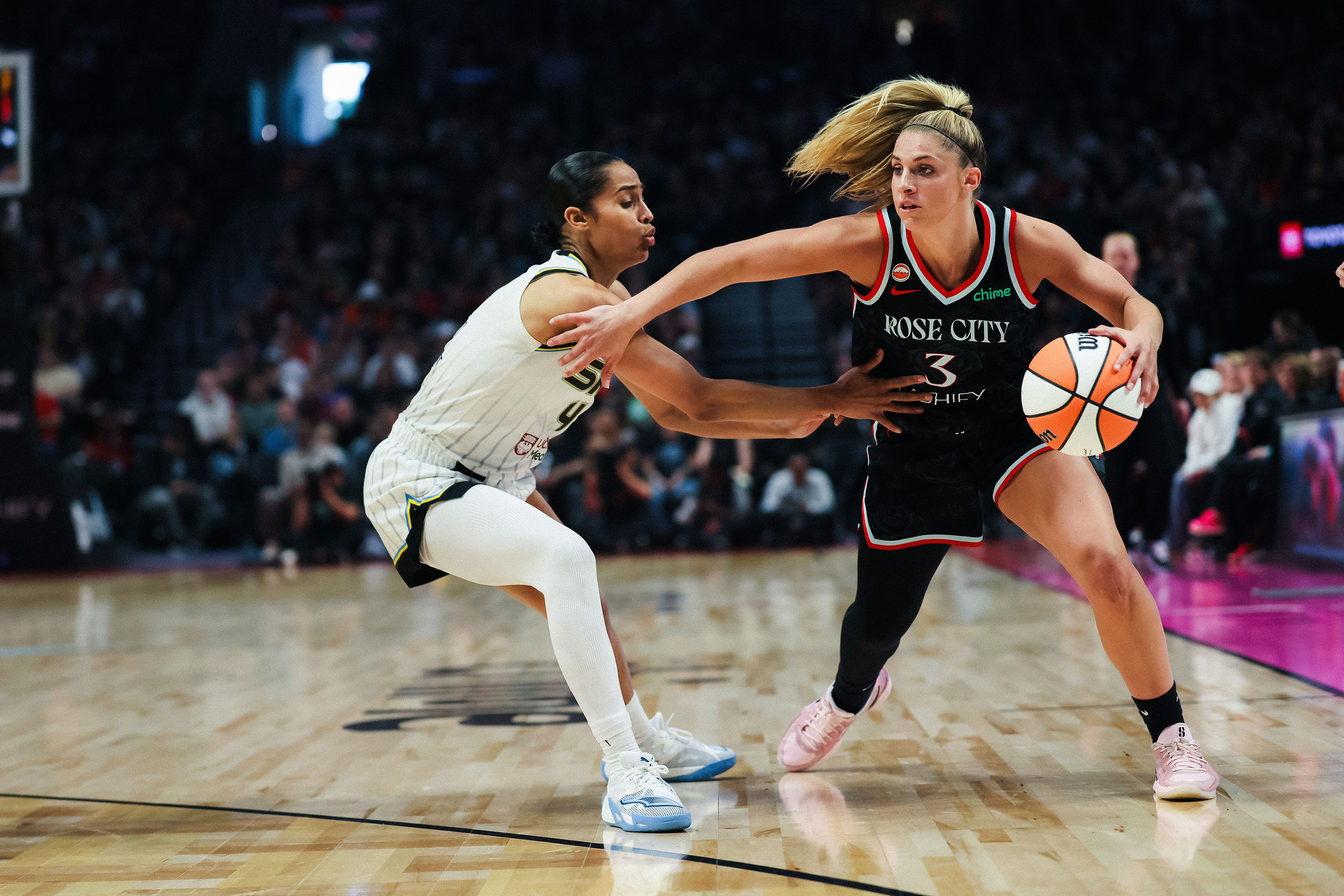
Image: Soobum Im/Getty Images
I never set out to spend an afternoon looking at season tickets for the Portland Fire, zooming in and out of views of seats in the Moda Center. But that’s what happened on a recent Tuesday, as I found myself comparing options, swiveling angles, eyeing the cost. The cost! I wanted to spend how much on what now?
Prior to this spring, I had little discernible relationship with professional basketball. As a child in Seattle, I’d been to a Sonics game, and my dad tells me it was a thriller, with Sam Perkins scoring at the buzzer to nab a one-point win over the Utah Jazz. I can only pretend to remember. I somewhat recall tubing at Snoqualmie Pass one winter and the hill being abuzz because Gary Payton and Detlef Schrempf were there, too. After my family moved to Portland, when the Moda Center was young and known as the Rose Garden, my high school dance team performed before a Trail Blazers game, getting our turns caught on the grippy court as fans found their seats. I didn’t stay for the game; I wouldn’t see the Blazers play until spring 2022, when Damian Lillard was injured, the team was wrapping up a dismal season, and 100-level tickets could be had for relative pennies. Portland lost. The arena was half-empty. The vibes, needless to say, underwhelmed.
I paid even less attention to women’s basketball. When the WNBA, which launched in 1997, arrived in Portland in 2000, I was in middle school and barely clocked the Fire’s debut. While those early games pulled a respectable crowd—typically more than 8,000 fans, just under the league average at the time—curtains would still be dropped over the Rose Garden’s 300 level, with blow-up balls placed in empty seats to create the illusion of fullness. In a roundtable conversation earlier this year, former Fire center Sylvia Crawley recounted how the players’ per diem was so meager that the only place they could afford to eat was the food court at the Lloyd Center. Before televised games, then–head coach Linda Hargrove would give players stacks of tickets to give away at the mall. “People were acting like I was handing out perfume samples,” Crawley said. “They were like, ‘No thanks, no thanks.’” The Fire folded after three seasons.
Things look very different in 2026. The WNBA commands more attention than ever, and in early May the rekindled Fire played their season-opening game to 19,335 fans at the Moda Center. I joined my friend Megan, a season ticket-holder, at the following matchup, and my first Fire game became the team’s first victory, won in spectacular fashion with a buzzer-beating putback layup by Sarah Ashlee Barker that had her falling onto her back and me hugging the stranger next to me. Had there been hugs at that Sonics buzzer-beater in the ’90s? Here, confetti fell from the rafters and players handed out roses to jubilant fans. The celebration spilled into the soft spring night. “Let’s go, Fire!” I heard in the distance as I pedaled away from the arena.
It was a storybook start to the season. Ten games in, the Fire had notched six wins, an impressive record for an expansion team that most observers had expected little from. In press conferences, players spoke about the collective determination and growing trust they felt with teammates and throughout the organization, and about the enormous support they felt from fans. After a decisive (and nationally televised) win over the Indiana Fever on a Sunday afternoon at the end of May, Emily Engstler, a forward in her fifth year in the league who quickly established herself as the starting lineup’s Swiss Army knife, said she felt a sense of intensity and grit on this new team. “I feel like I’m at the park, but like a lot more—” she paused, searching. Her right hand, etched with tattoos, hovered over the table like a ready spider. She turned to her teammates, Carla Leite, a 22-year-old firecracker guard from France with a big curly ponytail, and Megan DiLeo, a veteran post player with a long black ponytail who was then still known as Megan Gustafson (she got married in July). Engstler snapped her fingers, crisply, several times. “What’s that word?” she asked. Leite and DiLeo looked on, entertained but helpless. Engstler sighed, then bolted upright. Her double French braids stayed taut. “Disciplined!” she said. Leite giggled; DiLeo shrugged delightedly.
“Like, you know, a gritty ballpark group of girls but with a lot more discipline,” continued Engstler, who has a raspy voice. She recounted a moment in the game, when, as she was guarding Fever player Aaliyah Boston coming up the court, she felt a gust of wind from behind—it was Leite, with the steal. “I think that’s something you can’t teach,” she said. Later in the press conference, DiLeo, who was fresh off her first start of the season and had just scored 22 points, with a perfect 8 for 8 from the field, described the team as “a bunch of overlooked players.” Left unprotected by their former teams, they’d been picked up in the expansion draft and had arrived in Portland with chips on their shoulders—and then found themselves given respect. As she spoke, DiLeo began to cry. Engstler gently urged her on. As I sat in the press room, tears sprang to my eyes, too.
As players marveled at their experiences, I felt a measure of disbelief sitting in the stands. I needed earplugs at each game. Was I really in an arena filled with people, of all ages and genders, cheering for women? At first, I startled to see men in jerseys bearing women’s names. Early in the season, I rode past sports bar Jackie’s and saw a burly, bearded, tatted-up guy in a Luisa Geiselsöder jersey and gasped. At that win over the Fever, I watched a barrel-chested man in a Leite jersey twirl a towel over his head and holler in excitement, beer sloshing in his cup. Alongside them were every flavor of Portland adult, plus teenagers and kids and toddlers and, gosh darn it, adorable babies in noise-canceling earmuffs. I knew that women’s professional sports had been drawing big crowds for years—the Thorns, for instance, for 14 seasons and counting. But now I was witnessing it night after night, and I underestimated how moved I would be.

Image: Ali Gradischer/Getty Images
Soon, I was following the WNBA like it was my job. I’d already spent the leadup to the season following contract negotiations between the players’ union and the league for a story I was editing, an essay by Lola Milholland about Portland’s thriving recreational basketball scene for women, trans, and nonbinary players. The negotiations, protracted and contentious, resulted in massive gains for the athletes. Under the new collective bargaining agreement, average salaries have shot from $100,000 to $600,000, changing the financial calculus for players accustomed to competing in overseas leagues in the offseason to supplement their WNBA paychecks. Players also negotiated for comprehensive revenue sharing, a norm in professional men’s sports but still a novelty in women’s leagues, giving them a cut of the money brought in from media deals, ticket and merch sales, and so on—an important move as the WNBA booms in popularity. The CBA also included lump-sum payments to nearly 300 retired players (maybe even some who’d cashed their per diem at the Lloyd Center).
Sports are filled with stories, and this season—even as chaos actors and trolls tried to hijack the league for their own culture-war purposes—has overflowed with good ones. There’s Olivia Miles, the Afro-sporting rookie point guard for the Minnesota Lynx, nicknamed the Spectacle for her outrageous combination of talent, flair, and sports goggles. Her scoring is efficient, her savvy footwork and shrewd pacing can make her look like a dancer, and her ridiculous passes—no-look, behind-the-back, through-the-legs—have made everyone on her team better. Fans show up in wigs and costume glasses. At the Minnesota State Fair, there was an entire wall of crop art dedicated to Miles, admiring portraits built from lentils and beans.
Or another rookie, Sydney Taylor, an undrafted guard who was playing in Poland until being scooped up by the Chicago Sky. In August, she made two game-winning three-pointers in the span of three weeks, securing victories for her team over the Las Vegas Aces and the Golden State Valkyries, two of the best teams in the league. For a stretch, I couldn’t stop watching replays of the shot at the Valkyries game, as much for Taylor’s easeful athleticism as for the response of veteran teammate Natasha Cloud, who ran over to Taylor and scooped her into the air, gazing up in awe and celebration. The support! Tears sprang to my eyes, again.
At Fire games, I looked for these moments. I watched players leap for joy after landing tough shots. I watched them tug each other up off the ground. Engstler and fellow forward Frieda Bühner, a fair-haired 22-year-old rookie from Germany who loves science fiction and has proven a threat off the bench, began giving each other quick hugs during substitutions. When asked about it, Engstler said it was her idea. “I kind of have a lot of emotion, a lot of passion,” she said, “and I asked her if we could hug when we step each other out because it kind of grounds me back in.” On social media, I watched Fire players, who all lived in the same building this season, make brunch together, learn TikTok dances, and cuddle with Engstler’s kitten, Enzo. DiLeo’s corgi, Pancake, became a local celebrity in her own right. Karlie Samuelson documented her search for the Wildwood crows. Engstler got tattoos from local artists. It seemed like all of them, at some point, shared photos of roses.

Image: Courtesy Portland Fire
In time, losses accumulated for the Fire, as observers had expected they would. I began to understand what I’d heard about sports being a microcosm for life. After a win, I buzzed. Sloppiness—and turnovers have been a challenge for the Fire—left me peeved. In late July, injury struck: Barker, who’d made that buzzer-beating shot to secure the Fire’s first victory (and who is, like DiLeo and Engstler, a player who’s gone from the bench to the starting lineup), suffered a season-ending ACL tear. Though the team struggled without her, they didn’t give up. Late-game comebacks remained a penchant—in mid-August, the Fire nearly fought back from a 29-point deficit against the league-leading Minnesota Lynx—and play became better-paced and more fluid. As the regular season comes to a close, the Fire sit in ninth place, one spot shy of a playoff seed, with 16 wins and 27 losses: a respectable record, especially for a first-year expansion team.
The fan experience, meanwhile, has remained a blast. The Fire have drawn the fourth-biggest crowds in the WNBA this season, with more than 14,000 people on average pouring into the Moda Center for each home game. I’ve been at nearly all of them. In late August, a mascot arrived, a sparkly pink dragon named Rose. The team had been teasing the reveal all week, planting scorch marks and glitter at spots across town. I arrived well before tipoff and told a security guard I was looking for the—I wasn’t sure what to call it. “Smoldering glitter pit?” he offered. Inside the arena, it was a sea of spangles and sequins and tinsel wigs. “This feels like a Beyoncé concert,” I heard a fan say behind me as I roamed the concourse.
Several weeks later, I drove to Hillsboro, where the Fire players were in their first week at a brand-new training facility, a 100,000-square-foot complex they share with the Portland Thorns (both teams are owned by investment firm Raj Sports). All season long, the Fire had bounced from the event-packed Moda Center to Portland State University to the Nike campus, practicing wherever they could. Now they had landed—with only four more games to play. But the mood in the gym was hopeful and light. The WNBA had just resumed after a two-week pause for the FIBA Women’s Basketball World Cup in Berlin, and everyone—team members, coaches, practice players, staff—seemed glad to be reunited. At the end of practice, Bühner, who’d competed for Germany at the World Cup, was asked how it felt to return to Portland. “I was so excited to come back, honestly,” she said. “I was like, ‘Oh my god, I’m gonna see everyone again.’ I’m really happy here. I feel really comfortable here.”
DiLeo, who played in the World Cup for third-place Spain (she was granted citizenship in 2023), said the new facility felt like “a breath of fresh air.” Players now had their own lockers, their own spaces. “I feel more at peace than I have this entire season,” she said. She was looking forward to getting to know Thorns players, too—both teams had been in the cafeteria that morning. Jordan Harrison, an undersize rookie guard who went unselected in the 2026 draft and worked her way this season from a developmental to a standard contract with the Fire, was especially stoked on the cold tub. “My knees need all the cold,” she said.
Another cause for excitement: One of the standout players at the World Cup, a Spanish 20-year-old named Iyana Martín, is coming to Portland next year. When the little-known point guard was drafted in the spring, fans scratched their heads, especially when it was announced that Martín wouldn’t suit up till next season. Fire general manager Vanja Černivec urged patience. Based on Martín’s performance in Berlin—fearlessly cutting her way to the basket, patiently setting up her teammates to score, and sinking off-balance three-pointers—the wait seems likely to have been worth it. She won the tournament’s Rising Star award and was named to the All-Star Five. “The Portland Fire front office has to be ecstatic about Martín,” said commentator Brendan Glasheen during Spain’s bronze-medal-game win over Germany.
For most games this season, I had media credentials, which meant gaping at passing players in the unglamorous bowels of the Moda Center, sitting courtside as they warmed up, and being spoiled by midcourt views from the press box. I stayed for postgame press conferences, one of which was also joined by Pancake the corgi. It was very cool. And yet—in the press box, decorum reigns. There’s no cheering, no groaning, no twirling a towel over your head. It’s a strangely sedate pocket of the arena, and as the season went on, I grew a little tired of muffling my reactions. Games are filled with drama, and I wanted to eat popcorn and gab with seatmates.
As I looked at season tickets on that recent Tuesday afternoon, I texted Megan, the friend who’d brought me to my first Fire game. I was feeling iffy, hesitant. She offered to split a seat with me, and I leapt—while the views in 212 might not be what they are in the press box, the vibes rock. We’ll each get tickets to half the games, and we’ll pick out a few to attend together. I can't wait to hug some more strangers.