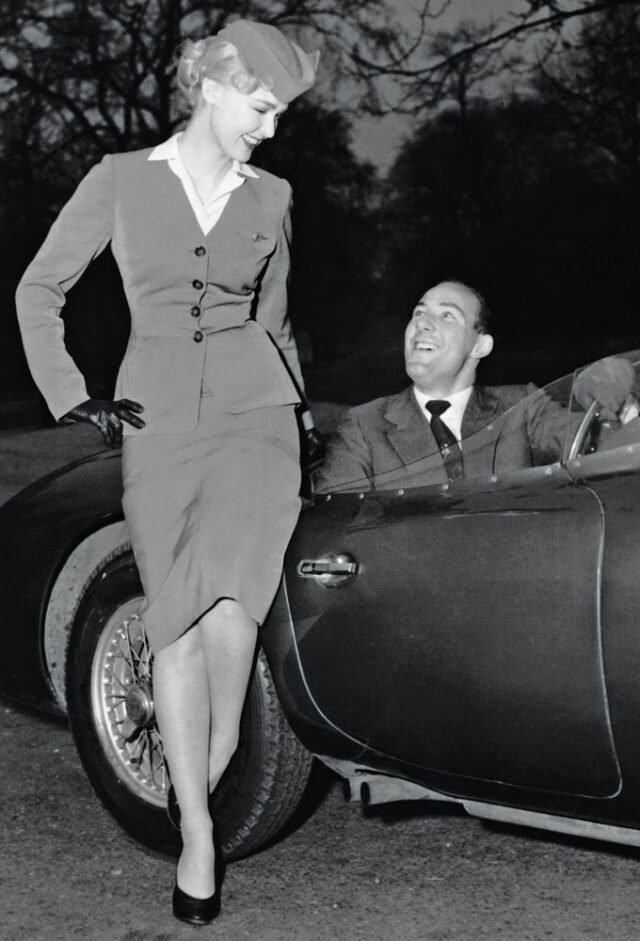
Twenty-four retired Pan Am stewardesses milled in a meeting room at the Multnomah Athletic Club one recent afternoon. Chardonnay circulated, and leopard print was well represented.
So commenced the annual business meeting of World Wings International’s Portland chapter, the local gathering of people who once worked for Pan Am, which died ignominiously in 1991 after decades of glamorous flight. High on the agenda: nostalgia for an era when international travel still tingled with mystery, romance, and weird sexual politics.
“Pan Am was the best job you could get as a woman,” said Barbara Geiger (years at Pan Am, 1954–1960). “It paid the best, had the best vacation, and you could travel all over.” After a job interview that included standing on a chair to have her legs inspected, Geiger’s service with Pan Am took her to China, the South Seas, and throughout Europe before she met her husband, a CIA operative, on a flight to Paris.
Besides being “well proportioned” (as a 1965 recruiting brochure put it), the female Pan Am recruit had to be younger than 27, have perfect vision, speak a foreign language, and be single. Once hired, she mixed perfect old-fashioneds and roasted prime rib to order in a galley smaller than a walk-in closet. She was trained to burp babies, convert dollars to deutsche marks, and calm a passenger having a panic attack. Starting pay: $301.50 a month.
Mary Nilson (1964–1966), now an antiques dealer in Lake Oswego, surveyed the MAC room. “When you get a start like we did, you don’t stand still,” she said. The group included an importer, a real estate agent, an interior designer, a college guidance counselor, a travel agent, and a career coach. Most were grandmothers. Several married pilots.
As the women mingled, conversation ranged from celebrity passengers (Joan Crawford insisted staff use the lavatory at the rear of the plane) to the short-lived recent television series Pan Am (“Was it accurate? No. But it was a good show.”) to ailments you’d expect among women long qualified for the senior discount.
Servers wheeled in trolleys of chicken salad. Chapter president Cinda Belozer (1972–1986), vivid in electric blue, cued up a slide show of last September’s global World Wings convention, held at the Benson Hotel and attended by more than 400 Pan Am flight-crew vets. Photos of women in crisp vintage Pan Am uniforms flashed over the screen as Sinatra crooned “Come Fly With Me.” Sandra Phillips (1963–1964), her rhinestone “I ⁄ Pan Am” choker sparkling, groaned each time her photo appeared.
When the key-lime-pie plates were cleared, members rose to leave. “I’ve got an early flight tomorrow,” said Jan Guerci (1970–1986), still a flight attendant, but now with United.
Still flying, after all these years? Amazing.
“It’s not amazing,” she said. “It’s a freakin’ miracle.”
1The Nation's Airline
Pan Am launched in the 1920s as the US’s quasi-official airline, at least in part to block expanding German airlines from serving Latin American routes. After World War II, the company invested heavily in new jet technology, and forged a reputation as th
2The Nation's Airline
Pan Am launched in the 1920s as the US’s quasi-official airline, at least in part to block expanding German airlines from serving Latin American routes. After World War II, the company invested heavily in new jet technology, and forged a reputation as th
3Flying High
Pan Am’s de facto monopoly on international flights out of the US made their planes a symbol of the high life—and a crossroads of celebrity. Here, Portland’s Betty Lou Ruble Snyder chats with Humphrey Bogart.
4Flying High
Pan Am’s de facto monopoly on international flights out of the US made their planes a symbol of the high life—and a crossroads of celebrity. Here, Portland’s Betty Lou Ruble Snyder chats with Humphrey Bogart.
5The Hat
In the Jet Age, Pan Am flight attendants’ tailored blue uniforms (not to mention snazzy bowler hats) made them icons of cosmopolitanism and adventure. Cinda Colton Belozer worked the airline’s second flight into China in 1981.
6The Hat
In the Jet Age, Pan Am flight attendants’ tailored blue uniforms (not to mention snazzy bowler hats) made them icons of cosmopolitanism and adventure. Cinda Colton Belozer worked the airline’s second flight into China in 1981.
7Going Global
At its peak, Pan Am served over 150 destinations, landing on every continent, in places both famed and obscure. Portland’s Gayle Larson poses outside the terminal in Paramaribo, Suriname in 1965.
8Going Global
At its peak, Pan Am served over 150 destinations, landing on every continent, in places both famed and obscure. Portland’s Gayle Larson poses outside the terminal in Paramaribo, Suriname in 1965.
9Ground Engagements
Pan Am flight crews waged a number of battles for better wages and working conditions. Barbara Wall Geiger picketed at San Francisco International during a 1954 strike.
10Ground Engagements
Pan Am flight crews waged a number of battles for better wages and working conditions. Barbara Wall Geiger picketed at San Francisco International during a 1954 strike.
11Airborne Cosmopolis
The airline prided itself on its multilingual flight crews. Irene Fujimura Nishimoto, hired in Seattle in 1960, got her job in part because of her language skills (she was technically too short) and became the company’s first Japanese-American purser.
12Airborne Cosmopolis
The airline prided itself on its multilingual flight crews. Irene Fujimura Nishimoto, hired in Seattle in 1960, got her job in part because of her language skills (she was technically too short) and became the company’s first Japanese-American purser.
13Women on the Rise
Pan Am invested in rigorous (and sometimes glamorous) training for its crews. Jan Miller Guerci’s time at the “academy” ended with a helicopter ride to the Pan Am Building in New York and a champagne toast from the company’s chairman.
14Women on the Rise
Pan Am invested in rigorous (and sometimes glamorous) training for its crews. Jan Miller Guerci’s time at the “academy” ended with a helicopter ride to the Pan Am Building in New York and a champagne toast from the company’s chairman.
15Meet Interesting People
An atmosphere of international intrigue sometimes hung over Pan Am’s operations. Lynn Fuller and Susan Greb meet some Latin American dignitaries.
16Meet Interesting People
An atmosphere of international intrigue sometimes hung over Pan Am’s operations. Lynn Fuller and Susan Greb meet some Latin American dignitaries.
Fly back in time with our slide show of vintage snapshots from Pan Am’s golden age
Published in the Oregon Beer issue of Portland Monthly.