Why Grasslands Barbecue Is More Than Worth the Drive
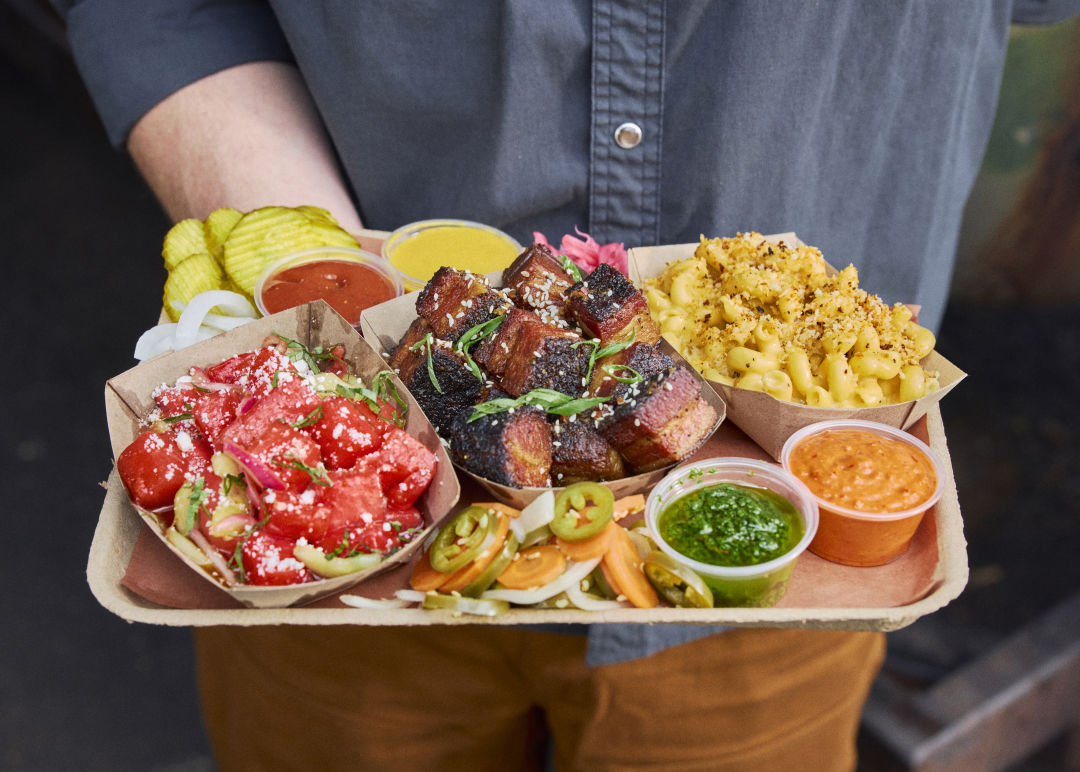
Image: Thomas Teal
How far are you willing to travel for great barbecue? Each weekend people from across the region—indeed, the country—help answer this very important question. They drive past ancestral salmon runs and looming hydroelectric works, through fruited valleys and orchards, all with a single destination: Grasslands.
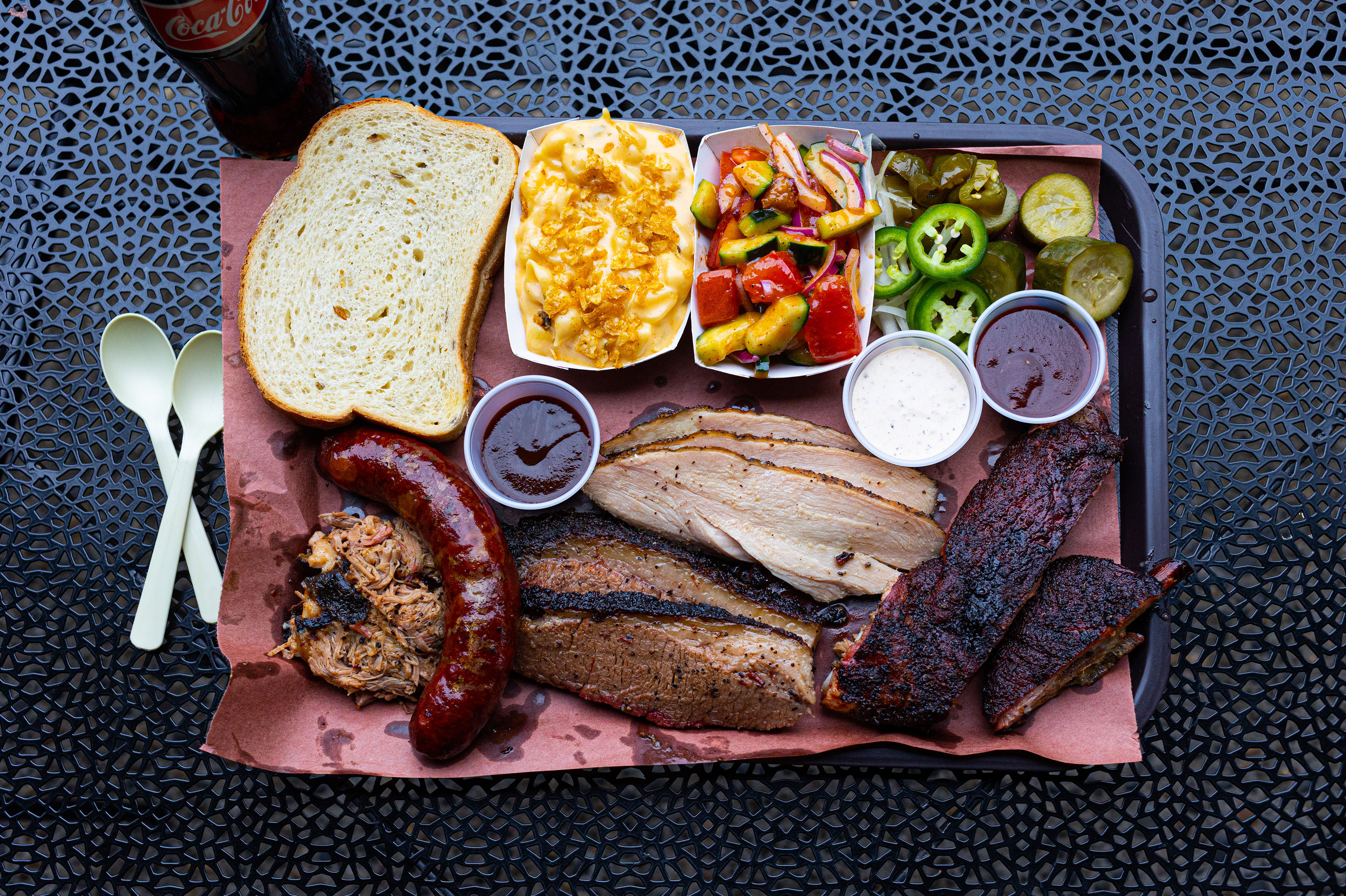
They come to the Hood River cart for picture-perfect brisket; sausages
of idyllic texture and taste; tri-tip steak; and a chorus of thoughtful sides, housemade sauces, and pickles. They drive for hours; they wait for hours more. Walk the line on a Saturday—one of the only days the tiny operation, serviced by three enormous smokers and a prep kitchen inside a nearby brewery warehouse, is open—and you’ll hear the same thing: The drive and wait are worth it.
Started in 2021, Grasslands is the work of owners Drew Marquis and Sam Carroll, plus Brendon Bain, who helped open the restaurant and is now a staff member. Their small team has created a distinctly Pacific Northwest destination for smoked meats served beneath dramatic Gorge skies, wind whipping off the mighty Columbia.

Image: Thomas Teal
Marquis and Carroll met at the University of Oklahoma. A decade later, Carroll was working at a Portland brewery and Marquis, after a sojourn across Tuscany, was working in markets and restaurants in Seattle. “Then the pandemic happened,” Marquis recalls. “I got laid off, and I was broke. I asked some friends if they would be interested in preordering brisket from me one weekend. That was the only way I could afford to give this kind of cooking a shot.”
The brisket was an immediate hit. Marquis and his wife, Nicki Marquis, began delivering Drew’s promising early attempts at brisket and sausage across the greater Seattle area. A friend who worked at Microsoft tipped off some fellow tech folks, and the spreadsheet of brisket-curious patrons grew. “I would put a notice up on Instagram, and the whole thing would sell out in 20 seconds,” he recalls. A central pickup location and a series of pop-ups followed.

Image: Thomas Teal
Avid campers and nature lovers, the couple had been looking for a place to put down roots and plot a future for the growing BBQ enterprise. This led them to Hood River, a jumping-off point for myriad adventures in the Gorge. “We just knew this city had potential,” says Marquis. “People keep asking us when we’re going to open up a spot in Portland, and it’s like, no—Hood River was always the goal.”
Barbecue aficionados are a curious bunch. Their affection for this style of cooking mirrors the reality of making it: It’s all about patience, reverence
for tradition, and a willingness to travel. A bit of driving distance outside of a major city is often required to find the good stuff, and that line is part of the experience. As with religious sojourners—to Lourdes, to Mecca, or the Char Dham Yatra—the nature of pilgrimage itself only enhances the ecstatic revelations.
For Grasslands, barbecue pilgrims make the trip from Portland and beyond, even all the way from Texas. The most important barbecue critic in the US (Texas Monthly’s Daniel Vaughn) included Grasslands in a 2024 article titled "The United States of Texas Barbecue," declaring that the brisket would “ hold its own” in his state. There is no higher praise in the sphere of American barbecue. But is what they’re doing at Grasslands really even Texas barbecue in the first place?

Image: Thomas Teal
“We call it Tex-ish,” says Carroll. “That allows us to play with the Texas barbecue tradition and do our own thing, but still get our point across.” A key differentiator is the use of Oregon white oak, as opposed to post oak, traditional in Central Texas, or other woods like mesquite or pecan, common farther south. To generalize, it delivers flavors that are slightly sweeter and complex, redolent of vanilla or toffee, compared with post oak’s dry, savory finish. The wood is sourced from a local landscaping company. “Working with Oregon white oak just makes more sense to us than shipping in post oak from Texas or something like that,” says Marquis. “The right thing to do is to use what’s already here.”
While the meat preparations draw from Texas, the rest of the menu is free to play and subvert expectations, as with an unconventional “Tex-Mex style” slaw, topped with cotija cheese and pepitas, crunchy and tangy and capable of slicing through even the fattiest slice of beef. Some weekends you’ll find smoked beets dusted with a housemade shawarma seasoning or watermelon aguachile spiked with colatura, a kind of Italian fish sauce Marquis fell in love with in Tuscany.
Again and again I have been blown away by the links: Hatch chile and cheddar, black pepper and parmesan, traditional Texas hot links, jerk chicken sausage with allspice and scotch bonnet peppers. Grasslands employs a three-day process, starting with brisket trim and pork shoulder that’s cubed, seasoned, and left to consider itself overnight to help promote emulsion. On the second day the sausage is ground, stuffed into casing, and linked, often with Carroll on the grinder working fast to keep things cold, Bain stuffing, and Marquis twisting them up into links. On day three they smoke—a “Texas-style cold smoke,” per Marquis, with the temp kept at 150 degrees for around four hours, then are plunged into an ice bath (which helps promote texture and “snap”). On the day of service the sausages get one more run in the smoker, at 300–325 degrees.

Image: Thomas Teal
“Week after week, we take these same items and try to make them a
little bit better,” says Marquis. This approach to incremental improvement,
called kaizen in Japan (sushi chefs talk about it), extends to a wider philosophy
around balance. And it evokes the two-ton elephant (or 1,000-gallon smoker) in the room: Why haven’t they opened a proper restaurant? Why haven’t they expanded to Portland? While they don’t rule anything out, it’s not in the plans at the moment.
“Right now we work on a farmer’s schedule,” explains Marquis. “We go hard in the summer—that’s like our harvest season—and it’s demanding and crazy. But we have a light at the end of the tunnel. Winter comes, and we can take a long break.” The entire business shutters between early January and early March—unheard of in today’s embattled restaurant milieu. “Two days a week is just right for us most of the year,” says Marquis. “We are very grateful for every single person who comes out to visit us, but we got into this venture because we wanted something that could work for us, too. We want to spend time with our families. We want to take holidays off.” Grasslands closed for a month when the Marquises had their first kid; it closed again when Carroll and his wife did the same.
“We’re very proud of the fact that anytime someone walks past this place, whether we’re serving food or just working the smoker, someone who owns the business will be here,” says Carroll. At this very moment my inbox is filled with PR inquiries from venture-backed, cashed-up enterprises desirous of reportorial outreach, so it’s refreshing to talk with business owners who are running the place themselves, and proudly so, prioritizing their lives and families alongside the food they serve.
For now, a stand at the charming Hood River Farmers Market is what expansion looks like: one employee selling freezer packs of sausage, hats that read “Line Culture,” and just one hot food option, a breakfast sandwich, often with brisket. In Portland, there would be a whole cult around this, but in the quiet, calm environs of a Hood River Saturday morning, wind swirling, sky blazing, it feels like a thoughtful addition without jeopardizing the careful equilibrium they’ve achieved.

Image: Thomas Teal
Portlanders are more than happy to make the drive. They include David Huang, who built a buddy trip to the Gorge around a visit to Grasslands. “It’s worth it to get brisket like this,” he tells me. I talk to folks from Salem, others from Boardman, which is another hour east along the river. The line tops out at around a hundred, who wait together in high spirits beneath dramatic skies, with Willie Nelson playing on the truck’s Turtlebox speaker.
A few years ago, I drove out here to eat barbecue with my family and jump in the river for my 40th birthday. There was simply no place else I’d rather be. It’s not just the barbecue—which really is that good, worth the gas money and the make-a-day-of-it commitment. They’ve tapped into something bigger, something good and true, that transcends food and business and arrives at something almost spiritual. They call it a barbecue pilgrimage for a reason.
Make It a Weekend
While in Hood River for a meal at Grasslands, you can also…
-
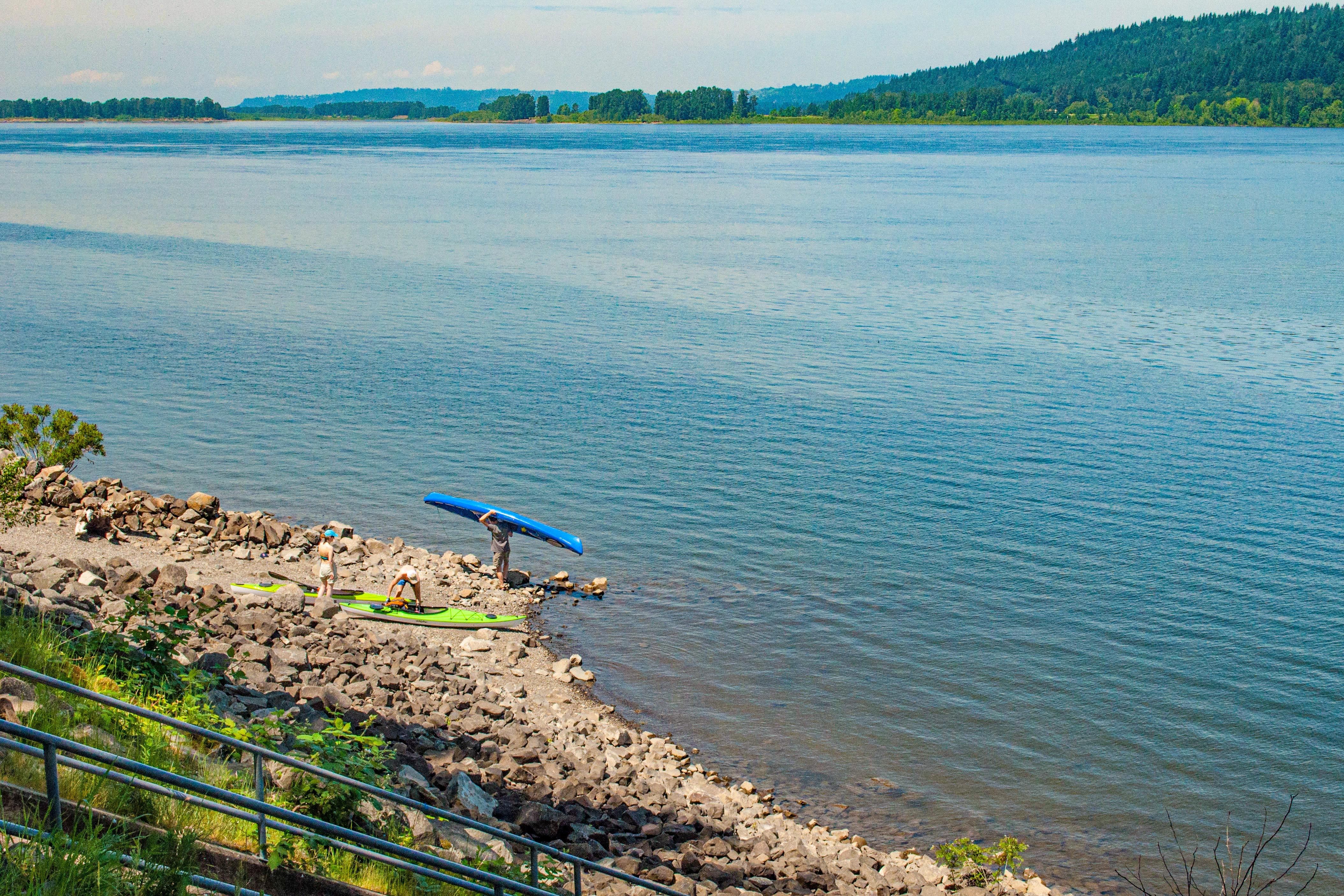
Jump in the river. The Columbia laps the edge of Waterfront Park just a few minutes’ stroll from the barbecue cart.
-
Grab a beer. Hood River is famous for breweries. My favorite spots for a beer here are the Pfriem taproom on the waterfront (don’t miss the bottle shop) and the newly opened the Walled Garden pub from local indie favorites Kings & Daughters brewery.
-
Stay the night. The newly opened Lightwell Hotel & Spa is just minutes from Grasslands. It has a buzzy lobby bar, atmospheric basement soaking pool and spa, an epic rooftop dining option, and comfy rooms.
-
Hit the market. The Saturday Hood River Farmers Market is charming and worthwhile, with Gorge-based vendors selling fruit, local salmon, fresh micro-farmed chicken and beef, and much more. Grasslands has a stand there, which was selling an outrageous brisket breakfast sandwich when I visited.
-
Get a pastry. Édeske comes highly recommended from Hood River locals for croissant, eclairs, a Technicolor assortment of bonbons, and some of the town’s best coffee. —JM