
Wildwood Really Is Laika’s Most Ambitious Project Yet
Before Colin Meloy became the front man of the Decemberists, he thought he might get an MFA in fiction. Circa 2001, the indie rock titan and his then-girlfriend, illustrator Carson Ellis, started collaborating on a children’s book while living together in a Southeast Portland warehouse. “It was kind of wildly inappropriate for kids,” Meloy recalls. Many of the details, he says, are fuzzy, but he remembers a subplot about teenage pregnancy and a band of drunken, lecherous soldiers. “We were like 25. We didn’t know what we were doing,” Ellis explains, half apologizing.
Ten years and five Decemberists albums later, the since-married pair reshaped that manuscript into Wildwood, a sprawling middle-grade novel that imagines Forest Park as an enchanted fantasyland overrun with militant coyotes and wise, speaking owls. To call Wildwood “appropriate for kids” might be a stretch—there’s necromancy, gory animal-on-animal combat, and the looming threat of a baby’s blood sacrifice—but families went for it hard enough that the book spent two weeks on the New York Times bestseller list in the fall of 2011.

Image: Courtesy Laika Studio
This October, Wildwood will become the sixth feature film from Hillsboro stop-motion animation studio Laika. It’s been a long time coming. First optioned before the book was even published, the project has been touch and go for 15 years. Epic, star-studded, and densely plotted, the final product feels like a level up for Laika, the scrappy company that began as Will Vinton Studios in 1975 before producing left-of-center gems like 2009’s Coraline and 2016’s Kubo and the Two Strings under the guidance of Nike scion Travis Knight.
Knight—the director of Wildwood and a lifelong, self-described “fantasy buff”—got his hands on an early draft of the novel before galleys were printed. At the time, he was producing Laika’s sophomore feature, ParaNorman, and was intrigued by Wildwood mostly due to the creators’ local connections. “It struck me as something that was breathing the same air as stories by J. R. R. Tolkien or L. Frank Baum, but it had a contemporary edge, and it was set in a place that I love: Portland,” Knight says of his first time reading the manuscript. From the jump, he knew he wanted to turn the 541-page book into a big, epic film. He also knew that his ambitions for that film outstripped Laika’s capacity. Production designer Nelson Lowry puts the predicament in concrete terms: “Before Wildwood, my biggest challenge was Kubo and the Two Strings, which had 60 different exteriors,” he says. “By the time I was done reading the script for Wildwood, I’d marked down 136 unique locations.”

Image: Courtesy Laika Studio
There was also the matter of getting Meloy and Ellis on board. The couple sold Wildwood to HarperCollins at auction in spring 2010, well before it was finished, and the bidding war caught the attention of several film studios. Though Meloy and Ellis were flattered, they shared an instinct to proceed with caution. “We had friends whose books had been adapted at that point, and we knew what could go wrong,” Meloy says. They half-jokingly told their agent they would accept a bid for adaptation “only if it’s done in the hand-drawn cel animation style of Watership Down, or in stop-motion.” Given that cel animation was essentially dead by 2011, and stop-motion is a notoriously labor-intensive process that requires the painstaking manipulation and photography of hand-built puppets, they figured their conditions were plainly absurd.
And then, lo and behold, the stop-motion wizards at Laika came knocking.

Image: Courtesy Laika Studio
Over the next 15 years, little went right. “By the time we had made five other movies, I thought, ‘OK, I think we can finally do this material some justice.’ Boy, was I wrong,” Knight says. “It eventually felt like, ‘Dear God, is the universe telling us not to make this movie?’” Various candidates for director came and went. COVID ground production to a standstill. In 2024, after elbowing through the pandemic and booking a slate of starry voice talent, Laika announced a fall 2025 release date, then additional production delays pushed everything back another year. After several set visits ended with promises that Laika was just “waiting for the technology to catch up with them,” Meloy and Ellis admit that their faith flagged that the film would be completed at all.
But come October 23, by hook or by crook, Wildwood is set to hit the big screen, occupying a strategic release window meant to both soak up Halloween viewing dollars and stay fresh in the minds of awards voters. (Each of Laika’s previous five films has been nominated for the Best Animated Feature Oscar. None has won.) At press time, Laika provided only an unfinished cut for Portland Monthly to view, so it’s hard to say with absolute certainty that they’ve pulled it all off. But judging from the available footage, Knight and co.’s claim that Wildwood is Laika’s most ambitious project yet feels justified: Captured by Oscar-nominated
cinematographer Caleb Deschanel, the sweeping spectacle is bursting with visual beauty, uncompromising darkness, and at least three set pieces that reach breathtaking, how-did-they-do-that? heights.

Image: Courtesy Laika Studio
The story goes something like this: 12-year-old St. Johns resident Prue McKeel (voiced by Disney Channel star Peyton Elizabeth Lee) is running errands in downtown Portland with her baby brother when she bumps into her classmate Curtis (Room’s Jacob Tremblay). Then a pack of crows lifts Prue’s brother into the sky and carries him into Forest Park, which Prue’s crunchy parents have always warned her to avoid. She plunges in anyway, and Curtis follows. Soon, they’re caught in a struggle between violent coyotes and ragtag “bandits,” and squaring off against a charismatic witch named Alexandra (Carey Mulligan), whose wickedness is layered with heaps of guilt and grief. There’s also a subplot about the fantasy realm’s corrupt, bureaucratic political system, which is headquartered in the Pittock Mansion. And an eagle voiced by Angela Bassett.
The tonnage of Wildwood’s characters and plot threads would intimidate even the bravest of screenwriters. Chris Butler, who had penned a few original scripts and directed ParaNorman before Knight tapped him to adapt Wildwood, says he rose to the challenge by zeroing in on the story’s unique point of view. “What interested me was that it felt like it was in the grand tradition of folkloric, fairy tale–informed children’s fiction—very much Narnia, very much Alice in Wonderland,” Butler says, “but those novels are old. Wildwood asks, ‘What if you had a contemporary, smart kid who found herself in this old-fashioned
adventure?’ My thought was, ‘Well, she’d know what was going to happen. She’d know she would meet a woman who would try to seduce her with chocolates, and she’d be like, No, I’m not going to be part of this.’ That’s when I knew I was getting somewhere.”

Image: Courtesy Laika Studio
In addition to scale, with its hundred-plus locations and thousand-person crew, the main quality that distinguishes Wildwood from Laika’s previous outings is its Portland setting. While Coraline and Missing Link are explicitly set in the Pacific Northwest, neither takes place in the Rose City. Wildwood, meanwhile, opens on a shot of the Pittock Mansion. A few minutes later, Loretta Lynn’s “Portland Oregon” accompanies a giddy sequence of Prue riding her bike through Old Town, past Powell’s, and along Gov. Tom McCall Waterfront Park while cherry blossoms sway in the breeze. Later, a plot twistis revealed at the fog-choked mouth of the St. Johns Bridge.
The effect, as Ellis noted from set visits over the years, is strangely moving. Production designer Lowry says that when he moved to Portland, “it reminded me of being a kid and looking at a treasure map with a bird’s-eye view of a fictional city. Portland has gardens and museums and a waterfront. It has an extinct volcano. All of it is connected by hiking and biking paths. There’s a lot packed into the city limits; to me, it was already this kind of cool, predesigned model railroad. I just brought the most vivid things out and made them more vivid.”

Image: Courtesy Laika Studio
Earlier this year, Lowry was seeing a film at St. Johns Twin Cinema when a trailer for Wildwood played. The audience clapped as soon as they saw the St. Johns Bridge, which sits a few blocks from the theater. “My heart kind of exploded,” Lowry says.
One theory he offered to explain the enthusiasm—both in the theater and in social media comments after the trailer was posted online—is that Wildwood’s DIY quality makes it feel like a vote of confidence for handmade art.
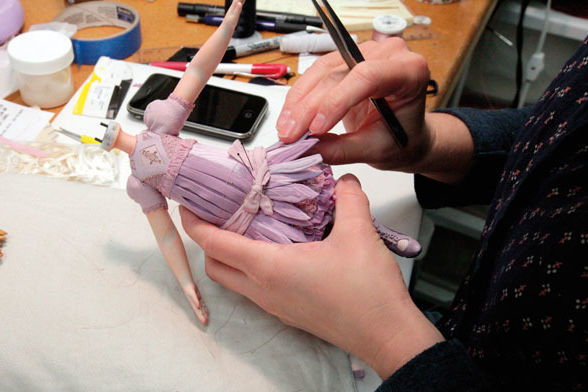
“There’s something about world-building for stop-frame that’s very unique: You start with nothing, and you’re crafting actual physical assets,” Lowry says. “I love the scope of it. I love the challenge. You have to design the leaves on the trees, the way a tire kicks up dust.” Butler is even more pointed, stressing that, in a climate that can feel hostile to patience and technique, “when you see something like this, it’s really energizing. It feels good to see something onscreen that’s been made by talented artists and craftspeople. I hope it becomes a rallying cry for the industry against AI, but maybe I’m getting ahead of myself.”

Image: Courtesy Laika Studio
At minimum, the craftsmanship impressed Meloy. He, too, has seen only a rough cut of Wildwood, but it put his early worries about adaptation to bed. “I was awed by it,” Meloy says. “Particularly thinking of the amount of labor that went into the handcrafting and the moving of these individual maquettes. And I think they did a really remarkable job keeping the story so well intact. It felt like a David Lean movie. It has a kind of throwback cinematic approach that you just don’t see—certainly not in stop-motion films.”
Though both Meloy and Ellis have come to separate the film from the book they published 15 years ago, they’ve each appreciated the opportunity to face their former selves. “I look at Wildwood, and I’m like, ‘Oh, I wouldn’t do it that way now,’” Ellis says, calling out her choice to render Forest Park in blue instead of green, for example. “But it’s also a moment in time I’m sort of nostalgic for: We were living [right by] Forest Park, and our son was 4 years old. There’s a lot good feeling around it.”

Image: Courtesy Laika Studio
Meloy concurs. Since he and Ellis published Wildwood, they’ve collaborated on two sequels and pursued a number of individual literary projects. In 2017, Ellis won a Caldecott Medal; Meloy is currently working on his first novel for adults. But in reconnecting with the writer he was back in 2010, he’s reminded of a playful artist who could never have imagined his whims becoming a multimillion-dollar stop-motion spectacle.
“It was just raw creation. We were trying to create something rich and from our own aesthetic sensibilities,” Meloy says of writing Wildwood. “And, I mean, I think it holds up. Right?”

FALL ARTS PREVIEW
How Laika is Revolutionizing Stop-Motion Animation with 'The Boxtrolls'

5 THINGS ABOUT
What's Next for Portland's Animation Powerhouse Laika?

The Mudroom