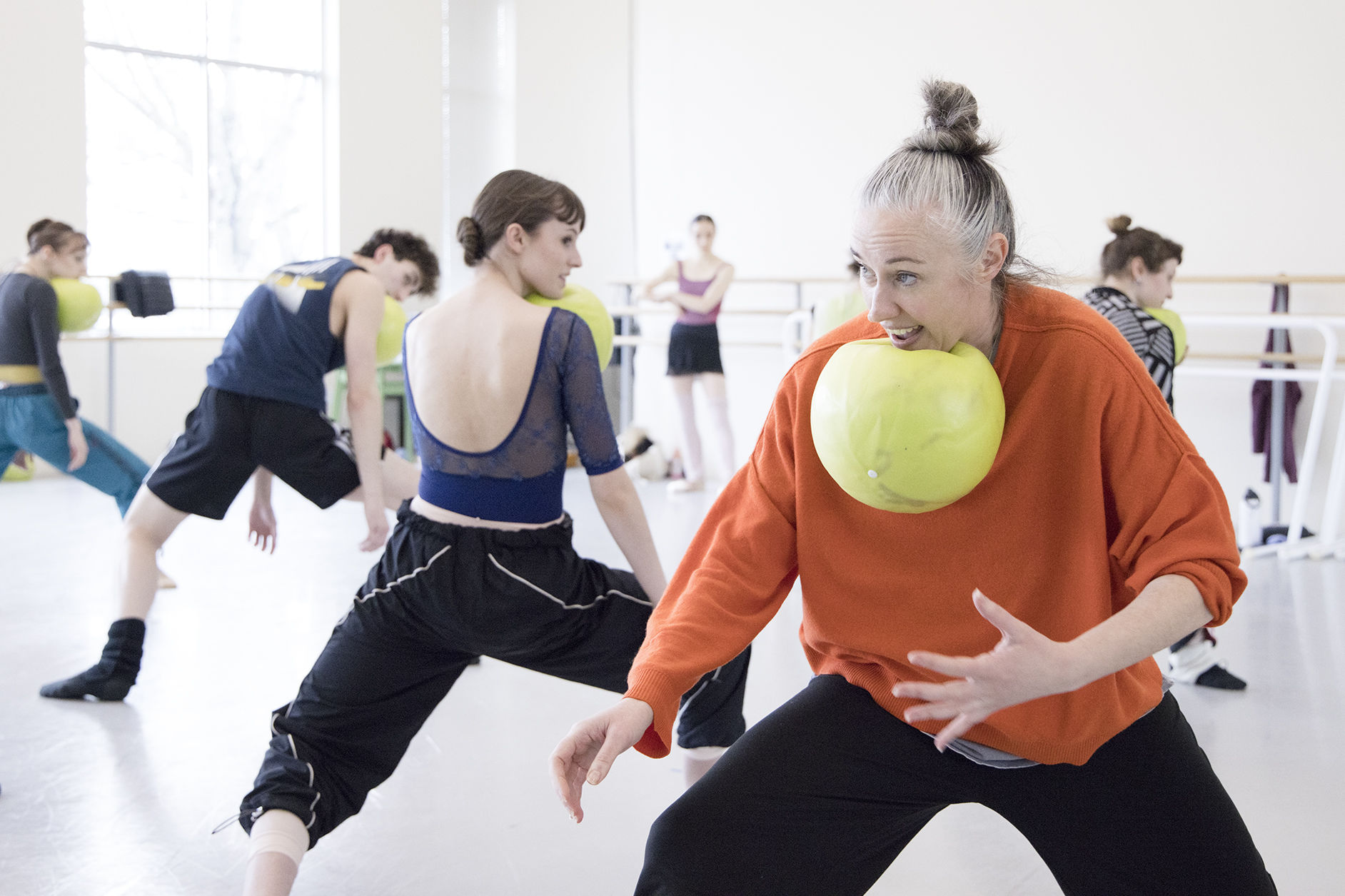
Archiving Dance: Linda K. Johnson’s Maps and Memories

Image: Michael Novak
Dance presents a slippery test case when it comes to preservation. Video tends to flatten and minimize the experiential qualities of this ephemeral art form, while photography freezes its trajectory to create a different sort of spectacle—extending a high leap, lift, gesture, or pose indefinitely. Despite these difficulties,
Linda K. Johnson relishes the task of archiving dance.
Over the course of 40 years and counting, Johnson has been a fixture in Portland’s dance community. In addition to creating and sharing her own work, she has nurtured generations of artists and taught at local institutions including Reed College, Lewis & Clark College, and Portland State University. When it comes to documenting or sharing some of her experience, an exceptionally keen memory serves as a superpower—she can transform a hypothetical footnote of dance lore into a chapter or even a novel through her sharp associative prowess.
This talent sits at the heart of The Evidence of Foot Fall, her exhibition at Place Gallery that’s part of Converge 45, the sprawling art triennial whose 2026 edition is titled Here, To You, Now. Johnson’s Converge contribution raises prescient questions about archival processes. Who creates, maintains, and contributes to an archive? Where does an archive live, and how does this site of existence shape its contents?
On a visit to Johnson’s rented studio in inner Southeast Portland as she prepared for the exhibition (running August 27–October 22), I learn some of her plans to reframe much of her past work and personal archive, and how The Evidence of Foot Fall will strengthen remembrance of local dance lore while also creating new memories, individual by individual.
Together, we pore over some of her creations, costumes, publications, and photos. She fastidiously stored much of her archive in boxes, portfolios, and protective sleeves—all deliciously tactile, ripe for riffling through, and patinated by eras gone by.
As we sit together, I flip through one of Johnson’s photo books, enjoying the crinkling of its translucent protective layers. One photograph from a couple decades ago shows Johnson riding a white horse bareback, completely naked save for her cat-eye sunglasses and a massive blond wig cascading past her waist. It’s evidence of antics I had only heard rumor of through art world gossip—this photo, with Johnson posing as “Lady GoDaDaVa,” was captured during an early Portland Institute for Contemporary Art’s Time-Based Art Festival, a notoriously experimental art affair inclusive of many disciplines.
I recognize her big smile in the photo, even though I didn’t know her at that time. Ten years ago, Johnson’s dance class served as one of my first stops as a dancer new to Portland. Since then, we’ve continued to get to know one another in the dance studio, at performances, and casually over tea or coffee. I got to perform in one of Johnson’s public dance projects early in the COVID-19 pandemic. I also found work writing about dance, and Johnson once told me plainly that I possessed power because of that work—I was keeping the record.
Johnson knows the necessity of keeping the record. Throughout her career, she has made major contributions to several linchpins of Portland’s dance scene that no longer exist, such as Conduit—a studio Johnson founded alongside dance artist Mary Oslund in 1995—and PSU’s dance program. An ongoing project of Johnson’s called Mycelium Dreams shores up shared dance history of places, times, and people, reflecting the creative potentials of archiving.
The endeavor, which will live on in a special collection of the PSU library, came about after Johnson had gone quiet as an artist while dealing with some personal challenges. As things settled and she arrived at a more spacious moment, Johnson began wondering to herself, “How have I spent 40 years of my adult life?” In the lead-up to her 60th birthday, she addressed this question by creating a large map of her artistic life.
“The map was a revelation, like, ‘Wow! Look at the life I’ve led with all these people.’” Johnson invited the folks referenced on her map to create their own maps, showing how performance often emerges from the many unseen relationships among those who labor together, much like a hidden mycelial network in a forest.
Johnson originally exhibited some of Mycelium Dreams in 2022 during a residency at Building5, an arts space in Northwest Portland that was once part of NW Marine Ironworks; I wrote about the project for Oregon ArtsWatch. For the triennial, she plans to reprise a showing of seven of the artist-made maps and offer points of engagement with many other aspects of her personal archive, even displaying boxes from her various projects for visitors to comb through.
Johnson set a goal for herself not to use any new materials, even for things like the exhibition’s wall text, keeping The Evidence of Foot Fall a truly archival undertaking. She uses ephemera and memory to bring forth new creations. Many of Johnson’s old costumes and elements from past works will debut as transformed soft sculptures, and she instructed sound designer Seth Nehil to use only sound from her previous projects to create new soundscapes for this exhibition.
As part of Converge 45, Johnson will perform a new solo work at 5:30 and 7pm on First Thursdays in September and October at Place (735 NW 18th Ave) to accompany her exhibition. She’ll also host a “long-form archival conversation” with BodyVox’s Jamey Hampton (September 19) and an event to revisit and recirculate the work of the late Keith V. Goodman, a dance artist and educator who taught, performed, and shared a friendship with Johnson (October 3). For this gathering, Johnson will invite attendees of one of Goodman’s past dance performances to participate in a conversation reflecting on their memories of this work, and then invite those who were involved in the performance to do the same. For a final illuminating gesture, she’ll screen video documentation of the original work.
As she tells me the reasoning behind this event, Johnson refers to her memories of a past performance of my own, a dance with my collaborator Emily Jones involving sculptural assemblage. “I could almost replay it for you. So I hold that for you. I am an archive for you,” she says. “That’s what we do for each other, and that’s where the work lives.”
It’s in this fortification of human memory by way of public engagement that Johnson’s triennial project takes on particular potency. Dance archives, whatever form they may take, can fall into disrepair, be destroyed or deleted, or devolve into misinformation. Yet Johnson’s proposition of bringing people into her own archive through The Evidence of Foot Fall proves a critical act of remembrance, pulling at the strings of communal recollection and reinforcing an untouchable collective memory that extends beyond lifetimes.
Editor's note: An earlier version of this story misstated the year the Lady GoDaDaVa photo was taken. Portland Monthly regrets the error.