A Flower CSA Will Keep You in Local Blooms All Season Long
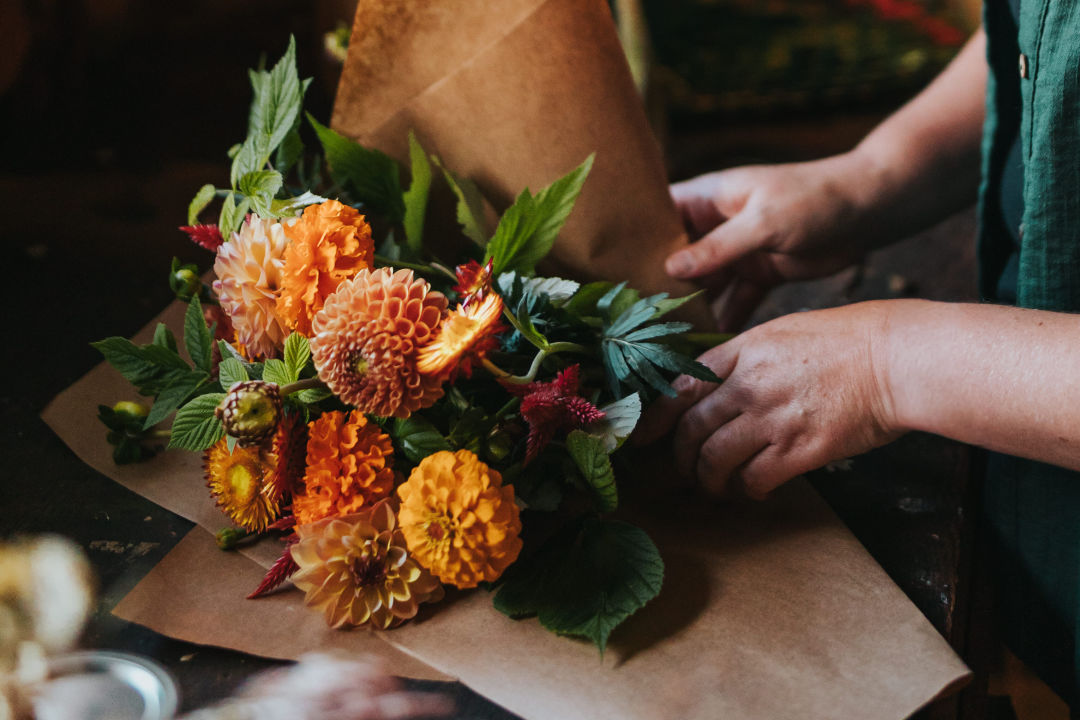
“Mrs. Dalloway said she would buy the flowers herself,” wrote Virginia Woolf in 1925. “I can buy myself flowers,” sang Miley Cyrus nearly a century later. Whatever the self-care cliché, anyone who’s followed the lead of these women knows it to be true: Buying yourself flowers feels really, really good. Delicate, perishable, nonessential—a bouquet is a joy-bringing, fleeting bolt of beauty on your kitchen table.
In Mrs. Dalloway, Clarissa goes shopping—for “delphiniums, sweet peas, bunches of lilac; and carnations, masses of carnations”—at a florist on London’s fashionable Bond Street. Woolf doesn’t tell us where the flowers were grown, but in that era, they almost certainly would have come from within the UK. By the time Miley showed up, the flower industry had gone global. Today, countries in the northern hemisphere import nearly all their stems; in the US, roughly 80 percent of cut flowers are imported, mostly from Colombia. Those are the plastic-wrapped bundles of roses and chrysanthemums you see bursting from buckets ($10.99! $4.99!) at Trader Joe’s.
But there’s another way to do it, and it ensures you’re kept in locally grown blooms all season long. A bevy of flower farms in and around Portland use the community supported agriculture model to offer what are essentially bouquet subscriptions. The customer pays upfront and then receives a regular (usually weekly) train of flowers. Prices range from $30 to $45 per bouquet—more expensive than TJ’s but comparable to the fancier arrangements at New Seasons. A few farms do home delivery while others ask subscribers to select from one of several pickup locations.
And for those who want to do the arranging themselves, many of these growers sell DIY buckets filled with dozens of freshly cut stems. Build-your-own bouquet bar, anyone?
The Wholesale Pro: Eda Creek Farm
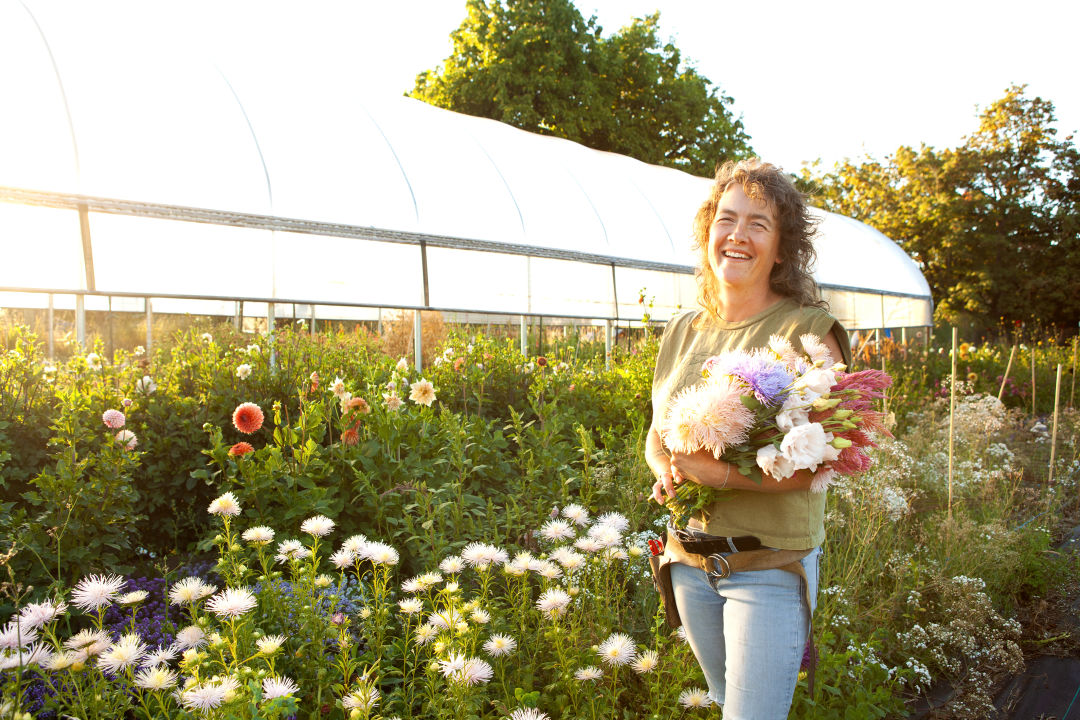
Sarah Head moves a lot of flowers. The Eda Creek owner, a former high school social studies teacher, grows about 100,000 stems per year at her property in Oregon City. Most of these she sells wholesale, at the membership-only Portland Flower Market on Swan Island. Others go into the weekly arrangements she does for Canard’s Oregon City location. And some fill her CSA bouquets, which she’s offered since 2020. As a farmer who grows for florists, Head likes to include plants that don’t ship well—in other words, stuff you’re unlikely to see in a grocery bouquet. Take Nicotiana: The flowering tobacco has lovely star-shaped blossoms, but it’s fragile and sticky and “just gets trashed” in shipping, Head says. Or Agrostemma, a pretty but easily bruised cottage garden flower.
Head splits the season into three six-week stretches. (Sign up for the full 18 weeks to snag the best deal, about $27 per bouquet.) Spring bouquets begin in early to mid-April: lavishly petaled ranunculus, peonies, poppies, sweet peas. As the weather warms, foxgloves, dahlias, zinnias, cosmos, and strawflowers arrive. The summertime star of the show is Lisianthus, or prairie gentian, which is dramatic and roselike, with an exceptionally long vase life.

When it comes to arranging, Head likes asymmetry, negative space—she’s done art throughout her life. “Color theory and movement and blocking, all that stuff that’s in any kind of art, is in floral design,” she says. And since an epic aphid infestation (“so gross, so gross,” she recalls), she’s become interested in beneficial insects for pest management. She’s been using a spray containing predatory nematodes, which are microscopic roundworms that infect their host with lethal bacteria. “An aphid taken out by a nematode looks like it just splatted into a window,” says Head. “There’s nothing but legs left.”

The Sculptor: Corolla
Marianné Copene has been in the flower business for nearly 20 years. She’s grown on farms, on leased land, in backyards, in disused lots. She’s sold wholesale, at farmers markets, at pop-ups. These days, she grows on a few patches near her home in the Piedmont neighborhood and in a high tunnel in Cully. She’s offered a CSA in some form since 2015 (the name of her business, Corolla, refers to the whorl of petals that surrounds a flower’s sexual organs), and after a yearlong hiatus, it’s back. A five-week spring share begins in early April and features fluffy ranunculus, daffodils, and tulips. Later-season shares are still in the works.
Copene, who also works as a large-scale installation artist, approaches arranging from the perspective of a sculptor. “I get to grow my own medium,” she says, and she provides herself a bounty: dome-shaped didiscus; dainty orlaya; spiky hyacinth and delphinium; cute and freckled martagon lilies. Working at the farmers market, she used to play a game where she’d build bouquets inspired by people she spotted in the crowd. “I would see somebody and appreciate their style, or just how they were walking,” she says. “Then I would make a bouquet with them in mind.” Not infrequently, she says, her muse would arrive at the stand, wishing to purchase that very arrangement.
Copene’s newest project, in partnership with the nonprofit P:ear, is a job training program in flower farming and floral service for unhoused youth. Three garden plots in Old Town have been secured, and Copene has been growing starts that will soon enter the soil. Expect those bouquets by July.

Image: Courtesy Stiner Banuelos
The Former Cheesemaker: Flowers Now, Cry Later
Stiner Banuelos goes after what she wants. For seven years, she owned local vegan cheese company Vtopian. Then, in 2023, “I just didn’t want to make cheese anymore,” she says. “I decided I wanted to grow flowers.” So she sold the business and found a job at a vegetable farm in Canby (called, confusingly, Empowered Flowers), where the owners encouraged her to grow what she wanted. She soon launched Flowers Now, Cry Later, and she currently tends to 22 six-foot beds filled with blooms.
Now in her second season, Banuelos is offering a 10-week summer CSA starting in early July and an eight-week fall CSA starting in mid-September. Subscribers can receive their bouquets wrapped in paper or, for $10 more each week, in a vase specially made by Banuelos’s potter partner, Justin Caraco. The vases, nearly as colorful and shapely as the bouquets they hold, are loans—they get returned each week. Banuelos takes an intuitive approach to arranging, sometimes inspired by the vase itself, sometimes by a notable plant—such as a bright green amaranth that Banuelos says “grew like balls” last season, which she paired with pale pink snapdragons, cosmos in white and various pinks, and lime-colored millet.
Banuelos’s favorite color is pink, but she grows the full rainbow: zinnias in yellow and coral and green, cosmos so red they’re almost brown, a member of the amaranth family called celosia that comes in a whole spectrum of bright colors and several eye-catching shapes (feathery plume, coral-like bloom). Plus? Lots and lots of vibrant orange marigolds for Día de los Muertos. Banuelos, who is Mexican American, grew hundreds for last year’s holiday, but she still sold so many she barely had any left for herself. All appear in the CSA, which Banuelos sets out to make accessible with several payment options..

The Next Generation: Walking Whale Farm
On their first date, in January 2020, Aaron Kerr mentioned to Madeline Tucker an interest in WWOOF, the program that places volunteers on organic farms as part of a live/work exchange. It was little more than a vague dream; Kerr at the time was doing tech work for an insurance company. Six months later, pandemic swirling, the recent college grads had quit their jobs (Tucker had been at an environmental nonprofit) and were growing veggies on a farm in Humboldt County. By 2021, after a series of WWOOF stops in California and Washington, they landed in Portland. They started Walking Whale in 2024.
Tucker, who studied sustainable agriculture in college and was involved with urban farming projects in Berkeley, says she once spurned flowers. “I thought they were silly and frivolous and a waste of resources,” she says. Then she began growing flowers in her backyard, began watching them attract swarms of pollinators—and began noticing their beauty, temporary as it was. Now she’s quick to cite studies that show how cut flowers can improve mood and reduce stress.

As part of the Headwaters Farm Incubator, a program that provides affordable land and support to upstart farm businesses, Tucker and Kerr grow on just under a half-acre in Gresham. This will be their third season at the PSU farmers market and selling wholesale, but their first with a CSA. A five-week spring share begins in mid-May, followed by summer and late-summer shares (six weeks each) and a four-week fall share. Expect many of the usual suspects: ranunculus, snapdragons, poppies, sweet peas, zinnias, dahlias, cosmos. Tucker and Kerr also prioritize textural interest—think unusual grasses and seed pods—and flowers that dry well. When it comes to bouquets (Kerr does most of the design work and arranging), Tucker says the goal is “whimsical cottage garden.”
Even More Blooms
The bounty doesn’t stop there. Among the many others with flower CSAs are Sarah Fry, whose Hoverfly Flower Farm operates on a quarter-acre in Cully. Fry is offering a weekly spring bouquet share as well as a table arrangement share (think something more composed and dynamic) available either weekly or biweekly. Focal flowers will include ranunculus, daffodils, tulips, and peonies. Come August, Fry opens her dahlia beds for U-pick.

Image: Courtesy Sarah Fry/Hoverfly
Lots of local growers got serious about their flower fields during the early days of the pandemic. Kelly Rae began growing flowers at her home in the Centennial neighborhood so she could show them off to her parents—dedicated gardeners in Southern California now in their 80s—during FaceTime calls. She dropped off mason jar arrangements for elderly neighbors, and their gratitude kept her going; she inaugurated the Petal Dispatch in 2021. This year, she’s running a biweekly spring subscription and may add a late-summer or fall subscription. Rae says she likes to juxtapose deep and moody colors against cheerful pastels.
Grace Krogh also found joy in giving flowers to neighbors in 2020. She and her family have since moved from Southeast Portland to Clackamas County, about six miles east of Oregon City, where Krogh now runs Still Life Flower Farm. She’s offering a spring bouquet share (orders close March 22) featuring some very luscious petals: In addition to Iceland poppies, lilac, and the requisite ranunculus, Krogh grows double daffodils and double tulips. She gravitates toward softer shades—white, pink, gold, soft orange. For the home gardeners out there, she also sells dahlia tubers.

Eva Bannan was 18 weeks pregnant when the pandemic hit, and she and her spouse put raised beds in the backyard and tore out the grass in the front. She now grows on about 1,000 square feet at their Kenton home, and she started Backyard Bannan in 2021. Currently, she offers monthly subscriptions as well as a biweekly subscription in the summer.
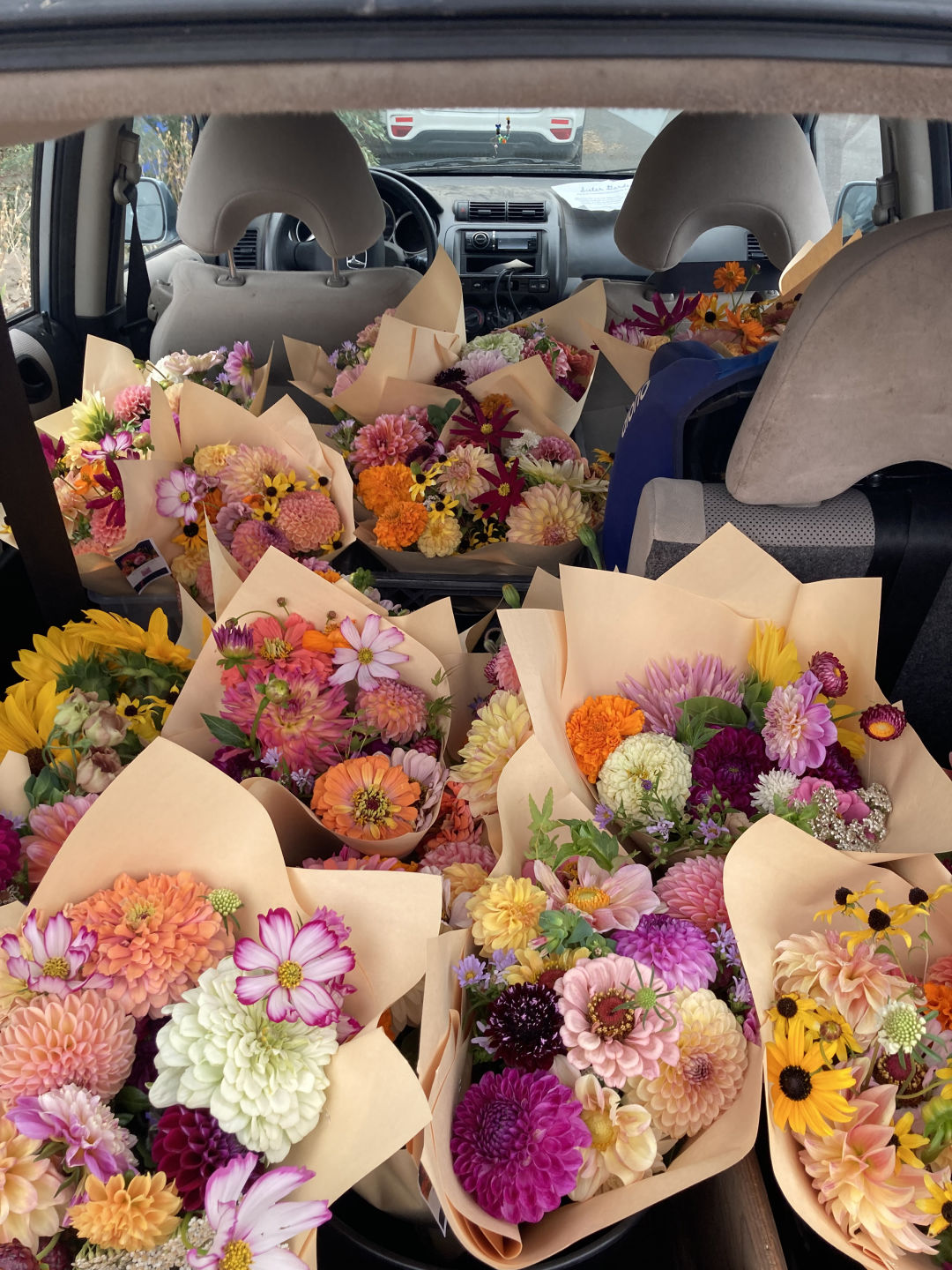
The garden was likewise a respite for Blanca García-Rinder, who grows at home in Rose City Park and at a friend’s larger lot in Montavilla. Garcia-Rinder launched Sister Garden Flower Farm in 2024 after apprenticing at a flower farm on Sauvie Island, and she offers weekly and biweekly options running from early spring through fall. She also sells at the Rocky Butte Farmers Market.
It’s the first season for Laura Jennings of L Spring Farm, which sits on about a quarter-acre on Sauvie Island. Her CSA is biweekly; spring bouquets (beginning early to mid-April) will include ranunculus, tulips, daffodils, larkspur, sweet peas, and snapdragons, while summer bouquets (beginning early to mid-June) will bring sunflowers, zinnias, cosmos, marigold, and giant poppies. Observes Jennings: “Flowers are kind of having a moment right now.”