In Antelope, Oregon, Light Breaks Through
Image: Joseph Laney
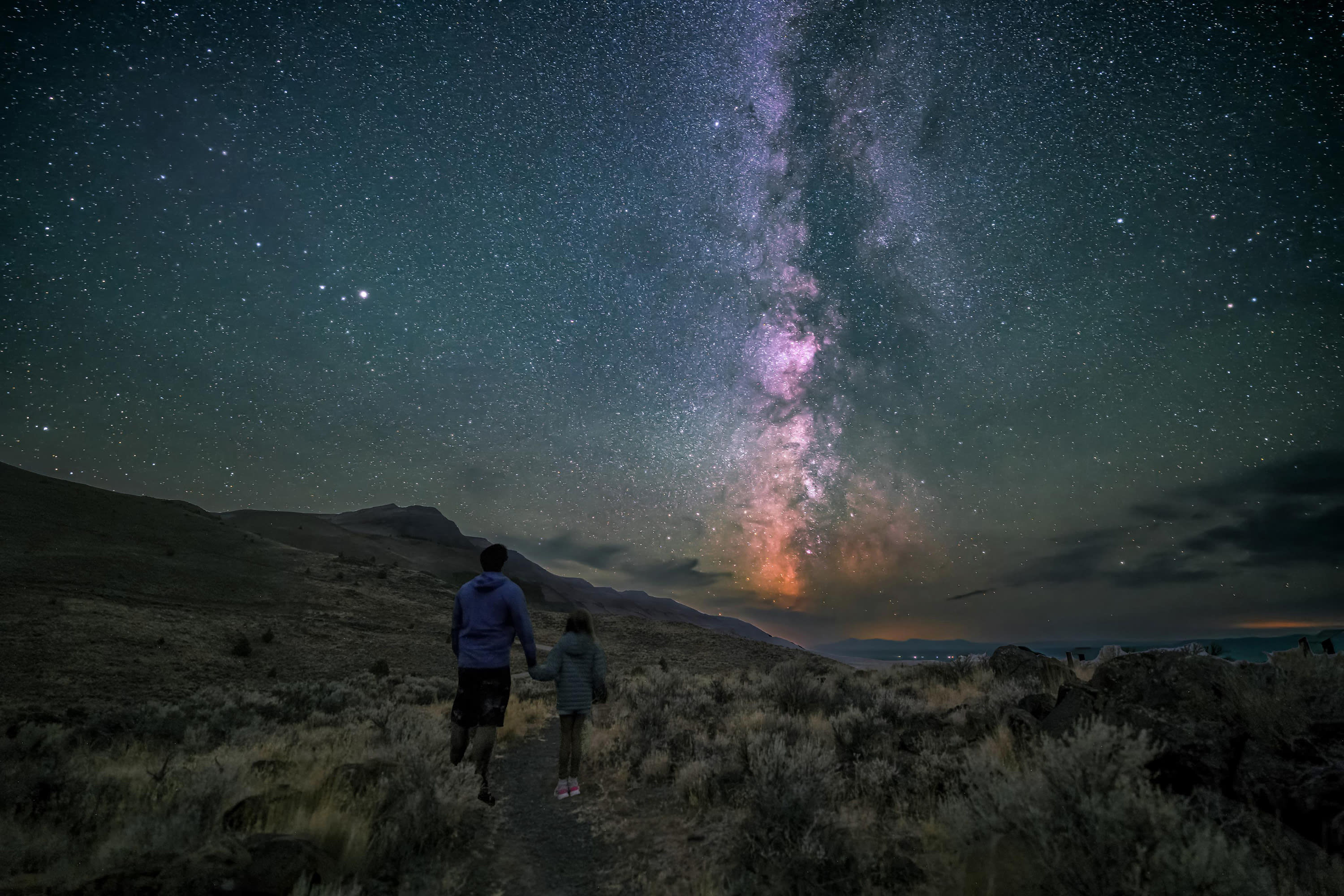
I came to Antelope for darkness, but it was a bright, windy spring afternoon when I steered into the 37-person town. I had hours to kill before sunset, so I decided to take my dog for a long walk. In 2024, Antelope was certified as the first “International Dark Sky Community” in the state, meaning the town has protected its night sky by adopting certain lighting standards, removing nonessential streetlights, distributing approved outdoor bulbs to residents, and committing to an education and outreach campaign. True dark sky registers as a 22 SQM—sky quality meter—on the Bortle scale, which measures light pollution; Antelope is at 21.62. “You can see the fog of the Milky Way,” local resident Nick Nims told me. “Last winter we saw the northern lights. The views are crazy.”

Image: Courtesy Antelope Basecamp
Some of my finest memories have been staring into the night all around southeastern Oregon, craning my neck, thinking about my existence, reveling in how the longer I stare into everything above me, the more I see. I jumped at the chance to see the stars over the much closer Antelope, about 75 miles south of The Dalles. Opened in January 2025, Antelope Basecamp is the project of a local ranching family who were instrumental in the community certification and also secured the first dark sky lodging designation in the state. It offers stargazers 10 A-frame cabins, plus sites to set up a tent or park an RV.
I’m the sort of person who is drawn to all varieties of darkness, so I’d come to Antelope before. There is nowhere to spend money: no store, no restaurant, no gas station. But a few years ago, after backpacking along the John Day River, I had stopped in to see Antelope’s lone plaque.
At the base of a tall flagpole, it reads “Dedicated to those of this community who throughout the Rajneesh invasion and occupation of 1981-1985 remained, resisted and remembered….” and quotes Edmund Burke: “The only thing necessary for the triumph of evil is for good men to do nothing.”
Antelope chooses to memorialize the time darkness came to town, when there was a tug-of-war over who owned the place. It was the time local people planted their feet and yanked their town back.

Image: Leah Sotille
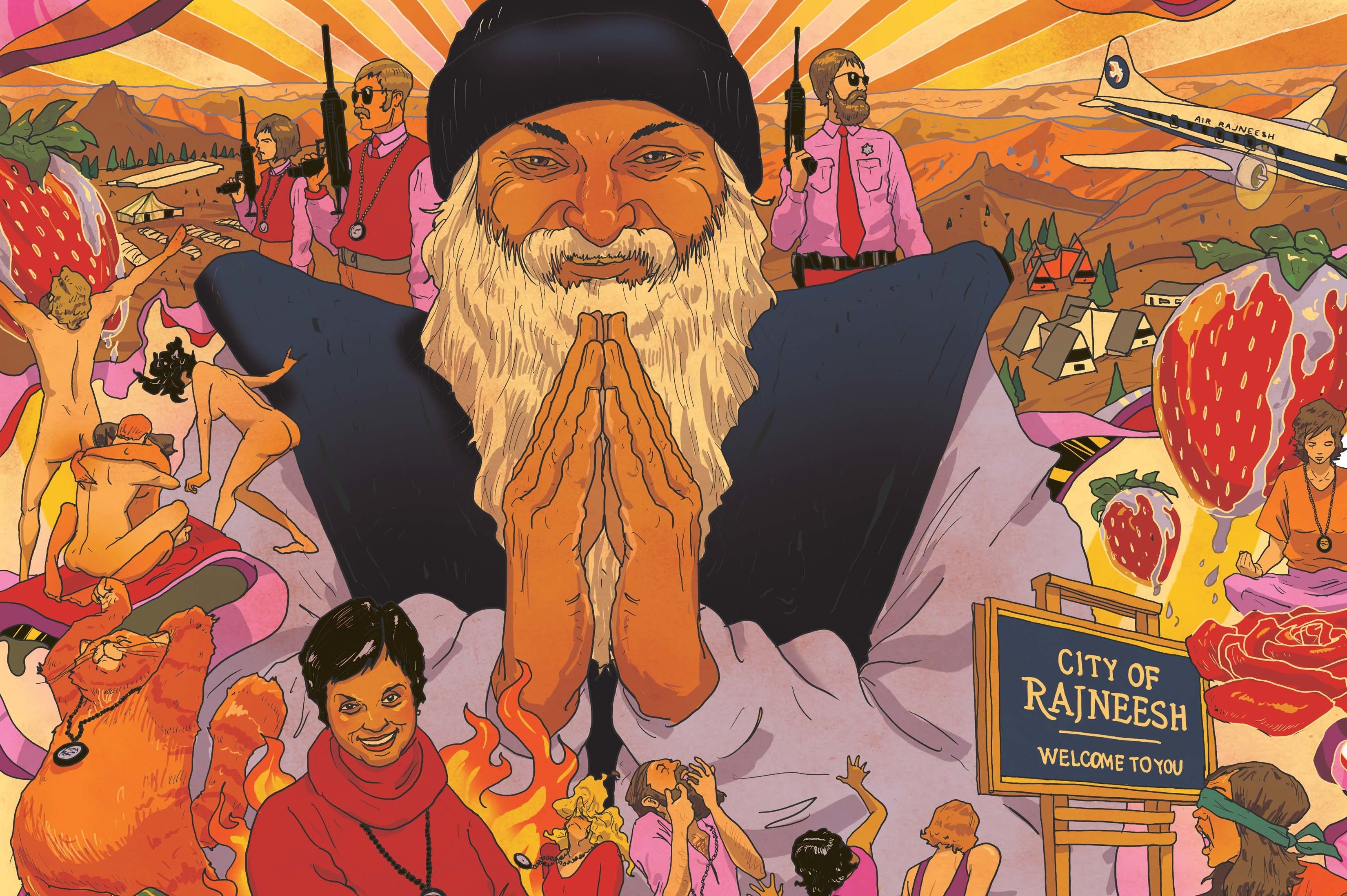
Like absolutely everyone, I watched Wild, Wild Country, the 2018 Netflix docuseries about how in the mid-1980s, under the direction of the Indian spiritual leader Bhagwan Shree Rajneesh, his red-clothed followers—called sannyasins—purchased a large ranch near Antelope to create their utopia. Then they overtook Antelope’s government and school board, renamed it Rajneesh, put up new signs at the entrance to town, opened a restaurant, and splashed the historic school in jaundiced green paint.
Rajneesh and his deputies redefined hypocrisy—preaching saccharine, unwavering positivity as they attempted to poison Wasco County’s water supply to sicken people and sway local elections. They smiled and meditated and bred salmonella in a lab, then used it to contaminate food in restaurants in The Dalles. They planned assassinations of state officials and plotted to kill sannyasins in their own ranks. They preached freedom as every corner of Rajneeshpuram, including the guru’s own home, was surveilled with hidden microphones. He lived in splendor, his followers in tents. Rajneeshpuram was a plainly fascist community desperate to convince the world it was a utopia.

Image: Leah Sottile
On my long walk through the small grid of Antelope’s streets, I tried to wrap my head around how a place where the loudest sounds are cooing mourning doves and rustling grasses was the stage for so much fear.
As I walked, I realized that despite all the quiet, the people of Antelope had something to say. A sign on a shuttered red and white café read “Private Property, No Trespassing.” Down Main Street, a burnt orange house behind a thicket of bushes showed “No Trespassing, Keep Out.” On the gate of a brown house, a sign read “No Peddlers.” On a brick house: “Private Property, Keep Out.” A patch of three-foot-high grass was surrounded by a chain-link fence: “No Trespassing,” a sign warned. On a slouching building, a placard proclaimed “You Matter,” and offered a suicide hotline; two signs also read “No Trespassing.”

Image: Leah Sottile
The 37 people of Antelope have put up 48 “No Trespassing” signs. I couldn’t help but think of them like scar tissue.
John Silvertooth—the overalls-wearing star of Wild, Wild Country—told me those are because of people coming to town and thinking homes and buildings are abandoned. “People, they get on this side of the mountain and they think they’ve arrived in the free zone where they can do what they want,” he says.
Nims, a newer arrival to the town, sees it as a holdover from the takeover. “Some of the folks remember the Rajneesh cult problem, and that’s still, in their eyes, a pretty fresh wound,” he says.
“The two are intrinsically linked. You can’t talk about Antelope without talking about the Rajneesh problem. Like anyone’s personal traumas it’s important to acknowledge that scar, but grow past it,” Nims says. “There’s difficulty growing past it.”

Image: Courtesy Antelope Basecamp
When night fell over Antelope, so did a storm. I popped the back of my Jeep and sat in it with my dog, boiled water for dinner, and watched the storm clouds gallop in like a team of horses.
Inside my A-frame, a heater ticked in warmth. The cute little triangle buildings, which each have a pair of twin beds and rent for $40–60 a night, are leftovers from Rajneeshpuram, and think about how this very one likely had a microphone inside. Used in the intervening years by the Young Life church camp that now sits on the old Rajneesh property a few miles away, they have been moved, updated, refurbished, and painted black on the outside. Inside, I switched off the light to get a look at the sky out the window, but clouds blocked the stars.
I read a book, then went to sleep, rain pelting the roof.
Of course, at 2:30am I woke up and had to go to the bathroom. (I’d gotten carried away with the complimentary tea the basecamp offered, and I am a woman in my mid-forties.) I zipped on a jacket, tied my boots, put my dog on his leash, and opened the door.

Image: Courtesy Antelope Basecamp
Everything in my vision went red—the color of the Rajneesh cult. I was half awake, and it jolted me. It took me a moment to register that Antelope Basecamp at night goes red. Above the door of each A-frame, a red bulb glowed. Red light keeps the sky dark.
In all that red, I could see everything clearly. After I went to the bathroom, my dog sniffed the ground, dragging me past the reach of the basecamp lights and into the deep black night, searching for a place he could pee, too. I looked up and couldn’t see a single star, but it was amazing. Silent. I’d taken nighttime walks in the forest before, but out there in the wide desert I experienced a new depth of darkness, like the earth had merged with the cosmos and I was walking in the night sky itself.
When I turned around, the basecamp glowed, beckoning. A tiny heartbeat thrumming in the center of Antelope, a little red town slowly, surely taking itself back.