An A-to-Z Guide to Portland Grocery Stores
Looking back at more than a century of the grocery game in Portland, a lot has changed and a lot hasn't. Many stores today are in spaces that used to be different stores, mergers and consolidations are hardly a recent trend, and every old or long-lost favorite was once a newcomer.
For most every letter in this A-to-Z rundown, we could have just as easily featured a different store: the recently departed City Market or Strohecker's, the on-the-rise Market of Choice, Gresham's farm-focused Growers Outlet, Southeast standby People's Co-op, or the Portland-founded, now Korean-owned New Seasons. What follows is simply a sampling of where we shop, yesterday and today.
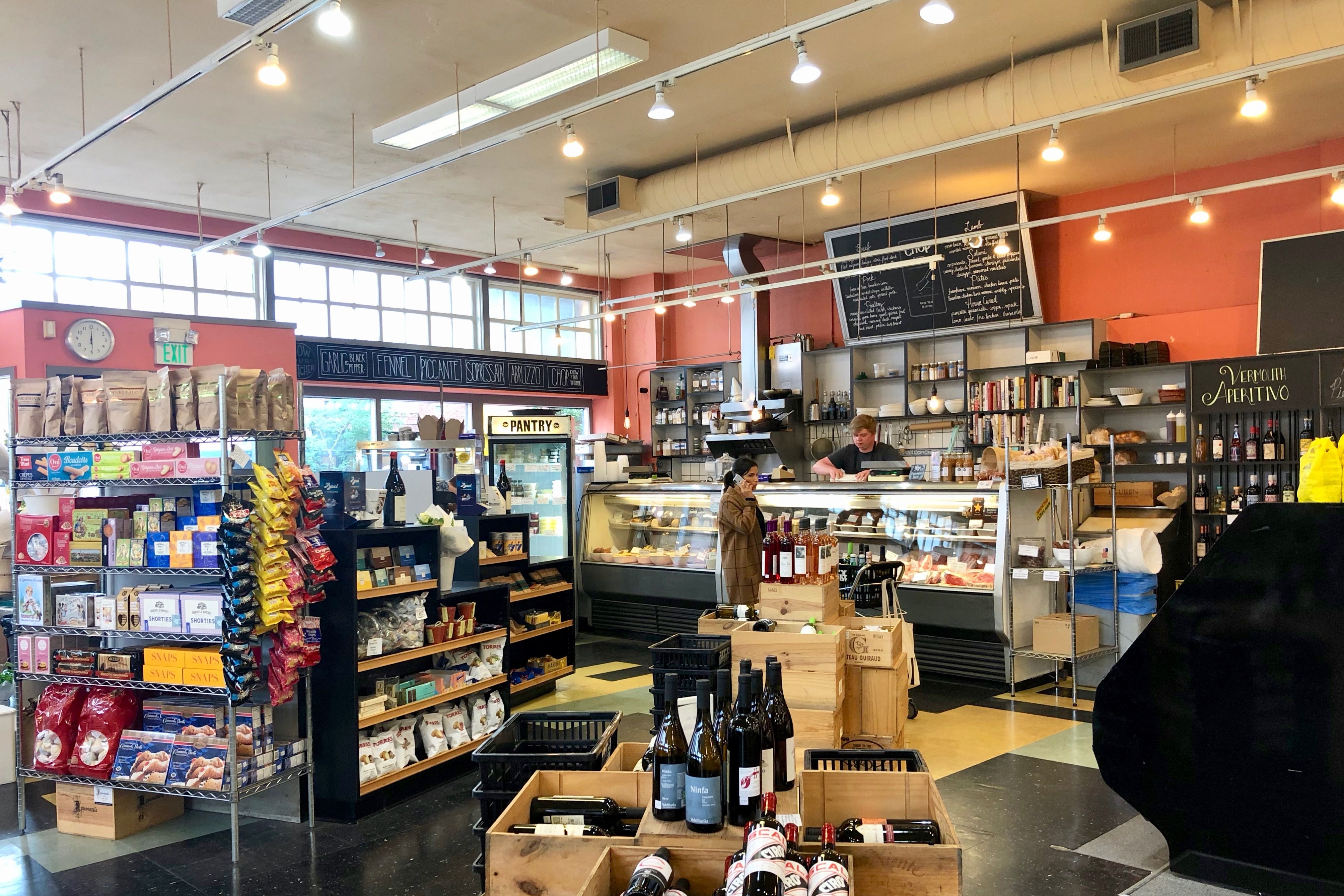
Above: Rubinette’s Josh Alsberg, at his produce stand inside Providore Fine Foods.
Anzen
Founded in 1905 in Nihonmachi, or Japantown, the shop then known as Teikoku Company was shuttered and liquidated by the City of Portland after the Pearl Harbor attack. In 1946, after being separated and sent all over the US in various stages of incarceration, Umata and Fumi Matsushima restarted the shop with a new name. Anzen moved across the river in the 1960s and advertised itself as a way to “tour Japan” and “taste the Orient.” It closed in 2014 when Umata and Fumi’s son Hiroshi Matsushima, a toddler when he was sent to the Minidoka, retired.

Image: Michael Novak
Barbur World Foods
This Southwest store was once plain old Barbur Foods, a neighborhood staple that held occasional contests to get more people in the door, giving away dinner for eight at nearby Henry Ford’s or a weekend at the Shilo in Lincoln City. But its inventory was nothing special. Since John and Mirna Attar took it over in 2004, there have been some additions: house-packed makrut lime leaves, Ya Hala desserts (the Attars own the Montavilla restaurant off SE 82nd, too, and a relative runs the adjacent La Bouffe market—see 82nd Avenue entry under E, below), a stunning olive selection in the condiment aisle, and pain au lait sandwiches and Lebanese meat pies filling the deli case. A World Market in the Pearl and a Barbur Foods in Concourse E at PDX expand the reach, but this namesake is the mother ship.

Image: Michael Novak
Cherry Sprout
There’s a long story behind the rooftop root veggie on the former Big City Produce, involving a “free carrot” listing in Tacoma, a truck, and a few people in bunny costumes. The short story? “It was a gift,” says Nick O’Neill, who has owned Cherry Sprout in Humboldt for the past decade. With produce, pantry staples, beer, wine, and even Boom Boom Balloons piñatas, it’s the kind of store there used to be more of. People come in and say, “I wish this was in my neighborhood,” O’Neill reports, as he explains how a small market stocking essentials is “one of the most difficult businesses you could ever do. We’ve been really blessed with built-in customer support that has grown with us. I don’t spend any money on marketing. We’re as tight and bootstrapped as you can be.”

Image: Michael Novak
Deals! Discounts! Detours!
Bryan M. Vance didn’t set out to become a grocery guru. He was just a little bit suspicious, having noticed that some items at the QFC he could walk to were different from what he saw at Fred Meyer, even though both were owned by Kroger. He was also hoping to stretch his dollar, as Portland—especially Sellwood, where he lived then—had a much higher cost of living than where he’d moved from.
“I started a spreadsheet of everything that I regularly bought,” he says, and for a month he logged prices at stores including Fred Meyer, New Seasons, and WinCo. “That’s when I realized I could walk to QFC, but I was gonna pay like 20 percent more for literally the exact same thing,” Vance says. “It was a convenience tax.” Going a little bit out of your way or your regular routine, he learned, could pay off.
That spreadsheet became Stumptown Savings, Vance’s website, news outlet, and online community where he gathers weekly specials at more than 20 local stores. He publishes a list every Thursday, pulling out the best deals of the week and the cheapest current place to get a dozen eggs, a gallon of milk, and other staples. Paid subscribers in his Savers Club can access even more details and be invited to members-only events. He also runs blind taste tests with local food writers for things like supermarket sushi (“One clearly won. One got spit out.”), store-brand seltzer, and rotisserie chicken.
The chicken winner, WinCo (see W, below), is Vance’s go-to. For sheer price, he’s also a fan of closeout stores like Daily Deals. “Just because it’s closeout doesn’t mean it’s old produce. It often means that a supplier had way too much, Fred Meyer and Albertsons wouldn’t take it all, so they’re able to buy it at a discount and sell it at a discount.” It’s hard to predict what a closeout store will have, he says, but “if you’re willing to go in there with an open mind and not really a set list, you can save a lot of money.”

Image: Michael Novak
82nd Avenue
Fubonn wasn’t the first Asian market on SE 82nd Avenue when it opened in 2006, but its sheer size and role as the anchor of a shopping center catering to Portland’s Asian communities marked a noticeable shift in the city’s geography. In the 20 years since, downtown’s Chinatown has seen more longtime businesses close, while the Jade District (so named in 2012) along 82nd continues to welcome markets offering many groups, not just Asian immigrants and their descendants, a taste of home. Here are just a few of them, from north to south.
Hồng Phát (101 SE 82nd Ave) Opened in 2013 in a former Safeway, this utilitarian Vietnamese grocery has a killer grab-and-go banh mi lunch special.
La Bouffe (8015 SE Stark St) This gourmet market is lined with tinned fish, tubs of labne, frozen pierogi, French cookies, and a small but impressive bulk section, with a table of olive oils to sample.

Image: Michael Novak
BooHan (1313 SE 82nd Ave) Cute and curated, this long-running “Oriental Market,” as its sign announces, boasts an impressive range of miso, garden seeds, and frozen Korean street snacks.
China Foods (1414 SE 82nd Ave) Largely a restaurant supply, this dimly lit warehouse is stacked with giant rice sacks, paint cans of sesame paste, and five-gallon buckets of soy sauce.
Chang Fa & Tin Seng (8310 & 8350 SE Division St) These side-by-side stores on Division just off 82nd sport seafood tanks, prepacked fresh meat, and a behind-the-counter array of Chinese herbs.
Fubonn (2850 SE 82nd Ave) This giant supermarket with an impressive kitchenware selection sits at the end of an arcade of dress shops, K-beauty counters, massage chairs, and giant claw machines.
Good Neighbor Market (4107 SE 82nd Ave) Find Eastern European chocolates and bags of salami-flavored, Pringles-shaped Ukrainian melba toasts, plus a butter selection to rival any high-end gourmet grocer.

Image: Michael Novak
Hồng Phát Supercenter (4200 SE 82nd Ave) This giant grocery attempts to fill the square footage of an old Walmart with a Chaos Shop in back selling electronics, toys, and home decor, plus the widest aisles in town.
SF Supermarket (5253 SE 82nd Ave) A huge meat counter and tanks of live shrimp and tilapia line the back wall of an old Fred Meyer. The frozen dessert aisle is a serious destination.
Villas Market (9515 SE 82nd) An old bowling alley houses a market, a hot lunch counter, and a panadería selling telera rolls and mini mantecadas.
Daily Deals (9907 SE 82nd Ave) On any given day, the shelves of this closeout store might be full of Greek crackers, grape soda, Romanesco, watermelon, or some very random personal care products.

Image: Michael Novak
Fred Meyer
Born Fred Grubmeyer in 1886 and shortening his name amid the anti-German attitudes around World War I (would locals talk about shopping at Grubby’s as eagerly as we do about Freddy’s?), Portland’s undisputed grocery titan got his start with a horse-pulled coffee cart. Meyer expanded to commercial real estate and launched into the grocery world in 1922, with a store downtown at SW Fifth and Yamhill. In the next decade, he opened what’s sometimes called the world’s first self-service drugstore, set up portable canneries to help supply his stores, and established Portland’s first “suburban” shopping center in the Hollywood neighborhood, across the street from the then-new movie house. The “one-stop shop,” with lots of nonfood departments and a rooftop parking lot, became a model not just for other Fred Meyer stores but for supermarkets as we know them today. Eventually expanding to Washington, Idaho, and Alaska, the company was bought by Kroger in 1998 but maintained its local name. Meyer himself died in 1978, at age 92.

Image: Tuck Woodstock
Green Zebra
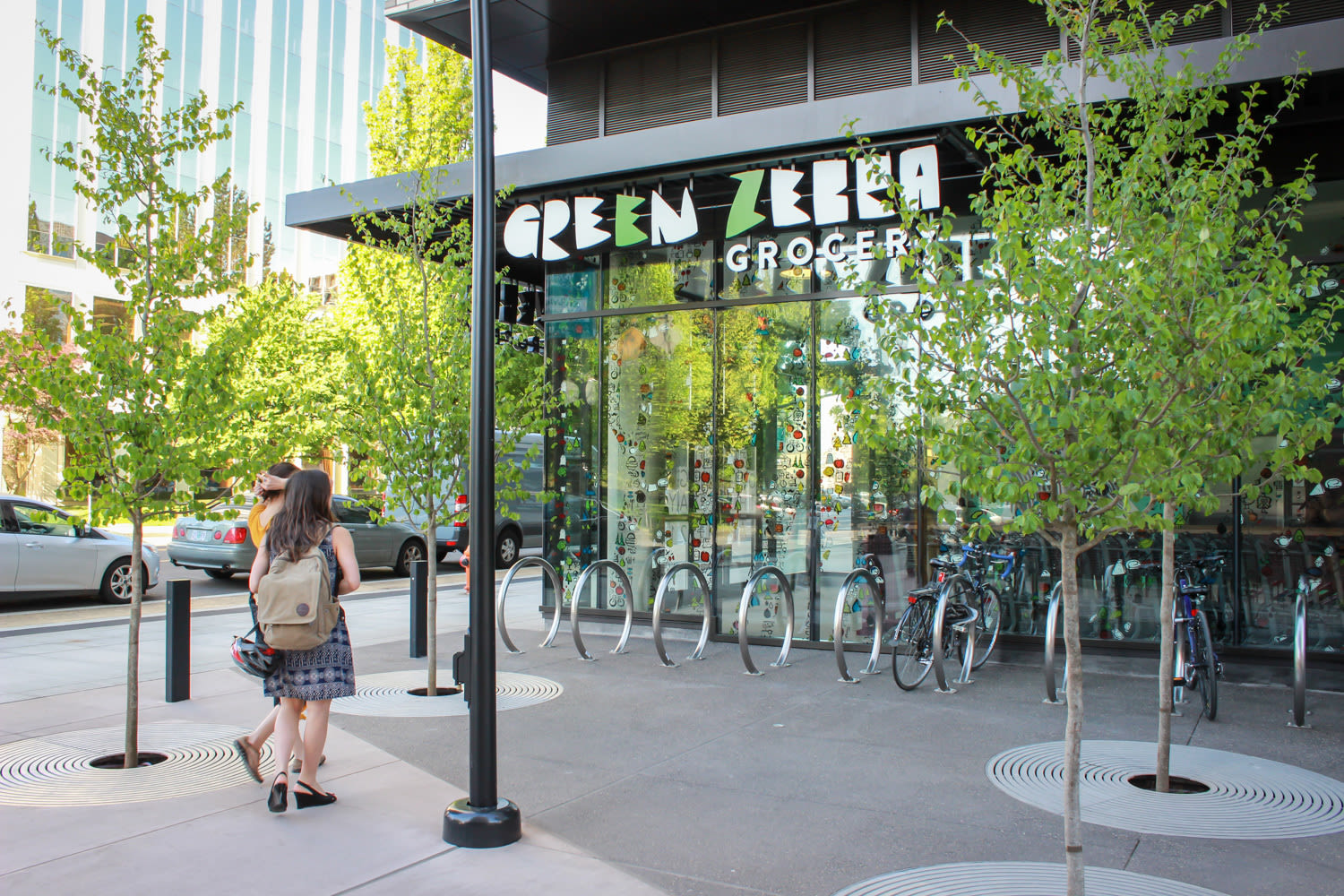
Looking back on the decade run of her microchain of healthy convenience stores, Lisa Sedlar has “nothing but gratitude in my heart.” The team that opened the first Green Zebra, in Kenton, is still a tight friend group. Later stores in the Lloyd District and near Portland State catered to people grabbing something on their lunch hour or between classes. The fourth, complete with a nacho bar, opened on a busy Southeast corner in February 2020. Pandemic shutdowns, remote work, and online classes soon took a toll, while rising costs for labor and just about everything else led to the chain’s closure in 2023. (The Kenton building is now a McDonald’s.) “We were seeking to redefine what it means to be a convenience store in America,” she says today. “Is that concept still relevant? Absolutely.”

Image: Michael Novak
H Mart
Started by a Korean immigrant on a corner in Queens in the 1980s as Han Ah Reum (translated as “an armful”), H Mart started spreading to the West Coast in the 2000s, including a Tigard location that opened in 2008 and dazzled an Oregonian writer with its “wall o’ kimchi.” Center-city dwellers were thrilled when H Mart announced in 2017 it would open another location in the old Zupan’s in the Belmont Dairy. But they were less thrilled with the nearly two-year wait for the store to finally open.

Italian Produce Merchants
When the local-food-focused, Eugene-based chain Market of Choice opened at SE 10th and Belmont in 2017, it was something of a return to form. The site was long the HQ of an Italian farmers and growers co-op, though in recent years it became known (somewhat annoyingly, to local Italians) as the Goat Blocks thanks to a brief residency of some brush-clearing ungulates. Grocers and restaurateurs would come there and to businesses along nearby Produce Row to buy farm-fresh items, often trucked in before dawn. One of Produce Row’s most recognizable businesses, Corno’s (pictured above), closed in the 1990s; one of its longest-running, Sheridan Fruit Market, closed this year.
Johnson Street Grocery
After a few years of farming in Sherwood, Shuichi and Yae Goto Murakami, originally from Japan, moved to the city in the 1920s and opened a small grocery at the NW 23rd and Johnson. (The corner was later home to a series of taverns and a Music Millennium; it’s now the Fireside.) Their kids worked at the shop, too, running errands and waiting on customers when they weren’t at school or the pool or the baseball diamond. In 1942, when the government sent people of Japanese descent to concentration camps, most of the family landed at Minidoka before being hired out to work at a cannery in Utah, where they stayed after the war. Only one son came back to Portland.

Kienow’s
Minnesota-born Daniel Kienow, whose family moved to Portland when he was a kid, was more than a decade ahead of Fred Meyer when he opened his first store in inner Southeast in the early 1900s. Like Fred Meyer, it turned into a booming enterprise for much of the twentieth century before a sale in the 1990s. Unlike Fred Meyer, the new owner leased out most of its stores to other chains, and the last Kienow’s, in King City, closed in 2000. (The Walgreens on N Lombard and the Zupan’s on W Burnside are in old Kienow’s spaces.) Its dozen locations, advertised as “the friendliest stores in town”—sound familiar?—loom large in the memories of older Portlanders, who rhapsodize about treats from the in-house Bohemian Bakery.

Image: Michael Novak
Lily Market
“Coconut milk, we sell a ton. Fish sauce, all the staples,” says Saysana Jeung, the youngest of 11 siblings, most of whom have put in time helping out at the family-run Gateway grocery that used to be one of the only places in town to find such things. Now in its fifth decade, Lily leans Thai, with huge bags of pad Thai noodles in the cooler and jars of dried fish snacks on the shelves, plus a popular lunch counter selling house-packed nam prik chile paste, and grab-and-go chicken larb. But it also stocks Ukrainian sodas, Korean frozen desserts, Filipino snack mixes, and Italian ladyfingers, along with an entertainment section that includes audiocassettes and VHS tapes.

MacMarr
This Spokane-founded chain arrived in Portland via a merger with Twentieth Century, whose owner, Ross McIntyre, told The New York Times in late 1928 that the next year was sure to be a great one for national prosperity. MacMarr was eventually absorbed by Charles Merrill and the growing Safeway group but kept its own name for a while due to some beef Marr and McIntyre had with the owner of another chain in the group. Its locations included what’s now Pets on Broadway and (above) Community Warehouse on MLK.

Image: Michael Novak
99 Ranch
While it might sound like a westernwear outfitter, 99 Ranch calls itself “your favorite pan-Asian grocery.” Founded four decades ago in California by a Taiwanese immigrant, it opened a Beaverton location in 2017, with a Northeast Portland store following last summer, just east of Mall 205. With well-labeled aisles and bright lights, walking around the store can feel like you’re in a Fred Meyer—except a lot of the vegetables are wrapped in plastic, lychee and durian are given pride of place among the fruits, the doughnut cases are full of moon cakes, more fish heads and whole fish are displayed in the meat cooler, even more claw machines line the entryway, and you’re likely to spot Hello Kitty on the toilet paper.

Oregon Groceteria
Today, most every market is a “groceteria,” where customers grab items themselves, cafeteria style, as opposed to placing an order at the counter. But in the early twentieth century the concept, which requires less staffing and can lead to lower prices, was still novel enough to be noted in a store’s name. Started in 1919, this chain of groceterias run by the Eriksen family had more than a dozen locations around town by the 1940s. Four of them were in Vanport City, the bustling workforce housing insta-town in North Portland that was Oregon’s second-most-populous city for a time, though it was never officially incorporated. When the Columbia River broke through a railroad embankment on May 30, 1948, Oregon Groceteria was the business to suffer the most losses. It sought relief in federal court for the destruction of its business in the Vanport Flood, but it never recovered.

Piggly Wiggly
The name may be associated with the South and Driving Miss Daisy, but there were Piggly Wigglies here, too. Before a wave of groceterias copied the model, what’s considered the country’s first such self-service store opened in 1916 in Memphis, with a funny name. It was quickly franchised across the US and proved a hit with housewives, according to Time magazine. “Instead of dealing with salespersons, the customer tours the store with a large basket, makes her own selections from neatly-stocked shelves,” the 1929 article explained. Its success came “partly because of its novelty, partly because neat packages and large advertising appropriations have made retail grocery selling almost an automatic procedure.” One group of Oregon Piggly Wigglies was run by Henry Meyer, Fred’s brother; some merged with the Charles Merrill group that became Safeway. Music Millennium (above), RingSide, OK Omens, Nob Hill Pharmacy, and Fang! Pet & Garden Supply were among the many local Piggly Wiggly spaces.
Quickie Mart
Was the name given to the first 7-Eleven franchises that started popping up around town in the mid-1960s, when Simpsons creator Matt Groening was in grade school in Southwest Portland, an inspiration for Springfield’s Kwik-E Mart? Plenty of locals bought up franchises, with the promise of “handsome new stores” and a chance to “be your own boss.” Running a convenience store wasn’t all fun and blueberry Squishees, though: The location at N Killingsworth and Greeley was once robbed twice in one day.

Image: Jason Hill
Rubinette
Located in Providore Fine Foods, alongside Revel Meat Co. and fishmonger Two X Sea, produce market Rubinette is not a place you go to see if it has what’s on your list. You go just to see what it has, to let its rainbow wash over you. At one point in July, Rubinette had about 16 different berry varieties: raspberries, strawberries, blackberries, gooseberries, currants, blueberries…. “People would walk by, and you could see their eyes popping out of their heads, like, ‘Wow, I’ve never seen this kind of array before,’” says Josh Alsberg, who started Rubinette in 2016. He says he sources directly from more small farms than any other produce market in the region “to get the highest-quality produce at the peak of ripeness.” He aims to balance what’s available with what the shop can move, he notes, “making sure we’re paying a fair price to the farms so they can stay solvent.”

Image: Michael Novak
Supermercado
With stocked drink coolers, bags of Mexican mesquite charcoal lined up in front of the extensive meat cases, piñatas hanging from the ceiling, and frosted cakes ready to be written on Supermercado can outfit any party or backyard cookout. Or you can just swing by and eat there, with its hot food counter, taqueria, bakery cases full of pan fino, conchas, and bolillo rolls, and frutas stand slinging mango chamoyadas.

Image: Michael Novak
La Tapatia
A sign in the parking lot of this Rockwood institution announces that no auto sales are permitted in the parking lot, but a shopper might be able to pick up some tamales, tacos, or elote between their car and the main door. In addition to grocery aisles, inside there are cremería and tortillería stations, a Crayola-colored seating area next to smoothie and hot food counters, outdoor cooking supplies, and statues of parrots, pigs, pugs, and more.
Uwajimaya
Started out of the back of a truck in Tacoma by Fujimatsu and Sadako Moriguchi, Uwajimaya reopened in Seattle after the family was released from World War II–era incarceration camp Tule Lake. In 1998, the still-family-owned Japanese supermarket expanded to Beaverton, its first location outside the Seattle metro area. While it was a taste of home for the west side’s fast-growing Asian communities, the 30,000-square-foot market and attached bookstore felt like a grand adventure to many Portlanders who weren’t from Asian households. Even something as simple as rice or soy sauce was offered in more versions than a lot of early customers knew existed, while the preserved foods and snack aisles, meat variety, fish selection, produce, and cooking implements for sale prompted many home cooks to try something totally new to them.

Image: Michael Novak
Vegan HQ
Portland was already an easier place than most of the US to be vegan, but things got a lot more fun with the opening in 2003 of snack-forward Food Fight!, its exclamation point a fitting indicator of the vegan convenience store’s general vibe. While it no longer anchors a vegan mini mall at SE Stark and 12th (though the vegan Sweetpea Baking is still there), Food Fight!'s Gateway location helps keep Portland’s vegan cred high.

Image: Michael Novak
WinCo
“WinCo is weird. But it’s cool!” says Bryan M. Vance of Stumptown Savings. Vance’s weekly roundup of Portland-area grocery deals has sent a lot of locals on their first trip to the Idaho-founded, employee-owned chain, short for Winning Company. That weirdness includes not accepting credit cards at checkout, not really advertising, and not exactly staffing stores for the optimum customer experience (we’ve waited in some long lines). The cool parts? That all helps keep prices down, and most are open 24 hours. Vance says the bulk section is “the best place to get spices, but also grains, pastas, cereals…and their baked goods are really frickin’ good.”
X-Cel Food Store
Not to be confused with X-L, a longtime doughnut factory on SE 82nd, X-Cel was one of several businesses over the years in a space on N Minnesota Avenue before the construction of Interstate 5 (this stretch was at one point known as the Minnesota Freeway) led to the demolition of hundreds of homes and businesses and the displacement of thousands of Albina residents.
Young’s Cash Grocery
While claiming a business is “cashless” is considered the peak of modernity in the 2020s, a century ago the word “cash” in a store name meant it was keeping up with the times, taking payment at the time of purchase. The old way—noting charges in a grocer’s ledger and having customers pay at the end of the month or whenever they were able—might have been handy for someone waiting for a paycheck or a parent sending a kid to fetch groceries to charge to the family account. But it wasn’t a sustainable business model as grocery stores grew larger and more competitive. SE Division’s Young’s Cash Grocery eventually dropped “Cash” from its name, but in the 1930s it was worth warning Depression-era customers they couldn’t just put items on their tab and settle up later.

Image: Michael Novak
Zupan’s
With local Durant olive oil, Papa Haydn lemon curd tarts and carrot cake granola, Bui salad rolls, boxed sets of Sebastiano’s marmalade, bottles of Nong’s Khao Man Gai sauce, and collaboration beers with the likes of Little Beast and Ferment, Zupan’s can feel like a food version of a Made in Oregon gift shop. It can also feel like a reminder that there are people in this city making a whole lot more money and who might just pop in for $9.99 tubs of the store’s preserved-lemon hummus (which is delicious), $100 tubes of Iberico ham, and bottles of Veuve Clicquot. John Zupan worked at Sheridan and as a produce manager at Fred Meyer before cofounding the store in 1975 (son Mike Zupan is at the helm today), so it’s no surprise that extra attention is paid to the produce department, where a good pairing gouda or jar of almond butter might be sitting in the same case as honeycrisp apples, all ready to grab for a picnic.