The Rise of the Nature Sauna

Image: Courtesy Daniel Goers/Imzadi
Thin February sunlight filters through an overcast sky as I pad down a forest path. In the background, the steady drone of a river cuts through the silence. On its surface, this would feel like any hike on a chilly day. But instead of a hidden waterfall or distant summit viewpoint, the destination is much closer. Within a minute of leaving my car, I see a greenery-crowned, black-walled structure emerge out of the trees.
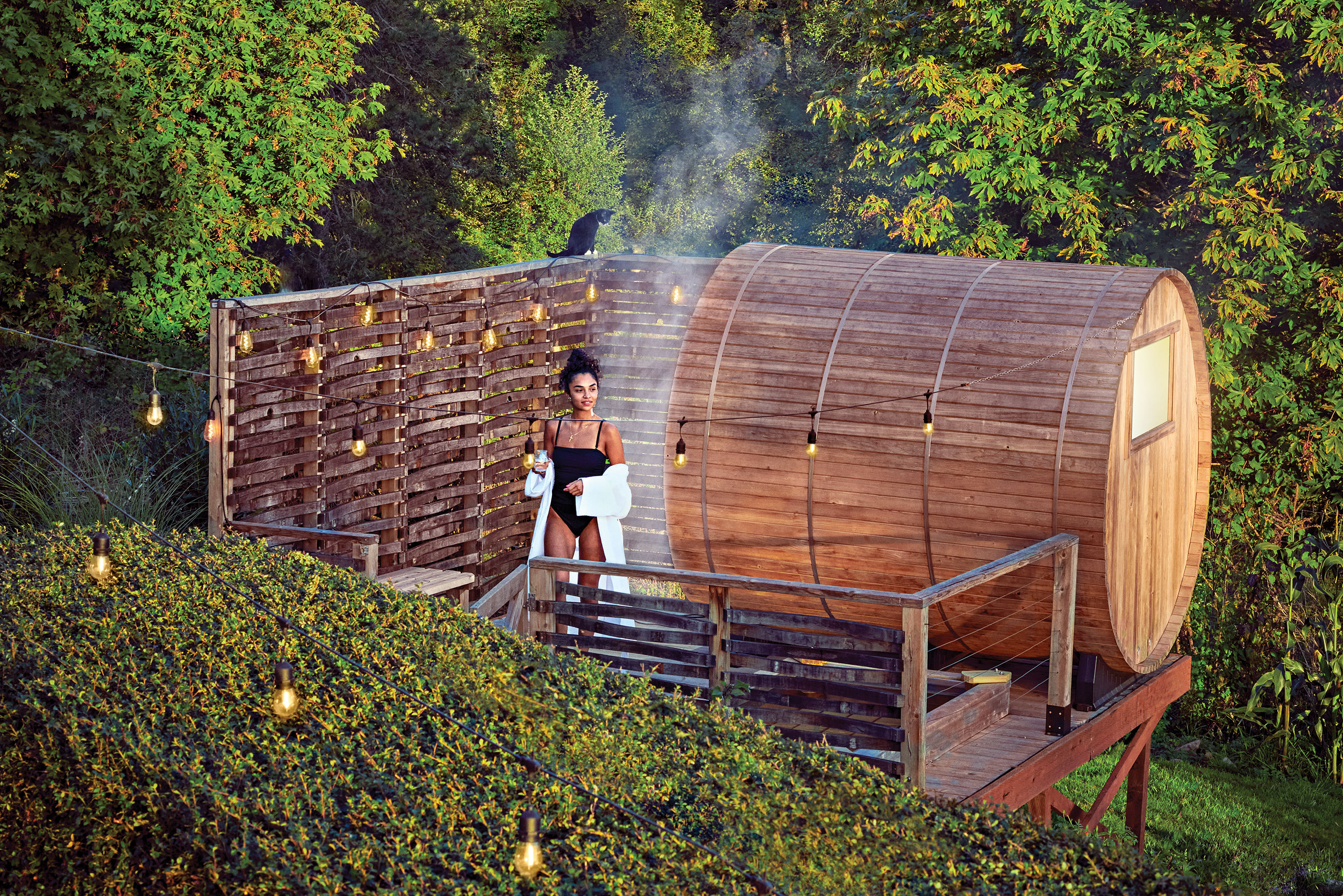
After being shown the ropes by the site owner, I’m left alone. Inside the cabin, I’m greeted by a wall of heat. Shimmying into my swimsuit, I climb to the top of a three-tiered bench and get comfortable. Warmth cocoons me as I gaze bleary-eyed out a floor-to-ceiling window. Ferns, mushroom-terraced logs, and moss-covered trees crowd the window’s edges, framing a view of the Klaskanine River at the foot of the hill. I can just barely hear the river’s murmurations, accompanied by the occasional sparking snap from the sauna’s wood fire. After I’m thoroughly warmed up, I make my way down the slope and wade into the frigid waters. Over the course of two hours, I repeat this process—heating my sweaty body before dousing it in cold. After a while, it’s the quiet that I notice. Not of the surrounding woods—those are alive with birdcalls, wind in the treetops—but of my mind.
I’m at Imzadi Sauna & Forest Spa, tucked outside Astoria with a roomy Finnish-inspired sauna, a bathtub cold plunge, lounge chairs, a restroom, and showers. Glimpses of buildings behind solid trunks and the odd hum of a car on the nearby road are my only reminders that I’m not deep in the woods. The forested setting brings a benefit that’s hard to find in a gym or home sauna, or even the mobile saunas that post up at city parks: a sense of being immersed in nature.
“[You] enter the forest through a long, meandering path,” Imzadi owner and designer Daniel Goers says. “There’s something about the process of transitioning to the space.”
Imzadi is one of a growing number of outdoor, nature-focused saunas popping up around Oregon and Washington. These outposts bring together the region’s wilderness with practices from across the world, ranging from Scandinavian sauna traditions to Japanese forest bathing.

Image: Courtesy Daniel Goers/Imzadi
“Social bathing is having a renaissance in the US,” says Mellington Cartwright, a.k.a. “The Saunalogist,” a Seattle-based sauna consultant, designer, and builder. In the Pacific Northwest, sauna traditions—particularly those from cultures that emphasize connecting with nature, as well as long-running Indigenous sweat lodge practices—have fertile ground to take root.
“The Pacific Northwest has such a beautiful tradition with our ecology,” says sauna carpenter Tucker Larson, whose company, Seattle-based Lögr Sauna Co., gets people off-grid on private, small-group guided excursions using mobile North Shore Sauna tents.
Then there’s the Nordic connection. Immigrants from Nordic countries moved here in droves in the late 1800s and early 1900s, opening saunas like Astoria’s Union Steam Baths. The region’s long, dark winters mirror those of northern lands as well; saunas provide a place for community, connection, physical health, and mental fortitude when the sun is a distant memory. “It’s a way to get through the winter,” says Cartwright, who is seeing a specific local strain of “small operators in natural settings…as a way to introduce bathing culture and get out into nature.”
A couple of hours inland from Imzadi, Highland Farms runs a six-seat Nordic spa with a wood-burning dry sauna, wet sauna, and cold plunge bath hidden in the woods at the foot of Mount Hood. Central Oregon has Gather Sauna House, a “wild spa” and mobile sauna that often sets up the banks of the Deschutes. Guests at Southern Oregon’s Tu Tu’ Tun Lodge sweat it out in a mirrored sauna overlooking the Rogue River. On Washington’s Long Beach Peninsula, Snow Peak Campfield features a hinoki cypress sauna, complemented by a forest-facing outdoor hot tub and cold plunge. Nearby Sou’wester Lodge has a rustic Finnish sauna fashioned from Port Orford cedar. The Olympic Peninsula’s SeaTsu Sauna calls itself a “Forest Bathing Sanctuary.”
While saunas often serve as gathering spaces, these particular retreats focus more on seclusion and serenity, designed to accommodate only a handful of guests and tailored around private, reservable sessions. The business model gives hosts a chance to guide the ritual or offer education and context, and it helps to prevent these natural sites from being overrun. Low- to no-impact designs, including mobile setups, center respect for the natural settings.
“Being a steward of this land is paramount to me,” says Goers.
At its core, sauna is elemental: fire for the heat, water for steam or cold plunging, wood and stone. By being out in nature, the ritual’s benefits, both mental and physical, reach deeper. In sharing sauna philosophies, both Cartwright and Larson reference a saying from sauna healer and researcher Laura Foon: that sauna comes from the forest and acts as a conduit to being in and communing with nature.
“The forest provides a link or a reminder,” says Cartwright. “It’s grounding in a primal way.”
Larson concurs: “Sauna is the medicine to modernity.”
In Finland, the sauna is often described as the “church of nature.” As I gaze absentmindedly out Imzadi’s window—deadlines tucked away into a corner of my mind, the fraught state of the world fading for a minute—I understand. I haven’t felt this at peace in a while.