The Mount Hood Stunt Bag Where Olympic Snowboarders and Skiers Train
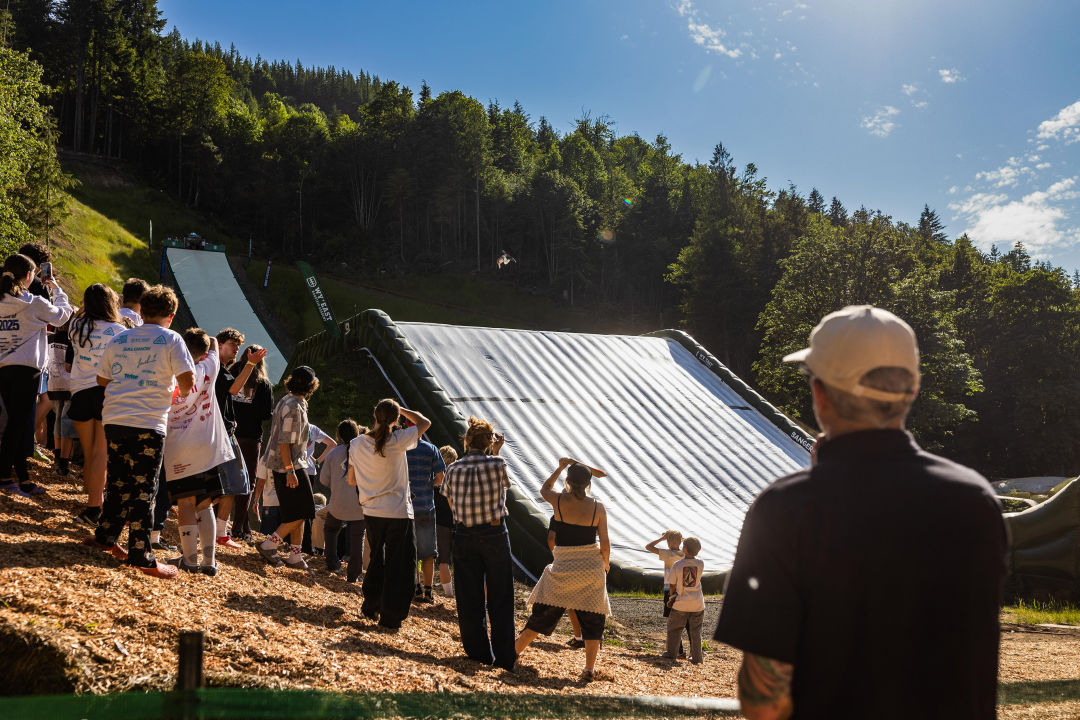
Image: Courtesy Wy'East Academy
By June 2025, as the mercury gauge in Welches tipped into the 70s and snow melted from mountaintops nationwide, winter felt long over. But the seasonal shift did little to slow retired snowboarder Shaun White. The three-time Olympic gold medalist grabbed his board and dropped onto a newly installed ramp at Wy’East Mountain Academy, the action sports boarding school tucked among the Doug firs at the base of Mount Hood.
“I’ve never ridden something like this,” White told Koin 6 that day. He’s an investor in Wy’East and an alum of the academy’s summer camps. "It was a first for me, and I don't get to say that much having such a long career in the sport."
White had just ridden an enormous inflatable airbag: a low-consequence training ground where elite skiers and snowboarders can finesse tricks before taking them to snow. Measuring 80 feet wide and 200 feet long, the airbag at Wy'East is the largest and first of its kind in North America. Airbags of this scale are still relatively rare, with comparable setups available only in Austria and Switzerland. Smaller versions exist at the US Ski & Snowboard headquarters in Park City and temporarily on Mammoth Mountain in California. Since this one opened last summer, a steady stream of Olympic athletes has slid down it, alongside academy students, ahead of this month's Milan Cortina Winter Games. (Where they will slide down mostly manufactured snow.)

Image: Courtesy Wy'East Academy
“There’s no other airbag in the world that’s open all year long,” says Troy Podmilsak, a big-air skier from Salt Lake City who’s on the US Ski & Snowboard team. “You have some kinks you need to work out, you can come here and easily do that within a week.”
Picture an inflatable stunt bag. In Hollywood, these stunt bags have long softened the impact of falls—off buildings, out of helicopters—that would otherwise be catastrophic. Around 2008, snowboarders adopted the concept, building early, flat versions that let riders jump, fall, and repeat—minus the bone-breaking risk. “Instead of landing on your head in snow, you may land on your head in air and you’re fine and you can walk away from it,” says Kevin English, Wy’East’s president and board chair.
As airbags evolved from flat landing zones into angled ramps that mirrored the arc of a jump, Wy’East brought several early versions to Mount Hood. They were massive—so heavy they required snowcats and entire crews to position and anchor—and even then, the wind often shredded them. Out of that frustration came a simpler dream: Give up on the temporary bags, and build one permanently into a hillside on campus.
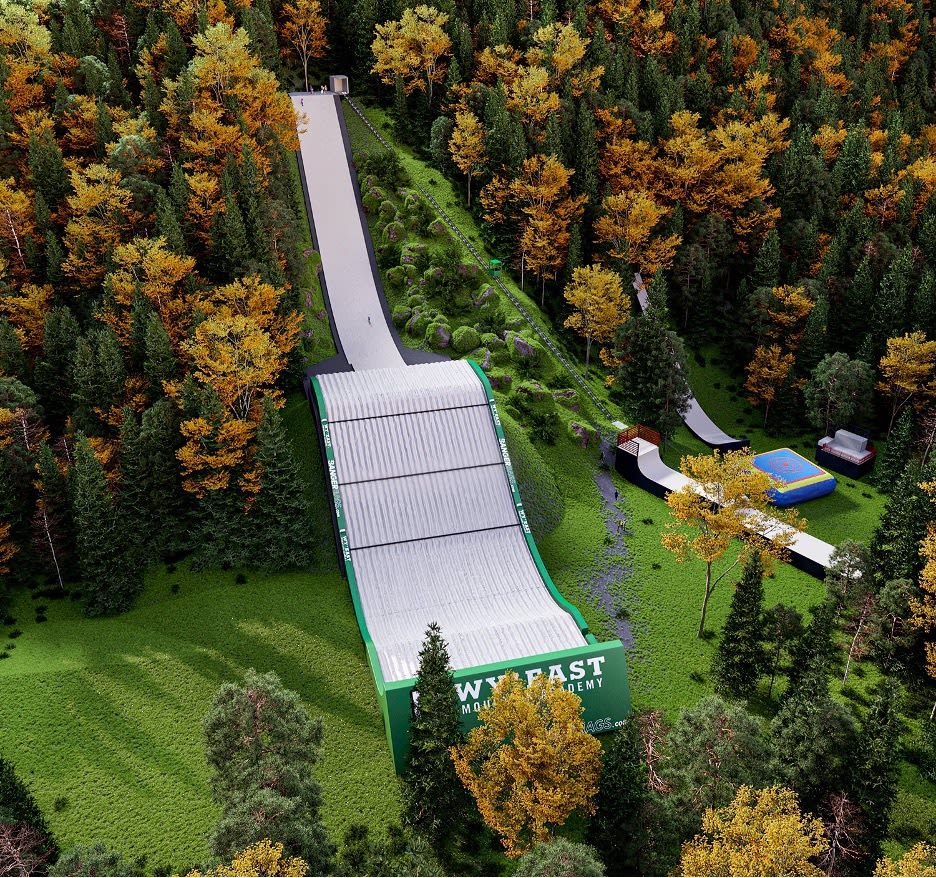
Image: Courtesy Wy'East Academy
As with many dreams, it wasn’t going to be cheap. Lucky for Wy’East, Ed Jaramillo—the generous parent of an academy alum and current board treasurer—donated a large portion of the nearly $4 million required to build the best possible. The school sought feedback from Olympic coaches, athletes, engineers, and architects, including a builder of Banger Park, the world’s biggest airbag park in Austria.
Like the ones at Banger Park, the bag in Oregon is made from a vinyl material covered in a dry-slope technology that English says looks like “little plastic Q-tips.” Ten to 15 centrifugal fans power the bag, and its stiffness is adjustable. A rider who’s perfecting a trick may want it a little firmer to mimic snow; if it’s their first time trying a trick, maybe they want it a little softer for a more forgiving landing.

Image: Courtesy Wy'East Academy
Another feature that sets the bag apart from others: The distance from the lip to the knuckle—in other words, the points where a snowboarder or skier enters the air to where they land—is adjustable from 35 to 50 feet. It’s a level of customization unheard of so far in airbag design, and no other bag in the world currently offers it.
Freestyle skier Nick Goepper, a 2012 Wy’East graduate whose return to the 2026 Olympics marks his fourth time at the Games, spent five days at his alma mater in September to hack his skills. “I only needed five days to get a month’s worth of practice,” he says. Rather than head to New Zealand or Australia (could be worse) to train during North America’s summer, he could hit the Wy’East airbag and spend more time at home.
With year-round snow on the Palmer Snowfield at Timberline, Mount Hood has a long-standing reputation as a development site for elite winter sports athletes. Every year, Olympic hopefuls and national teams carve snow together at the official US Ski & Snowboard training camps on Hood, while even younger athletes cut their teeth at the High Cascade Snowboard Camp and Windells freeski camp.
And now with the airbag at Wy’East, tricks that once took years to learn are getting dialed in between last period and dinner, even in a low-snow year. Since November, English says some little rippers have already progressed from throwing 720-degree rotations to full 1440s. That’s four full spins in the air, a trick that usually lands an athlete on a podium. Just imagine what wicked ollies, corks, and jibs Olympians will be throwing by 2030.