The Old-School Japanese Printer Bringing Portland Artists Offline
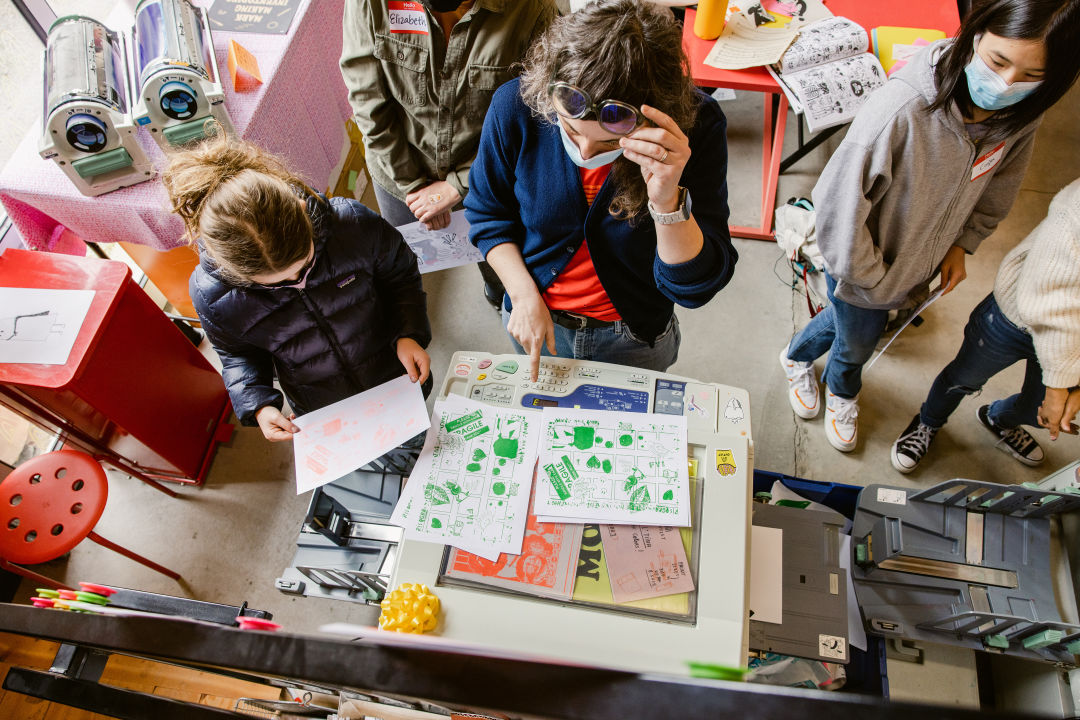
Image: Courtesy Outlet
Barbara is an RC6300. Born in 1993, she’s relatively old for a Risograph printing machine. She lived in a church basement in Beaverton until she was sold for $50 at an estate sale in 2013. A few years later, Barbara landed in the Kerns neighborhood at the Risograph print shop and studio Outlet—the shop’s first, though Outlet founder Kate Bingaman-Burt has since added three Riso sisters to the family: Janet, Corita, and Lil’ Tina.
Naming these machines is common, as each printer has a distinct personality. They are fussy, unpredictable, and temperamental. “Divas,” multidisciplinary artist Nia Musiba calls them. Musiba has made several runs of Riso prints at Outlet, based on their acrylic paintings, colored pencil illustrations, and cut paper drawings. Lil’ Tina, Janet, and Corita all excel at replicating pencil textures, watercolor washes, and pinpoint details (Barbara is mostly retired these days). But in contrast to more automated printing methods, you never quite know what any Riso will give you. Each print they spit out has a tactile, multidimensional finish. For Musiba, the mystery is everything. “Perfectly imperfect,” they say.
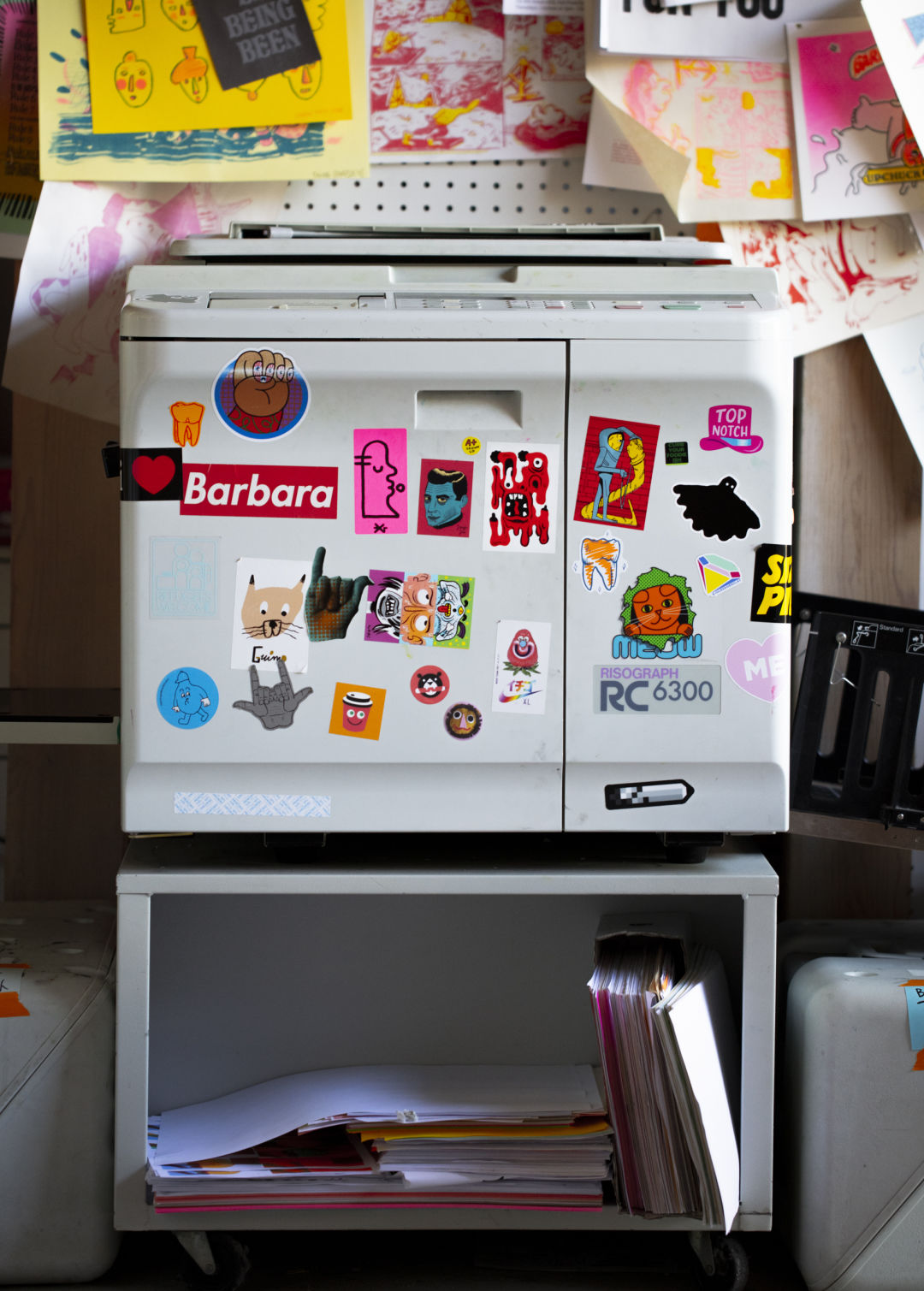
Image: Courtesy Outlet
Risograph printers work off stencils. Think of a screenprinter combined with an office copier. Though originally designed as a bare-bones office printer, instead of business memos, syllabi, and church flyers, the machines are more often used by artists today. The Riso’s rudimentary mechanics and ability to print a range of vibrant colors relatively cheaply make it an accessible alternative to more involved print-making processes like lithography, block printing, and silk-screening. Especially for graphic designers and artists working with computers, it’s also a respite from our hyperdigital world, a tactile bridge between realms of art and technology.
The Riso has joined the analog revival of turntables, film cameras, and typewriters as an exciting collaboration between handicraft and automation that challenges the relentless drive to digitize. You can’t simply send it a file. Because each layer is printed separately, multicolor prints require switching ink drums, creating new stencils, reloading the paper, and repeating the process for each layer; misregistration, where layers print slightly askew, is a signature quirk. All that tedium makes for prints with idiosyncrasies and one-off marks of making. “It’s yours,” says Bingaman-Burt. “Someone actually made it.”
Tokyo’s Riso Kagaku Corporation first introduced Risos in the 1980s and remains the only company in the world that manufactures them. In Japan, acquiring a machine and materials and performing regular maintenance is fairly straightforward. It’s more complicated in the US. Most stateside shops own secondhand Risos and do the upkeep themselves, or go on Facebook, Discord, or industry specific hubs like stencil.wiki for help. Riso communities have sprouted in New York, Dallas, Chicago, and elsewhere. Portland boasts its own colorful and active scene, with several studios and shops and prominent artists; much of Lisa Congdon’s work, for example, makes use of the Riso’s punchy palette, stenciled feel, and Xerox-like grain.
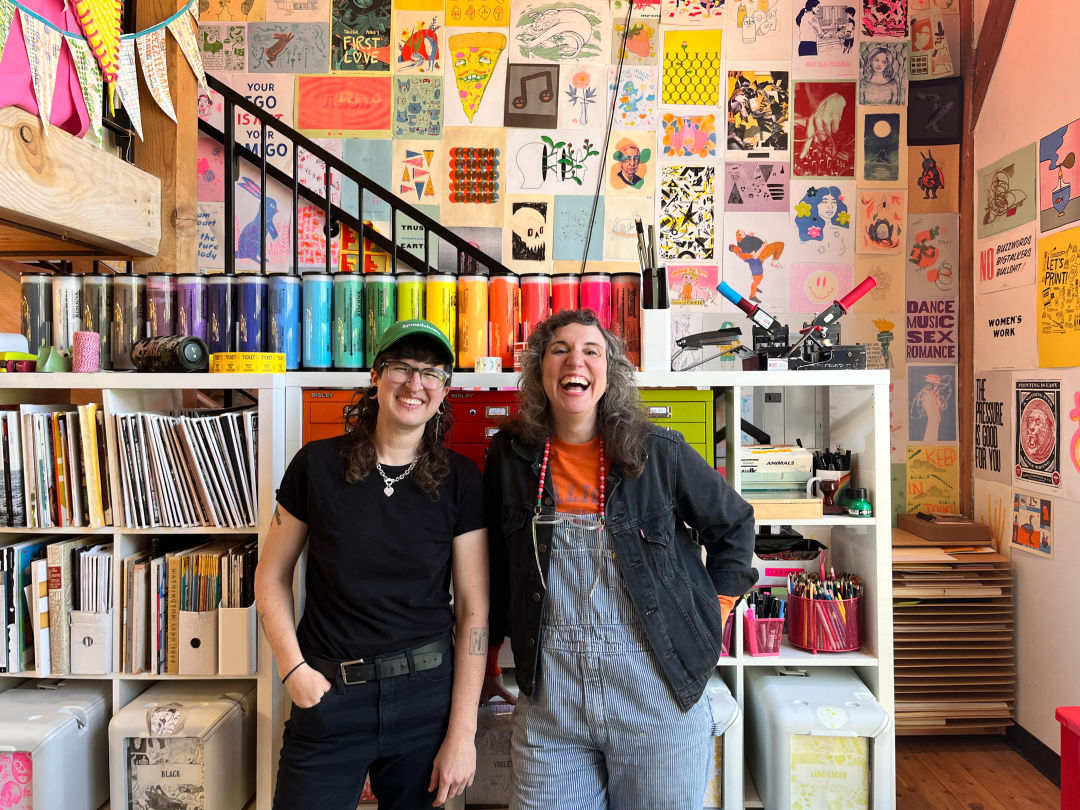
Image: Courtesy Outlet
Though the medium has amassed a cult-like following, it was a relatively obscure art form a decade ago. “If you went to art school after 2015, there’s a really good chance that you have used a Riso,” says Bingaman-Burt, who is also the associate director of Portland State University’s School of Art & Design. She opened Outlet in a former auto garage in April 2017. It gave its first Risograph workshop that August and has hosted two to three per month since. Every single one has sold out.
Outlet was one of Portland’s first Riso studios outside the university system. It caters to working artists and novices alike, holding studio hours for pros and demystifying the art through for newcomers. Increasingly, it’s also become a place to escape the omnipresence of screens. “We always hear this echo when we do the workshops, where people are like, ‘I’m just really happy to not look at my computer,’” Bingaman-Burt says.

Image: Courtesy Outlet
Risograph printing has only grown in popularity since 2017, especially in Portland. The medium surged during Portland’s 2020 protests, reprising another facet of the low-cost printer’s past—political and activist groups have historically used Risos to make large runs of posters and pamphlets. Since May 2020, Outlet has distributed thousands of free protest posters, flyers, and zines.
These days, Outlet isn't the only game in town. The Independent Publishing Resource Center opened a Riso studio in September 2017, with three secondhand GR3770s bought off a beauty supply distributor in North Portland. A few short years later, two more shops opened in town.
Sharita Towne and garima thakur founded Nůn Studios as a Risograph printing collective around the same time the pandemic hit. The Northeast Portland co-op celebrates activism and community organizing as well as experimentation and interdisciplinary approaches to Riso printing, pushing the tactile elements of the medium further with projects from artists like studio member ilish bath, who combines her ink drawings, digitized Hi8 home tapes, and family photos into Riso animations and digital projections. The co-op is also focused on working with marginalized artists, partnering with the IPRC on its re/source residency program for artists and writers of color.
While Secret Room Press has gone through various iterations since opening in 2019, including a backyard setup and a pop-up at the Lloyd Center, it opened its brick-and-mortar shop and art gallery on SE Division in March 2024. As a publisher, Secret Room has released 20 books—primarily comics, with the exception of a boxed collection of poems by cartoonist and poet Erin Tanner—all printed with Risos.

Image: Courtesy Riso Studio Arts
Riso Studio Arts PDX is the newest shop. Originally from Los Angeles, RSA opened its Portland outpost this June. It also offers introductory workshops, open studio access, and classes. But as an official US distributor for Riso Kagaku, it has also expanded Portland’s access to hard-to-find replacement parts and inks. Studio director Jayes Caitlin was worried the market was oversaturated. “Now I’m seeing that it’s not,” Caitlin says. “Riso has kind of ballooned.”
As the local scene continues to grow, Outlet remains its hub. Many Portland Riso artists got their start there. Illustrators, comics artists, and zinesters crowd in during its open hours, particularly in the weeks before annual events like the Portland Zine Symposium, Reed Zine Fest, and Summer Story Fest.
Tattoo artist Joshua Reid discovered Riso over a year ago and has been printing his flash designs at Outlet every month ever since. The machines recreate the bold lines, shading, and color blocking in his illustrations—a crucial nuance of his blackwork-style designs—and give what would traditionally be hand-painted ink illustrations a distinctly solid, printed feel. Like many artists I spoke with, Reid agrees that Riso has become part of “the zeitgeist,” especially in Portland.
As a printing assistant at Outlet, Musiba has seen firsthand how Portlanders have become enamored with Riso. “I definitely have the perception that it’s like, once you go Riso, you don’t go back,” Musiba jokes. But the movement is proving more durable than a simple trend. “Over these many years, I’ve just been like, ‘When is this bubble going to burst?” Bingaman-Burt says. “But I think if anything it is just going to get stronger.”