Making a Scene

Image: Portland Monthly composite and Owen Carey
Elizabeth Leach Gallery celebrates 45 years of business this year. To mark the birthday, we’re revisiting this 2006 profile of founder Elizabeth Leach, originally published on the gallery’s 25th anniversary.
The best way to understand one of the West Coast’s most prominent art dealers is to return to one of her favorite college hangouts—Laguna Beach, Calif.’s Diamond Cove. It’s a place teeming with co-eds spending their days milling about in skimpy bikinis, trying to catch the attention of surfers. But back in the day (the ’70s), Elizabeth Leach wasn’t content to watch the giant waves and ogle the giant-wave-riders from some dry towel. She was one of the few girls who ventured out there on a board.
“The rush of going down the face of a wave is just a glorious feeling,” Leach says, her blue eyes radiant as she recalls her boogie-boarding days over a sandwich at the Bijou Café. “You’re in this color that you can’t describe, this green-blue, and then the wave is coming over you and you’re in this tunnel of light. It’s like heaven.”
Leach remembers fearlessly, and foolishly, paddling out toward a reef with some Hawaiian surfers, and one of them telling her she couldn’t take her little board out that far. “And I'm like, ‘Why not?’” says Leach. “I went and caught a wave, and I’m right over the reef, and I could see that if I had fucked up my whole body would have been scraped.”
The escapade is indicative of how the stripped-down sport helped shape Leach’s life. Through surfing, she learned the value of judgment and camaraderie—and the necessity of taking risks.
“You have to understand that it’s incredible how brave she had been as a boogie-boarder, going out for the big waves,” says Dellanne McGregor, a longtime friend who works as a realtor in Manzanita. “I think boogie-boarding is emblematic of her personality. She’ll take the risks and trust her gut and go for it. It’s like what she goes for in the gallery: She knows how she feels about something, and she trusts her reaction.”
Walk into the Elizabeth Leach Gallery on NW Ninth St in the Pearl and the high-energy proprietor—a petite brunette partial to no makeup and jean skirts—is either on the phone with artists, galleries or collectors, or at one of her many stops around the world: New York, Los Angeles, Paris, Berlin. The 49-year-old Leach estimates that she takes at least 20 phone calls a day, travels at least twice a month and knows some 500 people in Portland—and at least that many elsewhere. Indeed, she works with some of the biggest names in the art world: Louise Bourgeois, Joan Mitchell, Yayoi Kusama, Adam Fuss and Kiki Smith, to name just a few. She has discovered artists such as Dinh Q. Le, whose work has since been shown at the Venice Biennale and at the Asia Society in New York, and James Lavadour, whose paintings today command up to $85,000.
Not only does Leach run one of the oldest art galleries in town—it turns 25 in August—but she is also a board member of Northwest Business for Culture & the Arts and a founding member of the Portland Institute for Contemporary Art, Crow’s Shadow Institute of the Arts (a nonprofit art facility on the Umatilla Indian Reservation in eastern Oregon), Portland’s Creative Caucus and the Bonnie Bronson Fellowship Award (given to mostly female local artists in honor of an artist who died in a mountain-climbing accident in 1990). And she’s president of the Portland Art Dealers Association.
On this day, Leach is in full swing for the coming season, making preparations for art events across the country and around the world, consulting with several local clients on their private collections and planning an April show of work culled from the best of Art Basel Miami Beach, an international art fair in southern Florida.
“She lives art,” says Stephanie Snyder, curator at Reed College. “For those of us who have jobs like this, there isn’t separation between our lives and our work—and that’s OK, but it’s all about how you do it. There are times we all get overworked, but with Liz I always feel the joy of being around art.”
Snyder remembers finding a welcome note from Leach when she first came to town a few years back. Busy as she is, Snyder says, Leach takes the time to meet with newcomers and help introduce them to Portland, the city she has come to call home.
Elizabeth Leach realized her talent and her desire to absorb art early on while at Santa Catalina High School, an all-girls Catholic prep school in Monterey, Calif. At the time, she was burying herself in books during her mother’s protracted battle with cancer (Leach was 13 when her mother was diagnosed, and 17 when she succumbed to the disease).
“I think it helped Elizabeth and each of her (four) siblings build their strength and character, because that was a very difficult thing for any person to come to grips with,” says her father, Howard Leach, a businessman who has served on the California State Board of Agriculture and on the University of California Board of Regents, as well as a stint as the U.S. ambassador to France from July 2001 to April 2005.
It was her art history teacher at Santa Catalina who helped uncover Leach's hunger for art and encouraged what became a near-obsessive drive. Leach, who had always excelled in school, remembers distinctly the moment her art teacher projected a slide of the Venus of Willendorf and asked the class of juniors to explain what the piece said about femininity. “I just came alive,” Leach says, noting that it wasn't just the art that excited her but the question, the notion that the world of ideas could be explored through visual expression and interpretation. “From then on everything just funneled into my passion for art—my interest in history, philosophy, the arts, culture; my interest in people and the spaces we live in and the things we make to express ourselves.”
By the time Leach was ready to take the AP art history exam as she prepared to matriculate at Scripps College near Los Angeles, her knowledge was so vast and her ability to speak about art so polished that she earned the highest score in the nation that year.
Leach had found an escape—but also a calling. In quick succession she married cinematographer Richard Gruetter; agreed to move back to his hometown, Portland; had her first child, Gwendolyn; and by 1981, at age 24, achieved one of her ultimate goals: She opened her own gallery.
Back then the Pearl was little more than warehouses and old buildings. Leach describes the first space she looked at in the area as “cold” and “gray,” and she settled instead on a small fifth-floor space at SW 10th & Morrison. Within the year Leach had moved to a ground-level storefront at 207 SW Pine, where she stayed (paying rent so reasonable she’s promised never to disclose the amount) for more than 20 years.
During that first year, her first husband’s career as a cinematographer was burgeoning. Richard Gruetter was winning film prizes and touring France, but times were rough. The couple had debts to pay; Gruetter’s mother practically let them build the gallery with her credit cards.
But it was free-range heaven for their precocious toddler.
“I used to walk around and ask everyone what they thought of the art,” recalls Gwendolyn Gruetter, now 20 and studying political science at Portland State University. “Either because I had my own opinion, or because I had actually heard the artist or one of my parents talking about what the piece was about, I would say something like, ‘That’s interesting, but can I tell you what I think?’”
A few years later the couple filed for divorce, and before long Leach remarried, this time to artist Casey Rivenbark. In 1988, when Gwendolyn was 9, Leach had her second child, Tyler.
It was tough being the mother of two, the owner of a gallery that demanded 12-plus hours a day and the wife of a stay-at-home artist. The strain ultimately took its toll. After two failed marriages, Leach says. It’s hard not to feel some guilt and regret, but at the same time she says she can’t help but enjoy her life as a single woman on the verge of sending her second child off to college.
“I’m sad that I made two decisions that didn't work in the long run,” she says, pausing to reflect. “And in an ideal world it would be so nice to be in a long-term relationship because of the history and the grounding, but I didn't have that luxury.”
Two children, two divorces and two decades after her arrival in Portland, Leach admits she adores her kids, but ultimately, she says, “Art is what drives me. It keeps me alive.”
“People don’t realize that this is really about work, and it’s hard,” says Portland-based abstract painter Judy Cooke, who has shown her artwork at Leach's gallery since it first opened and who recently won the prestigious Flintridge Foundation award, which includes a tidy $25,000 grant. “Everyone thinks being in the art world is glamorous, but it’s not glamorous at all.”
Leach sees her role as an art dealer as that of an ambassador for ideas—for artists, collectors and the community at large. “Individual artists are probably the most amazing people in the world,” she explains, "and people don't realize what they are bringing to the table.”
What Leach herself brings to the table—the influence of her gallery and her vision—is “immeasurable,” says Bruce Guenther, chief curator at the Portland Art Museum.
“Through her exhibitions, international art fairs and the presence of her gallery, she has helped establish Portland in the international community as an art market,” notes Guenther. “She has, through the dynamic of her personality and the strength of her gallery, been one of the most successful advocates for the place of contemporary art in our community.”
In her early days in Portland, as she was getting ready to open her gallery and taking the pulse of Stumptown, Leach began to reach out to younger, less established artists. Over the years, this commitment has not waned, says Jim Yohe of Ameringer & Yohe Fine Art in New York City, one of Manhattan’s most prestigious modern and contemporary art galleries. “The truth is that in this big world, there are a lot of galleries, and among them there are far fewer that really have that significant grasp of art,” Yohe says. “Liz definitely has that. She knows her art history, and she knows the art scene, the business and quite a bit about younger artists, both locally and nationally.”
Today Yohe says that even in New York City, Leach's Portland gallery is known as the place to see emerging artists, which wouldn’t be true if she didn’t travel so frequently to maintain her relationships with other galleries. “The art business, especially at our level—which is a good level—is usually about one-on-one, knowing the person, feeling right about the person you're doing business with,” he explains. “It’s very from-the-stomach work.”
Sean Healy was a no-name transplant just out of art school in New York when he first met Leach in 1998 at the Tidbit Gallery on N Albina St, where his mixed-media work was being shown. “Liz is definitely the reason that the work I was making at the time was exposed at all,” he says. “Without her there was no other outlet that I knew for getting your work out. I don’t even know if she was looking for a new stable of artists, but she seemed to pick a small group of us and cultivate our careers by bringing us to art fairs so that other curators could see the work.”
No matter how busy she is, Healy says, Leach will sit down with him to look over slides and discuss his new projects and visions. “She just wants you to focus your work and really be able to have some sort of conceptual backing for it, some sort of dialogue.”
Leach was the first Portland gallery owner to aggressively promote local artists, such as Judy Cooke, in other cities. There is a risk, of course, to investing in emerging artists—but she says that because she took those risks, the works of Amanda Wojick, Robert Lyons and Mark Smith are taking off.
“When I came to Portland in 1980, there weren’t a lot of people who knew about art, so I had to be an educator,” she says. “But I wanted to make art accessible. If you’re a snob, it’s a loss—for the art world, for the artist, for the people who don’t understand what is being shown. What a tragedy that they aren’t welcomed. ... I know how things are supposed to go, so why not help make them go there, and why not push?”
Leach knows what she wants, knows how she wants it and knows that some find her persistence abrasive—her high energy doesn’t always fit in. She remembers on several occasions nearly packing up and moving her gallery to a more established art town, but each time she decided she'd rather stay put and blaze a trail, cultivating an ever-larger audience—not merely of artists, but of buyers as well.
“I don't quit things easily,” she says. “Every time I was ready to throw the towel in, something amazing would happen—like the owners of the Heathman coming to me in 1984 and asking me to help acquire art for the hotel.”
The Portland she first met 25 years ago was a much smaller town, and she had enough trouble finding people who wanted to talk about art and look at art—let alone buy it. Now she boasts a thriving new space in the Pearl, surrounded by other emerging galleries. The local art scene is finally blossoming—but still, she says, it tests her patience.
“People in Portland need to learn to celebrate successes,” she insists. “They need to learn to celebrate edge. It’s finally coming of age, but it’s a miracle I was able to survive in this town.”
An important retreat for Leach is her home, perched high on a hill in a tree-lined neighborhood near Reed College. Her walls are filled with the works of locally and world-renowned artists, and every piece tells a story.
One of Sean Healy’s 2001 works, Cubicle, composed of photographic portraits that Healy took of two of his closest friends, hangs in the kitchen. The contemplative images are embedded in resin and attached to the wall with metal armature. “I like this one because it’s kind of a self-investigation, sort of a nostalgic what-his-generation-means,” Leach explains. “What do you do when you’re in your early 20s? How do you plug in? What’s real? What’s not real? Everyone who walks in is just arrested by this image.”
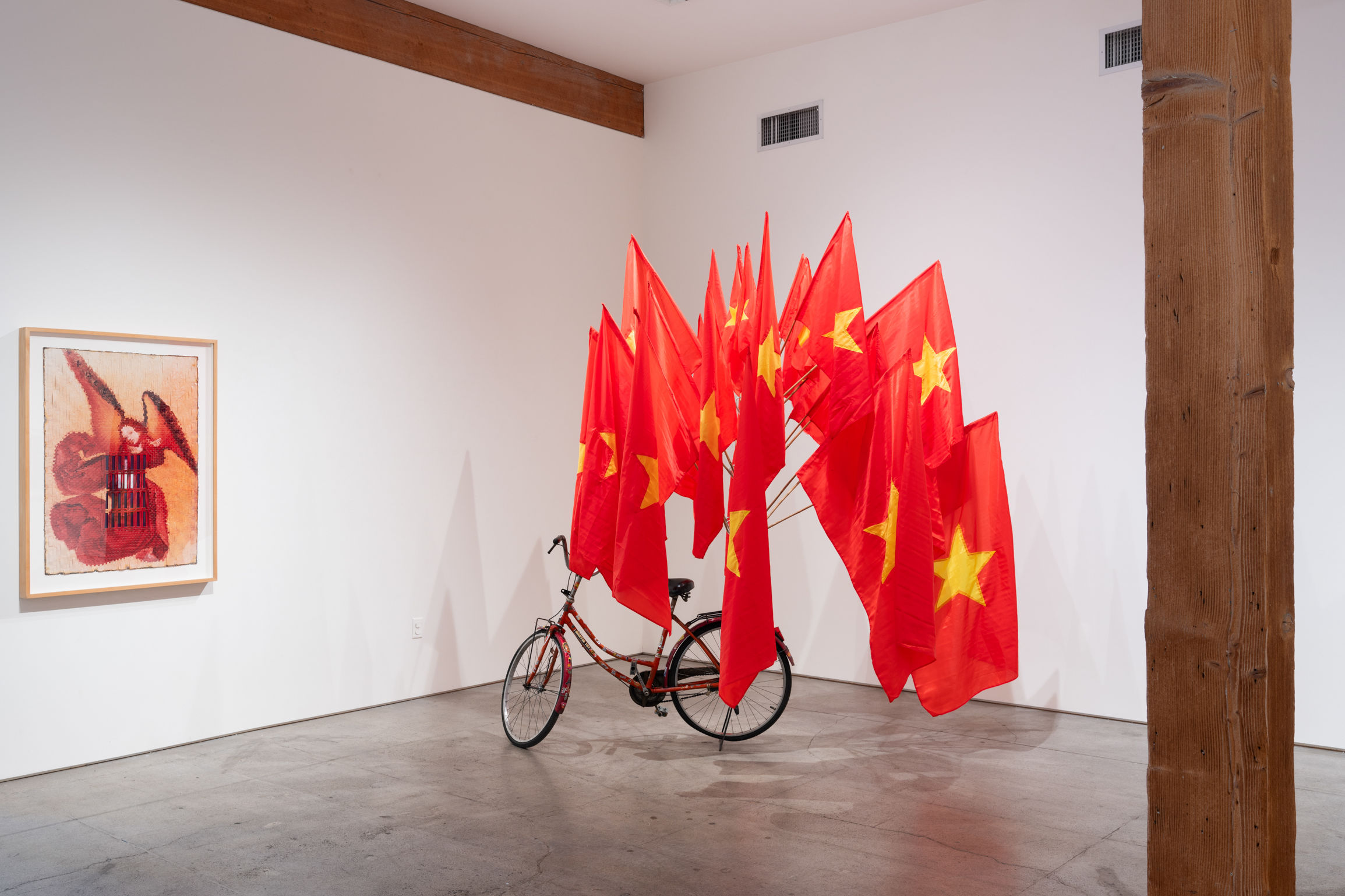
Car Crash Chandelier, by Melody Owen, who strung pieces of salvaged glass around an antique chandelier, refracting light in the darkness, occupies one corner of the living room. And over by the baby grand hangs Immolation in Color by Dinh Q. Le, a powerful arrangement of photograph strips woven to form a collage of images from Vietnam and, through the white of the central images, the outline of a burning monk.
As Leach walks through her dining room, she pauses over perhaps the most ambiguous work in her collection: several pieces of wood, painted white and thrown together every which way. In some ways the work seems symbolic of Leach’s chaotic life. Her home is tidy, but it is also lived-in, not museum-perfect. (She has always preferred, she says, a messy desk to a neat one.)
The sculpture, which Leach describes as an “abstract geometric construction,” gets its fair share of attention. It has no title, she notes, fingering its edges. The work is meaningful to her, an expression of a young mind she knows well. It’s emblematic of her devotion to understanding the artist—and to trusting her gut response to a work, regardless of the artist’s age or reputation.
It was, after all, produced by her son in the first grade.