Imani Perry and Keisha N. Blain Celebrate Black History at the Schnitz
You’re reading a past edition of our weekly Things to Do column, about the concerts, art shows, comedy sets, movies, readings, and plays we’re attending each week. Read the current installment. Sign up to receive it in your inbox.
“...and when the land kills of its own volition,” Toni Morrison writes in The Bluest Eye, “we acquiesce and say the victim had no right to live.” When school boards campaign to ban the novel, as they often do, they fearmonger around its depictions of sexual abuse. In my experience, censorship isn’t often carried out honestly. More threatening to a certain way of life, anyway, are the lucid truths Morrison captures about the complexities of racism in the US. “This soil is bad for certain kinds of flowers,” she writes. Though it’s often presented as a kind of natural order, the soil, the land, is of course the construction of a prevailing group—bigoted school boards, authoritarian governments. Keeping the youth away from provocative minds like Toni Morrison’s is how you maintain it.
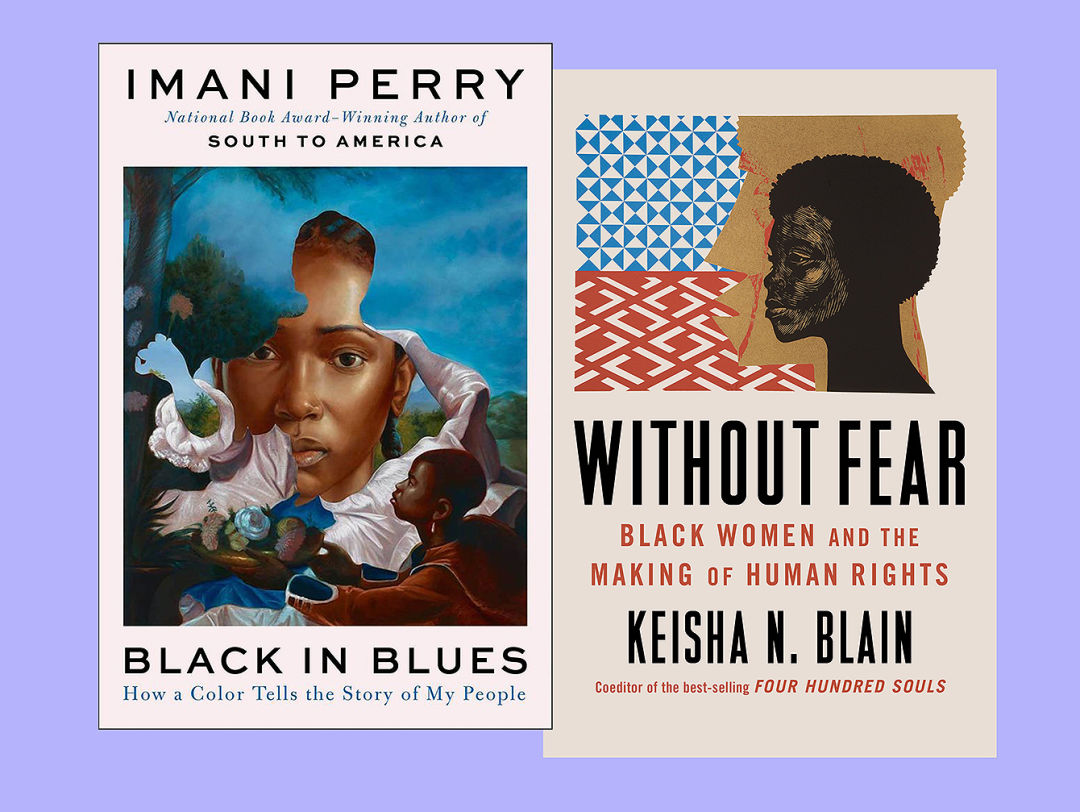
Black History Month is a particularly good time to reread Morrison, especially this year—because there’s quite a bit more racism in the soil than there has been in recent memory and because it’s the 100-year anniversary of celebrating American Black history (a week became a month in the ’70s). This week, two of the most provocative minds currently writing on the Black American experience are in town. Harvard professor and MacArthur fellow Imani Perry reads from her latest book, Black in Blues, at the Schnitz Thursday (7:30pm, $110+; tickets are part of a subscription series), and Keisha N. Blain, a Guggenheim fellow who teaches at Brown, brings Without Fear to the same venue Tuesday (7pm, $46+).
The titular blue eyes of Morrison’s book are a symbol of whiteness. In Perry’s book, subtitled How a Color Tells the Story of My People, they’re matched with many blue things that have shaped or been shaped by Black culture—white abolitionist Josiah Wedgwood’s blue jasperware ceramics, Miles Davis’s Blue Period, blues music—flipping the introspective conceit of books like Maggie Nelson’s Bluets and William H. Gass’s On Being Blue into a poetic anthropological study of race. Per The New York Times, Perry’s prose “swirls and flicks like an actual marble.”
Blain’s book is a more direct social study. Marginalized doubly by sexism and racism, Blain argues, Black women in the US are “uniquely positioned to combat injustices.” And she backs up her claim. Blain expands NAACP cofounder Ida B. Wells’s legacy past her anti-lynching and anti–Jim Crow activism—“readers will likely be surprised to learn that she also wrote critiques of the Armenian genocide and the imperialist impulses behind the United States’ invasion of Cuba at the beginning of the Spanish-American War,” writes the Los Angeles Review of Books. Wells also gave speeches in Britain to spread word about America’s horrific lynchings. In a similar effort, Mary Church Terrell spoke to the International Congress of Women in Zurich in 1919 about how peace after World War I was impossible while racism endured.
Blain’s major conceit is that, because of this unique perspective, Black American women have long advocated for human rights, which don’t change based on geography, as opposed to civil rights, which do. If you extend the conversation about “unalienable rights” and of all people being “created equal” to include all people in the world, that is, there’s no question about who counts as three-fifths of a person, or at all.
More things to do this week
DANCE The Sleeping Beauty
FEB 13–21 | KELLER AUDITORIUM, $27
If you were cursed to sleep for 100 years (doesn’t sound like the worst thing ever) it would be pretty sweet if everyone you knew joined in on your century of slumber, wouldn’t it? So you prick your finger on a spindle. You’ll forget all about it in 100 years, when the handsome prince kisses you and everyone in the palace wakes up. Love wins out! Same as it ever was. Oregon Ballet Theatre is known for its former artistic director Christopher Stowell’s adaptation of Marius Petipa’s classic choreography, which the local company’s full orchestra accompanies with Tchaikovsky’s score.
MOVIES In the Mood for Love
7PM SAT, FEB 14 | TOMORROW THEATER, $15
Wong Kar-wai’s masterpiece is an exceptionally romantic movie—a great Valentine’s Day flick. Set in 1962 in British Hong Kong, it’s about a cuckold and a cuckquean. Both, in fact, are being cheated on by each other’s unfaithful spouses. It’s shadowy and gorgeous, saturated luxuriously in a thick mood of color. After many mostly wordless exchanges, the unlikely not-quite-couple’s bond grows deep, and the yearning lasts and lasts. If Miyazaki is more your speed, the theater is also showing Howl’s Moving Castle at 4pm.
VISUAL ARTS Sticky
THRU MAR 7 | HELEN’S COSTUME, FREE
The first show of the year at residential gallery Helen’s Costume is a big wet kiss to the medium of painting titled Sticky. Berlin artist Jens Petersen wrote a kind of manifesto that serves as the press release. It begins, “Painting should be something you can smell,” and proceeds as a diatribe against social media art—when the post becomes the medium—and then becomes a wrestled love letter to the tactile messiness of “truth protruding one and half inch from the wall.” Petersen, whose own work often discourses with the hyper-online, is not in the show. Instead, the often abstract and intensely tactile paintings of Katherine Aungier, Pat Boas, Agatha Jaquiss, and Rebecca Shippee drive the point home.
Elsewhere...
- Wynne rapping over SZA’s “Snooze” at Chess Club. (YouTube)
- A photo essay collecting months of images from ICE protests by Portland photographer Rian Dundon. (Mother Jones)