Ten Years Ago, Outlaws Took Over an Oregon Refuge
On the night of February 10, 2016, Ohioan David Fry—thin with glasses and a long, black ponytail—sat in a tent with three other people in rural southeastern Oregon. They were surrounded by FBI agents. “It’s time to come out,” one agent said dryly through a speaker. “Go home!” Fry yelled back. “You’re making this a situation that’s dangerous by being here! Any one of us could go nuts!”
This affair was being live streamed, and the people in the tent screamed at the agents. “Kill us and get it over with!” one woman yelled. Another threatened to go down shooting. It seemed like at any moment, the clatter of gunfire would echo through the feed.
I ate dinner in front of my laptop that night, listening, dutifully tweeting in the way I thought was required of journalists a decade ago. The live stream was still going when I woke up the next morning, but only Fry was left in the tent. It continued as I commuted to downtown Portland. I had one earbud in to keep listening as I ordered a coffee, thinking about my strange severed reality: the mundanity of every day in one ear, complete chaos in the other. In the decade since, the volume of the chaos seems only to have gotten louder.
Fry finally came out with his hands up, ending the 41-day armed occupation of the Malheur National Wildlife Refuge, near Burns, Oregon. A dramatic chapter in Northwest history, the seizure of the serene 293-square-mile bird refuge featured a potpourri of far-right extremists: militias, white supremacists, sovereign citizens, anti–public lands activists, right-wing media personalities, conspiracy theorists. Fry had been upset about government overreach and had driven across the country to join the occupation. Most of the occupiers were men.

The directive for them to take and hold the refuge came from a man in a cowboy hat named Ammon Bundy. He told them to take a “hard stand” until the land making up the refuge was out of the hands of the federal government.
“Hard stand” would translate into ransacked offices and the teeth of a backhoe gnawing through Indigenous burial sites, hands pilfering through boxes of artifacts entrusted to the refuge by the Burns Paiute people. At press conferences, Bundy drew a tiny Constitution from his breast pocket and said the text within dictated the refuge should be owned by Harney County, Oregon, and its ranchers—just not the federal government. His words were an echo of the failed Sagebrush Rebellion of the early 1980s, whose leaders had the same ideas. He spoke only of ranchers and nothing of unceded Indigenous lands.
Reporters from around the world struggled to translate Bundy’s strange lexicon because it was a unique language born of the American West: a mishmash of settler-colonialist ideas derived of the ultraconservative brand of Mormonism he was raised in, and nostalgia for a place and a time that never was. But soon, these ideas trafficked at the refuge seemed to soak the fabric of our country, seep across it, trickling up the stairs of the White House and into the Oval Office, into the pages of bills and laws. The affair at Malheur was a showcase of American mythology, nostalgia, anxious masculinity, and the movement to “Make America Great Again” that would soon become inescapable.
At the refuge, reporters saw the hat and called Bundy a rancher. He was not. He grew up on a 160-acre melon farm and ranch in Nevada, raised by Cliven Bundy, a man reporters had also called a rancher. For 20 years, Cliven refused to pay the federal government the grazing fees required to ranch on the land around all those melons. An eager Sagebrush Rebel, he joined the anti–public lands fight when Ammon was just a boy, grazing his herd illegally on public land, throwing the bills from the feds in the trash and talking about ranching like it was a “right,” not a heavily subsidized privilege. When they came to collect in 2014, he rallied a crowd of armed militiamen, his boys at his side, and called simple bill collection government overreach. By the time of the Malheur standoff, Ammon had relocated from the Phoenix area, where he owned a vehicle fleet maintenance company, to a mansion in the Boise, Idaho, suburbs with an apple orchard.

But the Bundys wore cowboy hats, and the media wanted to tell a cowboy tale—the cowboy being such an intoxicating American symbol “of frontier freedom coupled with an aura of righteous authority,” the scholar Kristin Kobes Du Mez writes of the mythological figure in her book Jesus and John Wayne.
By putting on that hat, it was almost as if Ammon Bundy knew his message would be tolerated, softened, entertained as something other than drivel. It gave him power, evoking “an earlier era of American manhood, a time when heroic (white) men enforced order, protected the vulnerable, and wielded their power without apology,” Du Mez writes. “The myth of the American cowboy had been tinged with nostalgia from its inception.”
The men who came to the refuge had lost businesses in the financial crisis. They were men who served in the military and couldn’t acclimate to life back home, or men who wanted to serve but couldn’t make the cut. They were skittish, looking for an enemy. “What makes me nervous is government,” one man clad in head-to-toe camouflage told a reporter. That man had legally changed his name to that of a gun-toting commando character from the 1987 action film Predator.
Militiamen carrying rifles and men dressed as militiamen swirled around Bundy. They came from cities and suburbs—few actually ranchers, but all willing to take up arms in Bundy’s fight. “It’s more appropriate to think of the militia movement as having what might be called a rural mentality, an aspiration for a lifestyle and an identity that the rural represents to them,” writes extremist expert Amy Cooter in her book Nostalgia, Nationalism, and the US Militia Movement. To some extent, we were all watching a performance of aspirational rurality at Malheur. Bundy cosplaying as a cowboy, his suburban acolytes in camouflage playing warriors, the well-armed holdouts trying to survive in a tent in winter.
So many people watched what happened at Malheur and laughed. The guy with the Predator name. The group branded “ Y’all Qaeda” and “Vanilla ISIS.” People mailed them dildos. And it was funny, until it wasn’t, until it became clear this was the start of something so much larger.

Image: UPI/Alamy
A
s the refuge standoff unfolded, Bundy and several others were arrested on a rural road between Burns and John Day. But a car driven by Robert “LaVoy” Finicum, one of the occupation’s only actual ranchers, sped away from law enforcement. When his car crashed into a snowbank, Finicum reached for a loaded gun in his jacket and yelled to law enforcement to shoot him. They did; he died in the snow.
Finicum himself had long dreamed of being a cowboy, and started ranching less than a decade prior. It didn’t take long for him to be drawn into the sticky web of the Bundy family. Finicum listened to what Cliven said about rural ways of life, and he bought the family’s fiction that ranchers like them were under threat and were protected by the Constitution. Finicum stuck one in his pocket, and joined the fight. “Connections between Americanness, masculinity, whiteness and land remain at the heart of our national myth,” Cooter writes.
When Finicum sped away from that car and reached for a gun, he was an outlaw moved by a story about America where breaking the law would make him a hero. And America loves an outlaw, maybe even more than a cowboy. John Wayne played both. An outlaw, in the movies, is someone who chooses lawlessness for the greater good. And when Ammon first donned his handcuffs, he became a symbol for not just the men at Malheur, but men across the country.
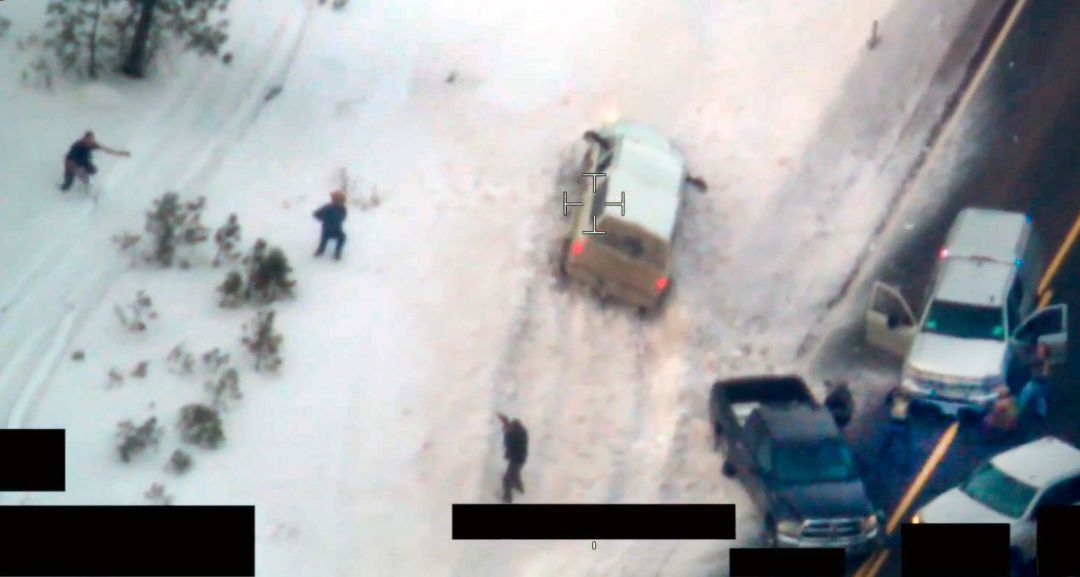
Image: ZUMA Press Inc./Alamy
Bundy and several defendants were famously acquitted by a jury in the fall of 2016, just weeks before the election of Donald Trump. “This case is about the death of rural America,” a juror told Oregon Public Broadcasting in the aftermath. It wasn’t; in actuality, it was a case about whether these people conspired to take over federal property. But the cowboy mythology had worked.
Hindsight is of course 20/20, but given everything I know now—given everything we all know now—it’s hard to remember how I could have been personally surprised by the takeover, the acquittal, the ways Bundy would hunt the West for other fights. Malheur is French for misfortune. A term of loss. I can’t think of a better word now for what happened that winter. It was the start of our collective loss.
During COVID, Bundy led protests outside of doctors’ homes in Idaho, blocking the entrance to a hospital, which later sued him for defamation, claiming tens of millions in damages. He lost in court, then lost his mansion. He eventually fled to Utah, where he filed for bankruptcy. He now lives in Cedar City, Utah, openly evading an arrest warrant. He told The Salt Lake Tribune last spring he just wants his peace. A cowboy. Then an outlaw. Now a martyr.
The refuge occupation was a rash before a fever, a symptom of our approaching political chaos. Trump was elected President, and his tenure would be marked by the ways he found common cause with militias, white supremacists, sovereign citizens, anti–public lands activists, and right-wing media personalities. Malheur was not in Oregon anymore. It was in the White House.

Image: UPI/Alamy
As I write this, Trump is seven months into his second term. Over the summer, he signed an ugly piece of legislation called “One Big Beautiful Bill” into law. The night before, a section of the bill was excised that would have sold off hundreds of thousands of acres of public land, particularly in the West—the removal of that section occurred only because Republican lawmakers from Idaho and Montana threw a fit. Everything Ammon Bundy crowed about at Malheur was that close to becoming law.
I recall the time before the refuge occupation when I couldn’t possibly understand why anyone would want to decimate public lands. I suppose I’d stuck my head in the sand and ignored how controversial wild places could be. I hadn’t let myself believe yet that the land was something people could look at, too, and see dollar signs.
I know now the power of a business suit, the power of a cowboy hat, the power these masculine symbols can have over absolutely everything. And while I understand better now why Bundy chose a far-flung bird refuge for his stunt, the literal collision of so much anger and conspiracy into a place of so much quiet beauty still gives me pause. But this has become the world we live in, the Oregon we live in. Beauty colliding with horror. A war in one ear, and life in the other.