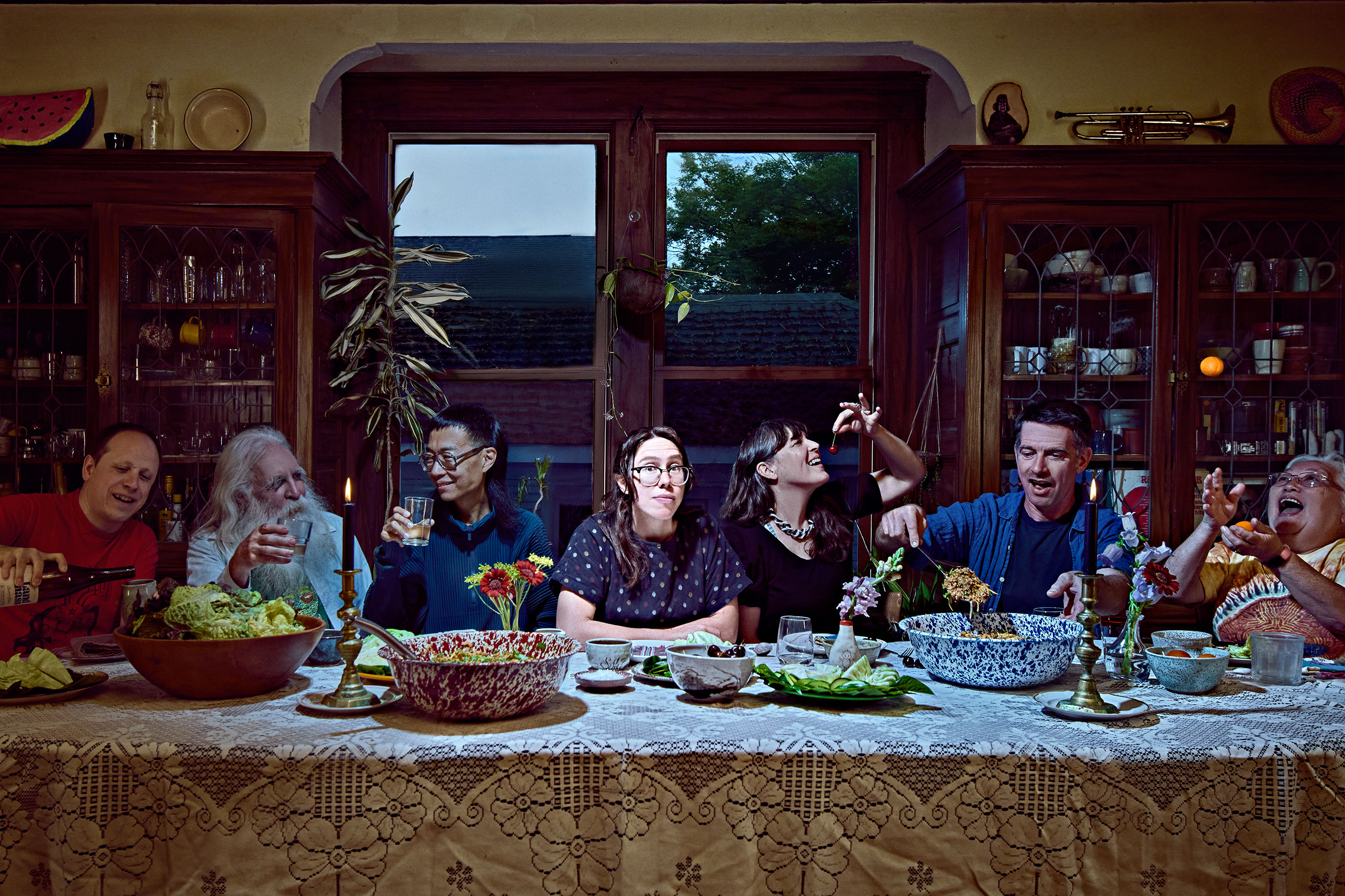
Potlucks Are the Feasts That Meet the Moment

Image: Stephen Dybus
Three minutes away, I felt nervous. I hadn’t brought a friend to bolster me. In fact, I’d brought only a bowl of sweet potatoes. Suddenly, I got a tickle in my optic nerve like I might get a twinge of vertigo, then a tickle in my intestines like I might need the toilet. This occasion wasn’t worthy of acute anxiety, I told myself. I resolved to be calmer.
As I parked, I could see people waddling under the weight of their dishes. At the door, a couple introduced themselves as “Pam and Jim, like The Office.” They’d arrived with Jim’s mom’s seven-layer salad. When I introduced myself, another woman piped up. “My alias is Lola,” she said. “Alias for what?” I asked. She refused to answer. So this crowd was welcoming and mischievous.
I’d arrived at the International Cooking and Dining Club, a Meetup group co-organized by Graeme Newell, our host for the night. Newell has the chiseled cheeks of an aging Cillian Murphy and the warm swagger of a man with many friends, which he is. Two years ago, he took the reins from Michael Beck, who founded the club in 2016. Every month the community chooses a country, and members take turns hosting. These strangers, who joined the club online, cook for one another, often dishes they’ve never made before. In short order, strangers become familiars. Some of them become dear friends.
In a potluck, the labor is divided among all participants. Together, many small contributions make a feast. It asks for our participation twice: first as cooks, then as diners. We’re instrumental in our own satiety, yet not wholly responsible for it.
“We had but even pot-luck, a little to moisten our lips.” Historians point to a sixteenth-century play by Thomas Nashe, a contemporary of Shakespeare’s, as the first appearance of the word. Perhaps because I was born and raised in Oregon, I’ve always associated the potluck with the Potlatch, an intricate ceremony with extensive gift-giving, dancing, and feasting practiced by Indigenous groups of the Pacific Northwest coast. During Potlatch, food and gifts are totems for the real action: knitting a web of relationships. Potlatch is both an event and an ethics of sharing abundance rather than hoarding it, a philosophy so politically and culturally threatening that the Canadian government outlawed the ceremony from 1885 to 1951.
During the Great Depression, the potluck as we now know it came to be. Churches, PTAs, and women’s clubs organized communal meals to bolster their ranks and offer care. Throughout the 1930s, The Oregonian published thousands of potluck announcements, often in the Sunday “Fraternal News.” What were the Kirkpatrick Ladies Sewing Club, the Carnation Club, and the Masonic Order of the Amaranth cooking for each other? While the paper never listed menus or themes, if we take the O’s home economics editor, Nancy Morris, as our guide, we can make an educated guess. On December 26, 1939, Morris recommended a frugal vegetarian lunch: “Hot Baked Beans on Steamed Brown Bread with Catsup, Pineapple and Cheese Salad, Sliced Peaches with Soft Custard.”
I haven’t always liked a potluck. I fear that instead of sliced peaches with soft custard, I’ll find grain salad with slimy pomegranate seeds. But if ever there were an era for renewing the ethics of the Potlatch and the cooperative power of the Depression-era potluck, it’s now, when food is the most expensive it’s ever been in my life, and people are hungry for both food and camaraderie.
“It’s a hedge against the isolation of adulthood,” Portland writer and audio producer Breesa Culvers says of the monthly potluck she and her partner host during the winter. Their rule: “Bring something if you can, but if you hate cooking or you’re a parent or your job is really hard that week or you have seasonal disorder, just get yourself here.” They welcome friends of friends and fold in strangers. A potluck can always handle one more.
My favorite potlucks often have a theme. For a bibimbap potluck, I made a single banchan. For an everything-from-scratch carnitas burrito potluck, I made the pinto beans. During my night at the International Cooking and Dining Club, it was a holiday theme, and all countries were welcome to the table. All around, people shared stories of their past and present lives. A powerful, ancient spell was at work: The food was softening us into approachable humans, ready for connection.
“My dad fell in love with Julia Child, in addition to my mother, in about 1969,” said Joe Cowan, a pink-cheeked gentle giant, who’d brought broccoli in Mornay sauce. Silver-haired Lucy Murphy grew up in a family of 11 in the Mariana Islands. Resourceful and used to a crowd, she’d brought the turkey and kept the gravy piping hot in a Hydro Flask. The recipe for the sweet potato bhajee I’d brought was a gift from my brother Zak, whom I live with in a communal household. A decade ago, he found it in our favorite cookbook, 660 Curries by Raghavan Iyer. It’s a knockout dish, heady with curry leaves and chilies, hiding behind the most boring name: “A Potato Mix.” I hadn’t even mixed the potatoes this time—I’d skipped russets and just used sweets. They fit right in amid their new companions.