How Doulas and Dog Trainers Help Find Oregon’s Dead People
Whenever Moriah Berthrong receives a new batch of placentas, she gets creative. She buries them, tosses them in fields, hangs them from trees. She immerses them in water. She burns them. She rubs them on towels and then runs those towels through the washing machine. She hides them in closets and in abandoned cars. She once encased a placenta in a concrete brick. Sometimes she ages them first—the better to train her dogs to find human remains.
During a September training session, Berthrong, in black utility pants and thick-soled boots, walks with her dog, Ember, onto a large, fenced field in front of her home in Oregon City. The day before, amid the divots and dirt mounds left by gophers, Berthrong buried three placentas. Now Ember, an 8-year-old Nova Scotia duck tolling retriever—known casually as a toller—waits patiently, her shiny copper coat rippling in the breeze.

Image: Kristina Barker
Berthrong unclips her, and Ember zooms ahead, following a scent all the way to the edge of the field and tracing it along a white picket fence. She’s a detective on a case, circling with intention and purpose and narrowing her search radius until she draws closer to her target. She pauses to hover over a brown patch in the grass and then lies down, her nose pressed to the ground. A moment passes. “Yes!” Berthrong calls, and Ember springs up and trots over for a sausage stick.
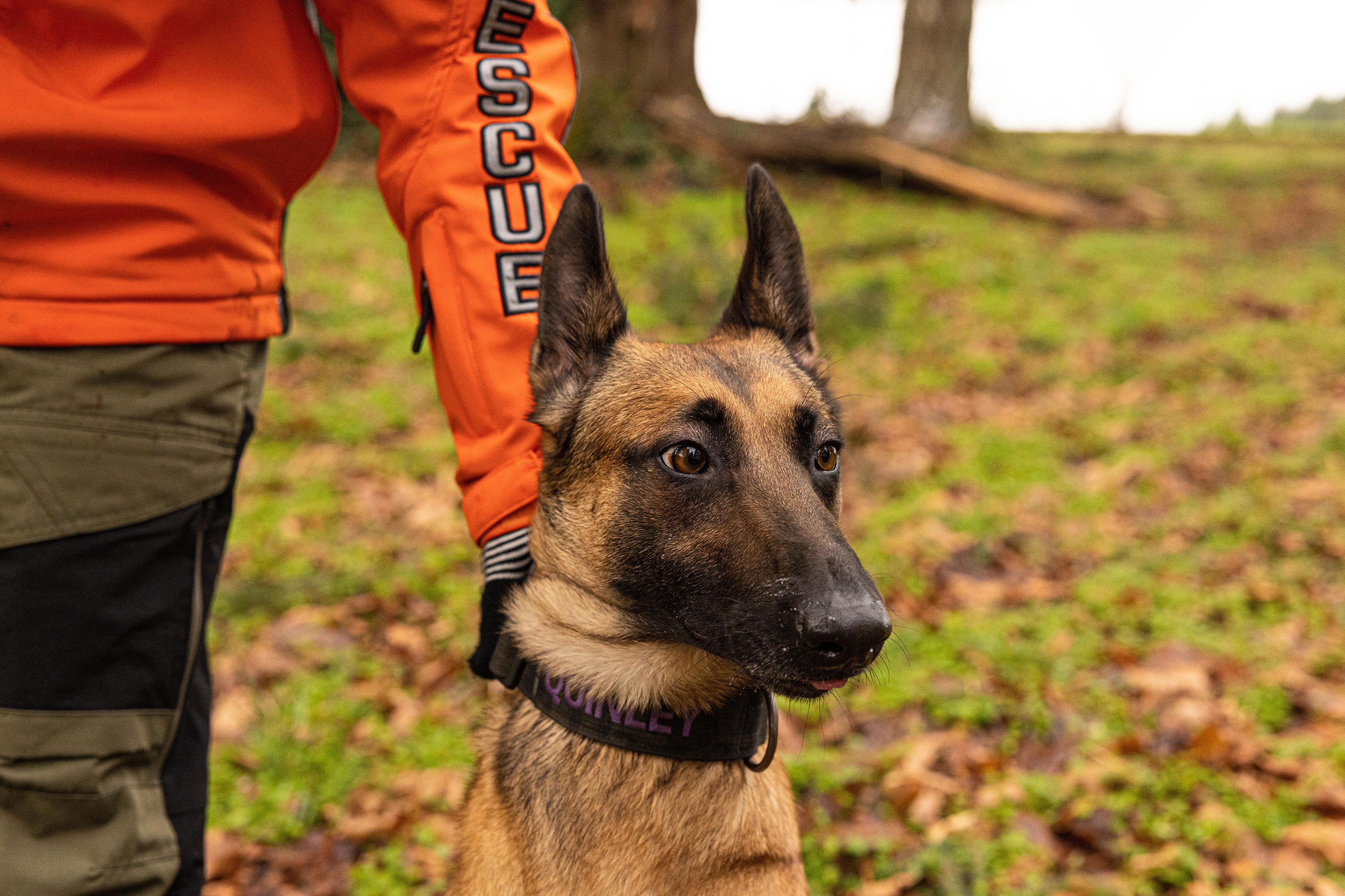
Ember is a human remains detection dog—in lay terms, a cadaver dog. She and Berthrong, a volunteer with Clackamas County Search & Rescue (CSAR), work together to assist with missing persons cases, homicide investigations, cold cases, and disaster recovery. It is work that puts them in close contact with all kinds of misfortune, from hiking accidents to suicide to acts of violence. On their missions to find the missing, they scour the forests around Mount Hood, enter derelict houses ransacked by squatters, and sweep the waterfronts along the region’s many rivers, tracking down those who need to be found so their loved ones can lay them to rest.

Image: Kristina Barker
“We can’t provide closure, but we can provide some information and some answers, and that makes a huge difference,” says Berthrong, 48. “Most of the families that we’ve talked with, the hardest thing is the unknown. They don’t know if the person is still alive or if they are dead, and if we can at least answer that, that allows us to begin the process of grieving.”
Dead bodies produce a complex array of volatile organic compounds, which evolve over time and change in response to environmental conditions. Dogs, with a keener sense of smell than humans, can be trained to identify these scents, but that requires exposing them to the real thing: bones and decomposing human flesh. According to CSAR coordinator Sgt. Jeff Juker, human remains can be a challenge to source, and without a reliable supply, handlers have had to train their dogs on whatever they’ve managed to scrounge up via word of mouth—the baby teeth of nieces and nephews, the knee bones of neighbors after replacement surgery.
But since 2019, Berthrong has had access to a trove of material that is disposable, free, and abundant: placentas. Thanks to a program spearheaded by a Portland doula named Camilla Rae, families from around the metro area can donate their placentas, which Rae stores in a freezer at her home. She and Berthrong meet in a parking lot of a Home Depot midway between their homes for a handoff every few months. Equipped with as many placentas as she could ever need, Berthrong uses the remnants of birth to find the remnants of death.
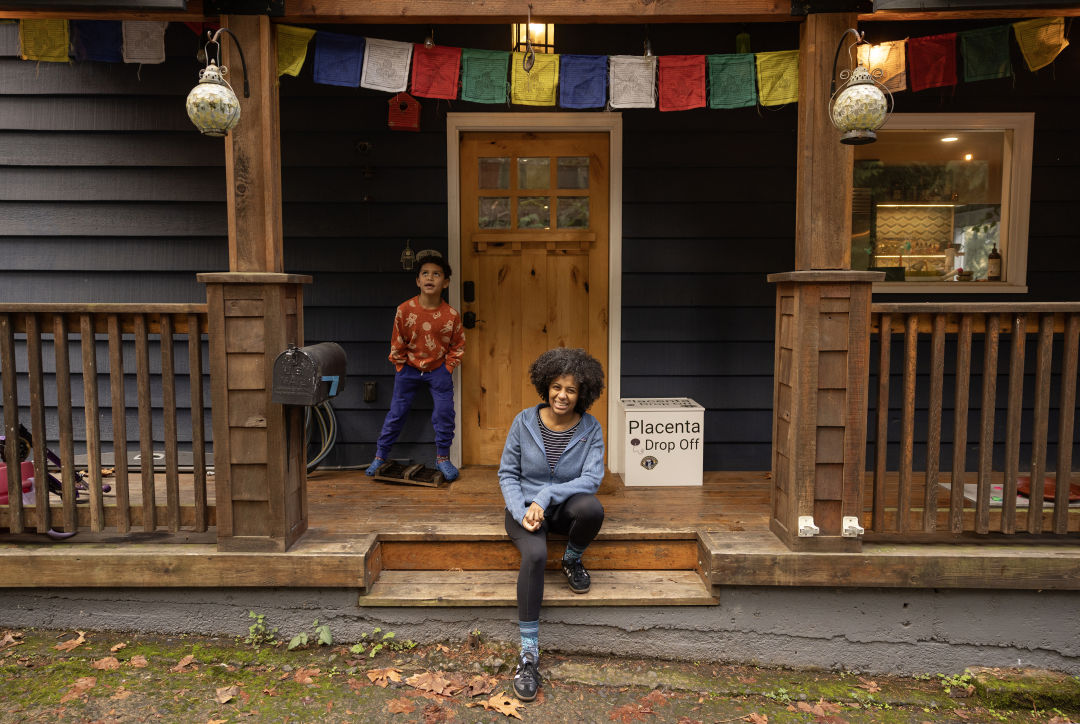
Image: Kristina Barker
At her Arlington Heights home—where Tibetan prayer flags hang from the front porch and kids’ toys are scattered across the floor—Rae sets herself up at a designated sink in her kitchen. Each donated placenta must be frozen, and so whenever she receives one, Rae carves out 10 minutes (or more if she receives numerous) to process it. She pulls on latex gloves and takes a deep breath. Most placentas don’t have much of an odor, but if one sat out for a while, or if a baby pooped on its way out of the womb, they can stink. (Rae’s husband refuses to be in the room while she performs this task.)
Rae describes the smell like liver or a steak that’s been in the fridge for a few days, or like a tampon left in a little too long. “You know how, like, when blood kind of sits on itself?” she says. “It’s this visceral, meaty, bloody smell that hits your nostrils and burns a little bit.”
The placentas squelch as Rae rinses them to remove excess blood or clots. She seals each in both a Ziploc and a biohazard bag, then arranges them in neat stacks in a spare freezer dedicated for this purpose.
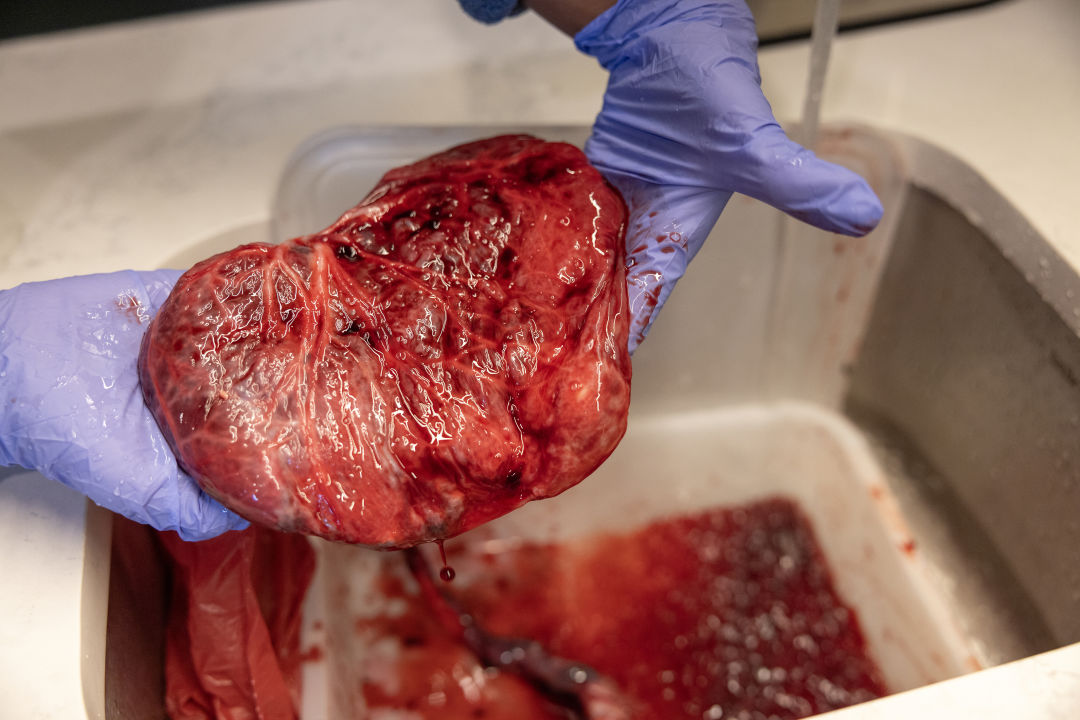
Image: Kristina Barker
The placenta is a temporary organ that forms during pregnancy, attaching to the wall of the uterus and connecting to the fetus via the umbilical cord. Essentially a life-support system for the developing baby, it transmits oxygen and nutrients, removes waste, produces hormones, and passes antibodies. During a routine childbirth, it’s delivered shortly after the baby. About the size of a salad plate and weighing a pound, on average, a placenta is slick and slippery, and can be awkward to handle—a bit like holding one of those water wiggler toys. They vary in color—reds, browns, blues, and purples—and the wall bears a branching web of blood vessels. Rae has sometimes noticed a shimmer to the veins.
The standard in the US is for the placenta to be treated as medical waste, but cultures across the world have had widely varied traditions, often tied to the belief that the placenta is a living relative or guardian to the child. In an analysis of 179 societies, medical anthropologists at the University of Nevada, Las Vegas, found 169 disposal methods, including burial, incineration, and intentional placement in a specific location, such as hanging in a tree.
Over the past decade, it has become more common, and even trendy, for child bearers in the global West to ingest their placenta, known as placentophagy, in pill form—a practice that also saw a surge of interest in the 1970s. To make it consumable, the placenta is steamed, dehydrated, and ground into powder, which is sealed in capsules. Though there’s no hard scientific evidence about the benefits, a body of folk knowledge claims that consuming placenta can boost milk supply and energy, and help new mothers regulate the dramatic hormonal and mood swings of the postpartum period. There are also warnings against the practice, and in 2017 the CDC issued a report after an infant was hospitalized in Oregon with Group B Streptococcus agalactiae bacteremia, which was found to be present in the placenta capsules the mother had swallowed.

Image: Kristina Barker
Rae, who has three children, chose to bury the placenta from her oldest under a fig tree outside her home, and is storing the others for future tree plantings. She’s worked with clients who also wanted to bury theirs or who used them in an art project—say, painting them to make a print. Part of her role as a doula is to walk clients through the possibilities, but until 2019 she didn’t know donating to search and rescue (SAR) was an option. That year, she befriended Ariel Salzman, a fellow parent at her son’s school and a longtime canine handler with a local SAR unit. Rae loves hearing birth stories, and Salzman regaled her with a tale of stashing her placenta in a takeaway food box and alarming a nurse at the hospital in the process. She was saving it, she explained, to pass along to the human remains detection (HRD) team for use in dog training.
Rae thought she knew every potential placenta purpose, but this was a new one. Salzman described donated placentas as precious but scarce; the team was lucky to get one per month. Rae, meanwhile, was practically rolling in placentas.
The doula was also motivated by a personal connection. In 2017, a friend of Rae’s was caught in a rockslide outside Aspen, Colorado, while hiking with her partner. Their bodies were found days later by a search crew. Amid the tragedy, Rae had seen how meaningful it was that their remains were recovered. She was moved by the idea that placentas, often discarded, could help bring that kind of resolution to others. Salzman put her in touch with Berthrong, and Rae enlisted her doula network to start collecting placentas for the HRD team.
Rae, whose practice is called Full Circle Baby, began informing her clients about the donation option, and she let other doulas in her community know, too. At first, the flow was modest. In 2020, the first full year of the program, Rae collected about 15 placentas, but word spread over time. In 2025, Rae’s program collected 150 placentas for the HRD team.

Image: Kristina Barker
Throughout, it has felt well worth the effort. When Rae talks about the program, she hears stories about other people who’ve gone missing. “Everybody has [lost] someone in some kind of tragic way,” Rae says. “It not only brings me back to my own grief, and the fact that I felt so helpless, but it also makes me so proud that my grief turned into something that is helping other people process theirs.”
Families who participate in the program sign a release form, and usually their doula then coordinates the transfer with Rae. She sometimes drives to the hospital to make a pickup. Other times, doulas hand off the placentas to her; many keep coolers in the trunks of their cars for this purpose. Logistics can be complicated—babies, famously, are born at all hours of the day and night. So in August 2021, Rae installed a white metal box on her front porch. “Placenta Drop-Off,” it reads. Ridwell, for organs. Her kids love to check if there’s anything inside. Often, there is.
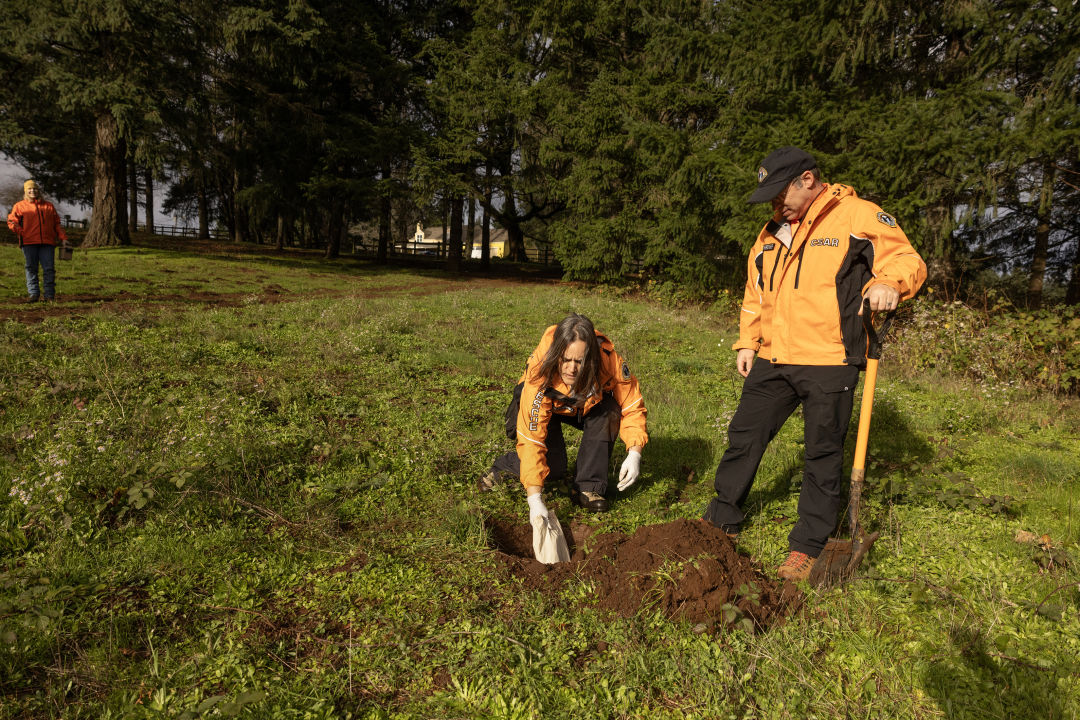
Image: Kristina Barker
Berthrong has always been obsessed with dogs. As a kid, she checked out every book on dog training from the library. She studied animal science in college and met her husband, now a veterinarian, in the program. On their five acres, they have a menagerie of farm animals, including chickens and pigs, and added a black lab puppy to their brood last September. That brings their total dog count to four—the same as their number of children.
Over the years, she’s tried her hand at breeding dogs and kunekune pigs, and around 2007 she started working with the organization Guide Dogs for the Blind, which led her toward more specialized dog training. She also helped one of her kids raise puppies to become autism service dogs and acted as a group leader for a 4-H canine club. In 2014, she began competing in breed shows with her Anatolian shepherds, Kaptan and Nala.
The experience piqued her interest in the world of canine sporting events, and she spent a year attending dog shows to learn more. In 2017, she learned about tollers, which are excellent sporting dogs, and met retired police detective Holly Howell, who told her about SAR work.
Later that year, about a week after picking up Ember from a breeder in Boston, Berthrong had a vivid dream: She and Ember were out in the woods, searching. She felt like she was exactly where she was supposed to be, doing exactly what she was supposed to be doing. A few weeks later, she reached back out to Howell, who invited her to attend an SAR training session. Berthrong—and Ember—were hooked.
Since getting certified in 2019, Berthrong has gone on more than 100 missions, nearly half with Ember. A black tattoo on Berthrong’s right upper arm shows her and Ember walking through the forest, with Mount Hood in the background and a skull below.
“It’s very much a partnership of us learning to interpret the dog’s body language, to kind of see what they’re thinking and what they are taking from the environment, and then us being able to respond and help them,” Berthrong says. “It allows for a lot of collaboration and problem-solving, and I like the training challenge of that. And it’s really fun to see the dogs when their eyes just light up and they’re like, ‘I figured it out,’ and they get so excited.”

Image: Kristina Barker
The three-person, all-volunteer HRD team—Berthrong, Howell, and Terri Hines, an underwriter for an insurance company—meets for three-hour training sessions every Thursday and every other weekend. They’re a sturdy, unsqueamish bunch who spend their spare time researching cold cases and enjoy true crime and police procedurals. Berthrong named her new puppy, whom she hopes will follow in Ember’s footsteps, Temperance, after Dr. Temperance “Bones” Brennan, the forensic anthropologist on the TV series Bones. She calls her “Tempy” for short.
When she receives a delivery of placentas, Berthrong stores them in a white chest freezer, emblazoned with a red biohazard label, in an outbuilding on her family’s property until the team is ready to use them. During training sessions, handlers present dogs with “problems” to develop and hone the skills they need on missions. The missions frequently involve identifying the scent of human remains in the woods, in water, or in vehicles, so trainers design exercises that reflect those scenarios and make the problems harder over time.
For example, an entry-level training exercise might be to bury a placenta in a field a few minutes before the dogs are sent to find it, which Berthrong says would create a “pretty straightforward odor picture.” For a more advanced exercise, the trainers might bury a placenta, or placentas, days before and in an area with denser vegetation; as time passes, the odor will travel and spread out, making it more difficult for the dogs to locate the source.
When working on water searches, the trainers might start by placing a placenta in a “training aid delivery device,” or TADD, a special type of jar that lets scent out but doesn’t let water in. An easy problem could be to place a placenta in the jar in shallow water, so the dog only has to get its paws wet to find it, while a more advanced version might involve placing the jar in deeper water, secured with crab line.

Image: Kristina Barker
To train for missions where a body is in a vehicle, the team has a relationship with a tow yard in Portland, where they hide placentas in abandoned cars. They have trained in a Clackamas Fire District–operated “burn building,” a facility where firefighters can practice their skills with controlled, live fires, as well as in more niche scenarios that arise in homicide investigations and cold cases. The placenta encased in a concrete brick? That stemmed from a case where police thought a suspect might have hidden a body in a recently poured patio. Human remains smell different depending on their quantity (is it a full body or just a part?) and how long they’ve been decomposing, so handlers run variations of training scenarios, changing factors like the number of placentas buried together and decomposition levels. Berthrong has a designated space on her property where she leaves the placentas out to age.
While SAR teams all over the country, and even the world, accept placenta donations, an organized program like the one coordinated by Rae—which bridges the gap between birthing families and HRD canine handlers, streamlining the donation process and ensuring a steady supply of placentas—is rare. Thanks to that steady supply, the local trainers have been able to expand the breadth and depth of their training exercises, which improves the teams’ skills out in the field.
“The biggest difference is the creativity it’s allowed us to come up with, because the dogs do get very stuck, and the need to constantly challenge their expectations is part of our training,” Berthrong says. “Just knowing that if something doesn’t work out and we ruin the source in some ways, then it’s OK, because we have more.”

Image: Kristina Barker
In addition to their regular training sessions, handlers pay their own way to attend seminars at the Forensic Anthropology Research Facility at Texas State University. Essentially a ranch riddled with donor corpses decomposing under various conditions, at 26 acres it’s the largest so-called body farm in the world. Berthrong has taken Ember for two Level 1 Seminars, which she says are great “for getting a variety of whole-body decomposition odors in your dog’s database,” and for private training. She took Tempy there for a puppy training in January. There are only about a half-dozen other body farms in the country: A Colorado facility specializes in decomposition at high altitude; one in Michigan specializes in cold-weather conditions.
SAR work involves encountering tragic and gory scenes, and it can be emotionally draining. On her way to a search, Berthrong does breathing exercises. Afterward, volunteers sometimes stop for food and debrief together. Berthrong occasionally pulls over and cries by the side of the road until she feels ready to drive home. The Clackamas County Sheriff’s Office offers a peer support team and a chaplain. But finding a body also brings a sense of bittersweet accomplishment.
“Some of the missions are a huge success,” Berthrong says. “This person has been missing for so long, and we found them.”

Image: Kristina Barker
In May 2022, a friend of Rae’s went missing. His name was Mark Schmidt and he had been part of their tight-knit social group, playing golf with her husband and regularly attending game nights. For three days, no one in their circle heard from him, and they contacted law enforcement for a wellness check. They found Schmidt’s apartment empty; he had left his phone behind. Ten days later, she received a text, informing her that Schmidt had died by suicide, his body found near one of his favorite hiking trails.
Schmidt’s mother had flown out from the Midwest for the search, and in conversation with Rae and other friends of Mark’s, she expressed gratitude for the care and compassion with which the mission had been run. Months later, when Rae saw Salzman, she shared her sadness over the loss. As she spoke, she saw a look of recognition spread across Salzman’s face. Salzman had run that search, and had dispatched dogs that had been trained on Rae’s donated placentas.
Rae was stunned. She had always seen the placenta donation program as a way to give back to her community, connecting a clear supply with a clear demand. For the first time since her friend’s accidental death, Rae encountered that swirl of heartbreak and relief, the realization that knowing, as painful as it was, felt better than not knowing. Berthrong’s dogs had done that. Rae’s collected placentas—stuffed into plastic bags shuttled to Home Depot parking lots, hung from trees, burned, encased in brick—had given Schmidt’s family and friends, including herself, a modicum of peace amid the pain. “I don’t know just how meaningful that would be to me as a mom, to know that I got to hold my baby one last time and to be there at that moment,” she says. “I’m able to recover this one last moment in love, because other people showed up with love.”


