An Interview with Queso Queso

Image: Michael Novak
Lee esto in español: Entrevista con Queso Queso
After confirming I’m not recording, the graffiti artist Queso Queso briefly turns on his camera. A black and silver lucha libre mask shows up on my Zoom screen. “You see me?” he asks, giggling at his own theatrics. Then he tips his cowboy hat, clicks, and again the screen goes black.
The voice behind the mask is young. I guess early twenties. Let Reddit figure it out, he jokes. He says he grew up in pregentrified North Portland, the son of Guatemalan parents busy with multiple jobs. Microwaved quesadillas were a frequent “struggle meal” of his childhood. That’s where the name comes from. “Let’s keep that a secret” was his answer to the rest of my biographical questions, “part of the Queso Queso mythology.”
Queso Queso is a prolific graffiti writer, a “bomber,” meaning his work is devoted to volume over detail. He’s good at it. Over the past two years, he’s hit pretty much every corner in the metro area. But his tags land differently than most. Instead of taking over walls and obscuring signage or other tags, they fold into curbs and crosswalks and MAX stops. They blur with the city’s structures, appropriating the stenciled block letters of notices that usually read “No Parking” or “Bump” or “Watch Your Step.” It’s only on the second or third take that you realize what looks like a municipal safety message actually reads “Cheese Cheese” in Spanish.

Image: Michael Novak
It’s goofier than your average vandalism, less menacing. When the president painted Portland as “war-ravaged” last year, a Rolling Stone dispatch used the tag as a reassuringly silly foil, promising that the only thing “ravaging” the city was “a mysterious graffiti artist who keeps stenciling the words ‘QUESO QUESO’” on streets and sidewalks.
Tag-style graffiti hinges on this mystery. If it’s any good, you should wonder what possessed someone to scribble “Penis Girl” or “Shrimps Is Bugs” or “Queso Queso” all over the place. The risks associated—the City of Portland has made very public moves to discourage graffiti in recent years, even jailing several artists—bring up the same conundrum as an esoteric painting hanging on a museum wall. Someone made a great effort to get this perplexing work in front of you, and it invites you to ask why.
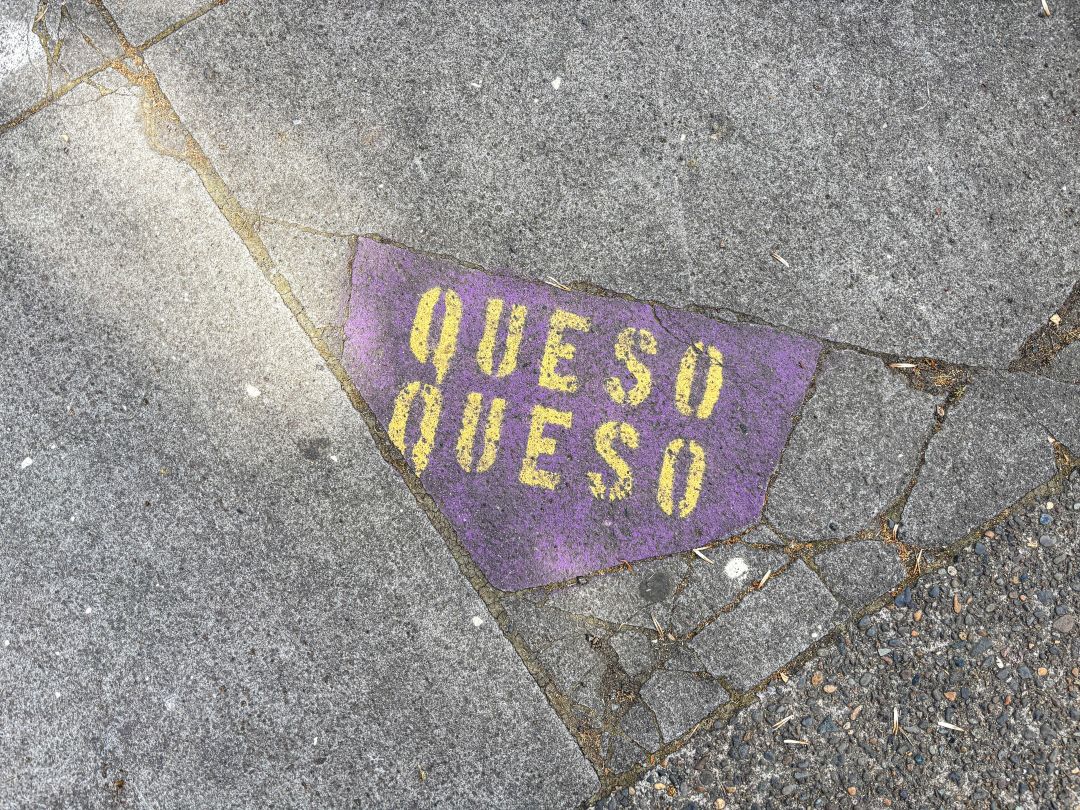
Image: Matthew Trueherz
But graffiti, unlike art displayed in a museum, slips into everyone’s everyday. As the novelist Jonathan Lethem has written, graffiti “inserts itself like the blade of a knife between creation and destruction.” It highlights the cracks in the culture. It upsets the order, reminding you that even the most concrete of concrete structures were built by someone. A tag plastered impossibly high on an overpass or discreetly knit into the rigid architecture of a street crossing breaks the illusion that some institutions are too solid to amend.
In time, the person painting the tags splits from the persona. If there is one central ambition behind the Queso Queso project, it’s the potential in this mode of open-sourced mythology to inspire and connect people. “It’s taken a life of its own,” the artist says. “It belongs to the people.”

Image: Matthew Trueherz
The people have largely taken to social media in hopes of figuring out why Queso Queso is covering the city in cheese. Thanks in part to the artist’s Instagram, his persona has blossomed into a very Portland kind of folk hero—one that matches his affinity for the larger-than-life magic that surrounds lucha libre. Though one tag on a food cart launched a theory that the whole thing was a guerrilla marketing campaign, most Queso fans are simply happy to help write the legend. Hundreds have shared photos of their shoes next to a Queso Queso tag, giddy to be in on the bit. “You’ve genuinely made our lives more magical and become part of our family lore,” one fan commented, relaying that she’d bonded with her teen over collecting photos of the tags. “Plz tell her tio Queso says ‘hiiiii’ ♥,” the artist replied.
However inscrutable, or illegible, tags do have something to say. It might be a bang, a whimper, a fuck you. Always, it’s an assertion of existence: “X was here.” By that logic, Queso Queso’s tags might announce that a Spanish-speaking person was here, was and is everywhere. And perhaps the way this goofy nom de guerre fits itself so convincingly into such rigid civic architectures as street signs could be read as a demand that Spanish-speaking people are not simply here, but that they belong here.

Image: Matthew Trueherz
Snooping around the internet, you can find a few traces of the man behind the mask. During the No Kings protests in the summer of 2025, a photo surfaced of a man in a crowd holding a paint-splattered stencil spelling out “FUCK ICE” above his head while another that read “QUESO QUESO” hung from his backpack. There’s also a behind-the-scenes video of the artist at a photo shoot promoting a gallery show, to which Queso Queso contributed a painting. It’s a neighborhood scene refiguring a street sign and several buildings to spell out “Viva la Raza.” The phrase, translating to “long live the race,” or “long live the people,” was popularized in the late 1960s as a slogan of the Chicano Movement and farmworker labor strikes. But in the early 2000s, it also became a favorite tagline of a certain WWE star.

Image: Matthew Trueherz
“He didn’t code switch. He was just him,” Queso Queso says of Eddie Guerrero, the wrestler who made his Mexican American heritage a central facet of his performance. “He was an exaggerated version of a stereotype, but, regardless, he was there representing us.”
Queso Queso wants his own work to conjure a similar feeling. “Oh, that’s my dude, that’s my person,” is the response he hopes the tags inspire, “that’s us right there.” He offers the Spanish phrase ese es mi gallo (“that’s my rooster”) to explain, translating it as “that’s the one I’m betting on.”
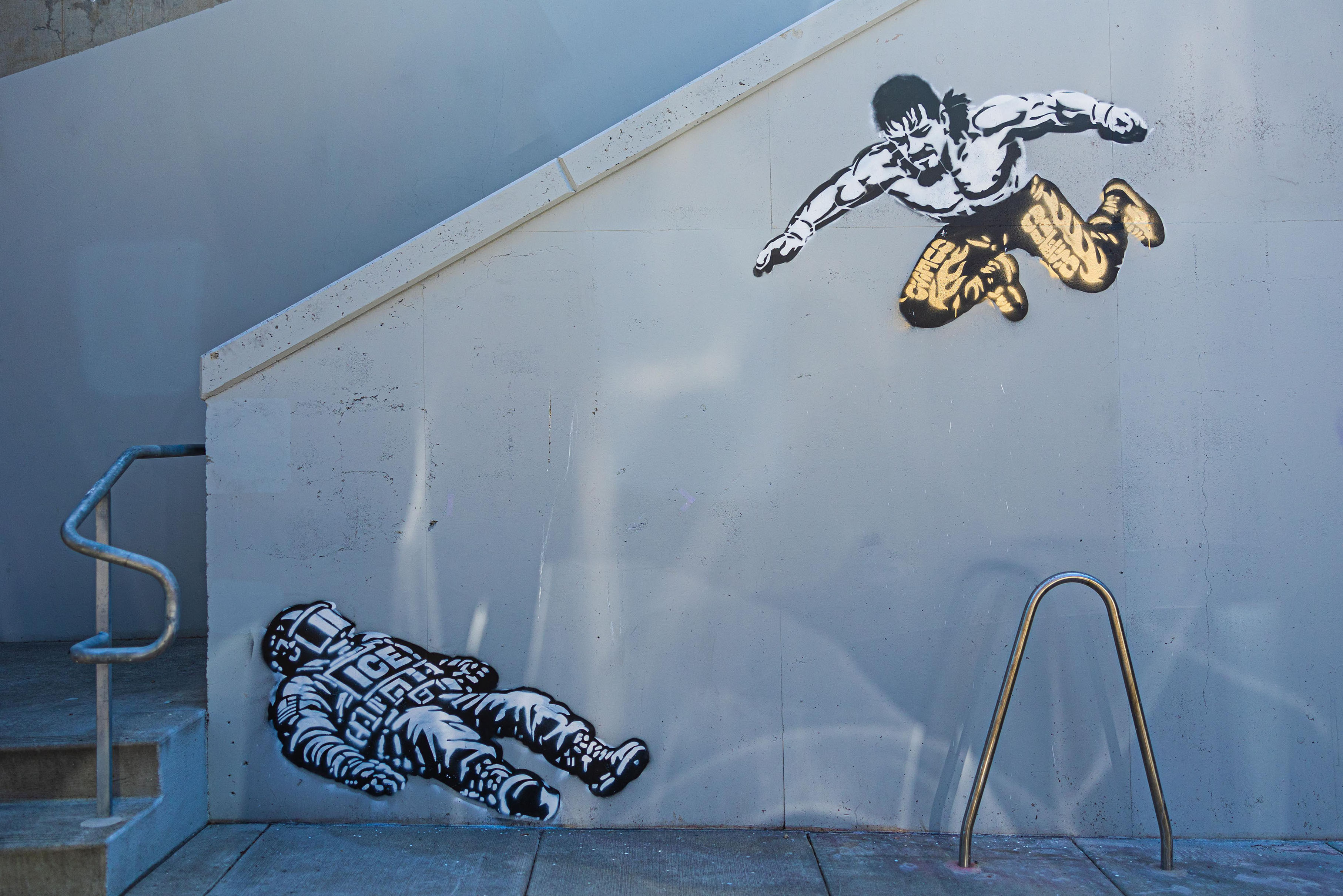
A few days after our interview, a mural of a wrestler with Eddie Guerrero’s mullet and flame-printed tights appeared on a wall about a half of a block from the magazine’s offices. Among the flames is a block-lettered QUESO on each leg. The wrestler is midair, about to pounce on a supine US Immigration and Customs Enforcement agent geared up like a Stormtrooper.