Christmas Special: The Gay Folk Art of Jeffry Mitchell

Is dressing a Christmas tree a folk art practice? If it is, it’s certainly one of Eurocentric culture’s most popular and enduring. What other tedious, decorative ritual do hundreds of millions of households take up annually, whether stringing their trees with lights and family ephemera, or tinseling and setting them with fancy porcelain tableaux? The trees have largely morphed from religious emblem to autobiographical totem in our highly secular age. At PDX Contemporary Art, Jeffry Mitchell’s show Winter Blooming runs about the lifespan of a Tannenbaum, through December 27, though its Christmas Tree on a Birdhouse has a longer shelf life.
Mitchell makes what he calls gay folk art. The pots and pictures and tables and stools and mailboxes and fireplaces represent a version of gay normalcy. Mitchell mentions decoration in the artist statement—the insult par excellence in fine art circles—though decorating isn’t exactly what he’s done to the gallery, or not all he’s done.
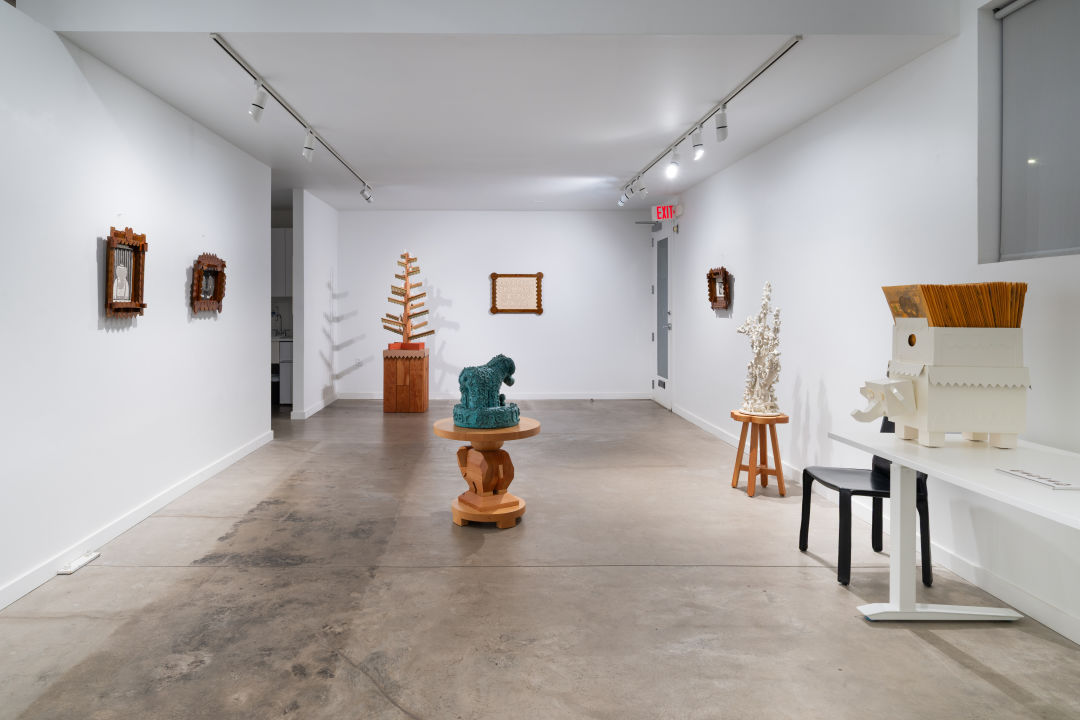
With respect and admiration, Mitchell draws on folk art traditions the same way the author of a realist novel or memoir draws on the familiar world; folk art, broadly, is his medium, the context in which he can render and celebrate his singular experience, perhaps critiquing broader norms along the way. Particularly, his work transforms an idea of the home—the things that surround and support a life—into his home, his inner life. The show is not a replica of where he lives but a white box gallery with allegorical, hyperbolic, and abstracted intimacies spilled into its corners. The artist supplies the telling details and welcomes, charms, romances you into animating the story.
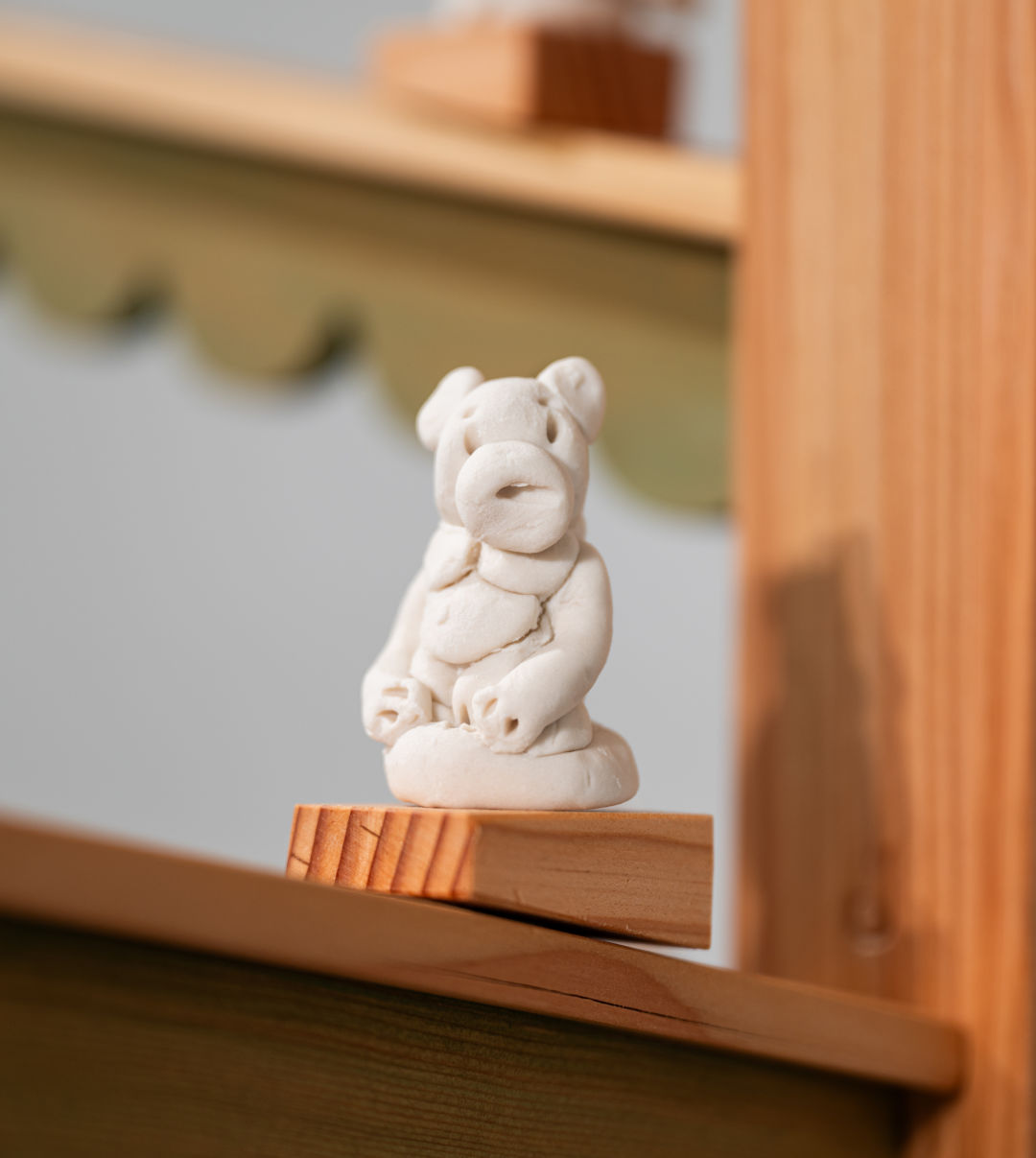
Mitchell’s tree is a spare fir armature. The birdhouse it sits on is straight out of a Peanuts comic strip. Porcelain miniatures ornament its scalloped branches like a cartoon family: owls, bears, a rooster, monks, farmers, and, as always, “elefants,” the patron saint of Mitchell’s oeuvre.
Follow the elephants and you’ll furnish a home. The motif makes the base of a carved wooden pedestal table that holds a patinaed bronze cast of an elephant momma and calf. There’s a pair of elephant stools. They show up in a set of ceramic bookends. Elefant Delivery, a kind of mailbox, holds a series of manila envelopes (hand-painted with elephant scenes) stuffed with a limited run of prints. The floppy-eared friends don’t show up in two sets of bronze andirons—metal supports that hold logs in a fireplace—but they do complete the picture of a cheery winter home.

Collected, the pieces swirl into a powerful conceit fit for the contemporary art world, one that subverts and illuminates the ways everyday objects affect identity and representation. Individually, more than merely carrying out inspirations, Mitchell’s pieces are a tour through a few hundred years of folkways. The envelopes stem from mail art, the ’60s correspondence movement that came about as a way for artists to sidestep the fussy gallery system. The molasses-colored frames around a series of aquatint etchings, cobbled from shellac and finely milled wood scraps and cardboard, hint at tramp art, the mid-nineteenth-century movement of highly tooled housewares made primarily from discarded cigar boxes. Taken alongside the porcelain ornaments, a series of cast pewter figures might trace fashions in European tableware and trinkets—from when Chinese exports replaced the “poor man’s silver” with porcelain in the 1700s and then when, as part of the anti-industrial arts and crafts movement, pewter saw a resurgence at the end of the nineteenth century.
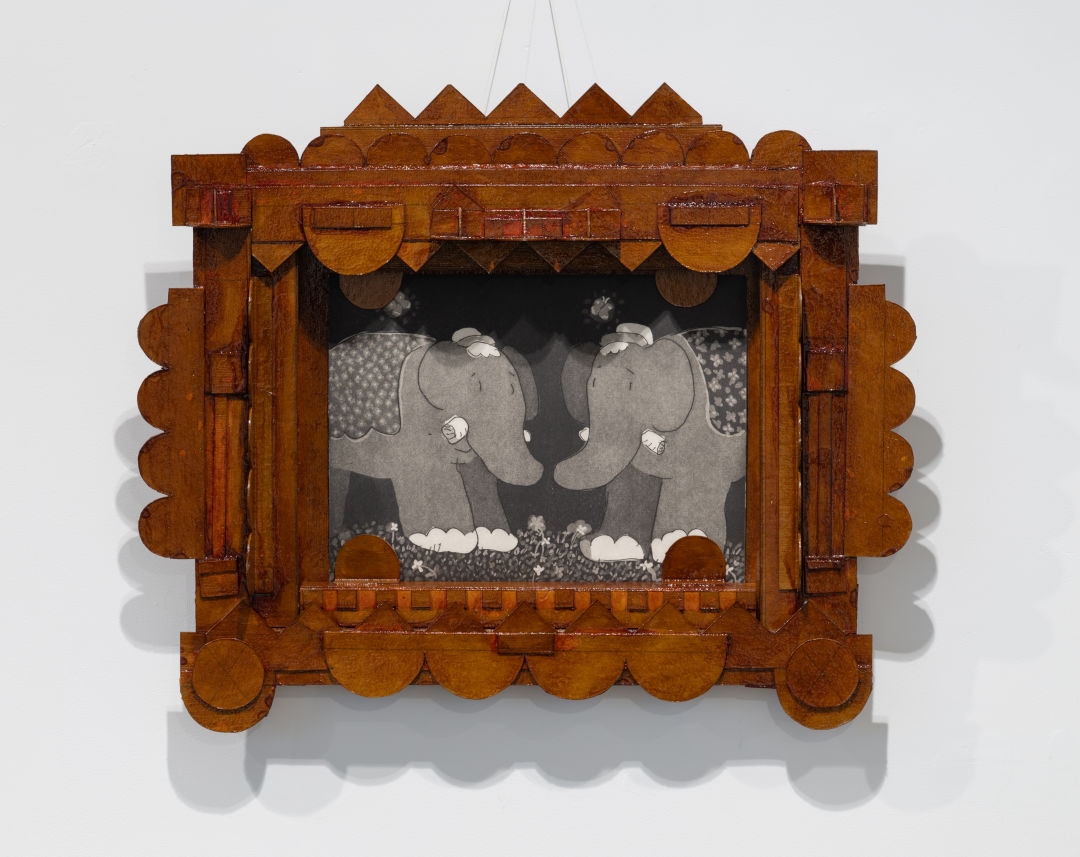

The works are more labeled than titled, which enhances the show’s delightfully frank tone. Such giddy art requires a steady confidence. And the ostensibly bland labels are another place Mitchell leverages folk art’s penchant for incidental bits of autobiography and anthropology. One print of two elephants is titled Enamorados, “lovers,” the Spanish gesturing toward Mitchell’s partner, Puerto Rican artist Iván Carmona. Those pewter figures, which have a lovely network of fingerprints that glint in the metal’s gum-wrapper shine, are called Animalitos. Three of them—Circus Elefant, Country Elefant, and one with its trunk pressed to the ground, Yoga Elefant—read like a day in the life of Jeffry Mitchell.
In previous shows, Mitchell has foregrounded the gay elements of his gay folk art to great effect: a nude photo set in an elaborately confected frame, elegantly lustered porcelain sculptures recreating gay bathhouse scenes. While it is a pair of roosters, Solid Gold Cocks, from 2018, is a rather phallic pair of roosters. Queer identity isn’t pushed to the margins in Winter Blooming, but Mitchell’s work has moved away from direct references to sex of any kind in recent years, making his central conceit even more nuanced by expanding queerness past lines of sexuality. Instead of a binary answer to the question of what makes this gay folk art gay, it unspools endless questions about the stories the things we surround ourselves with might hold.


