Why Can’t a 5-Year-Old Write a Memoir?
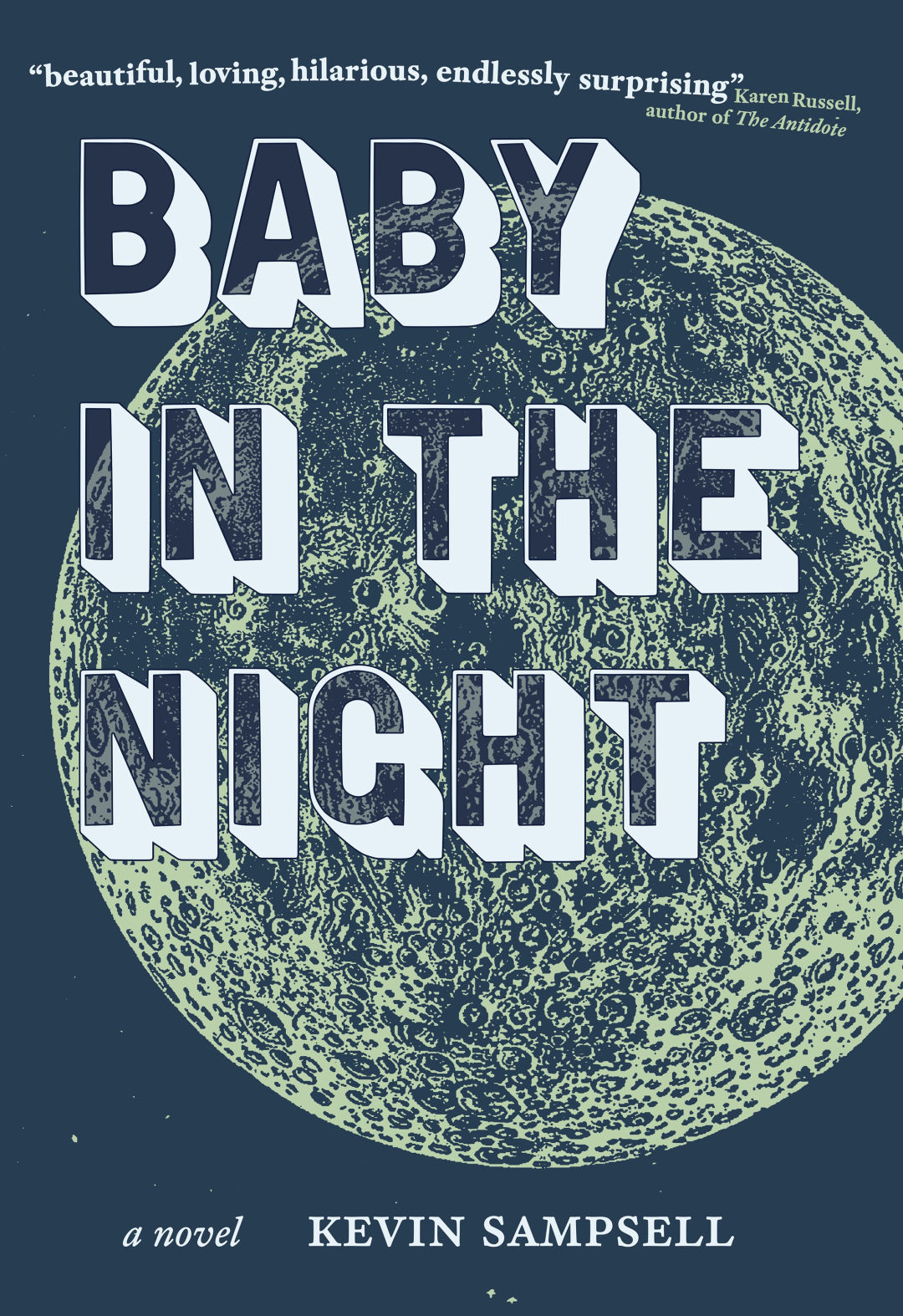
Image: Courtesy Impeller Press
The protagonist of Portlander Kevin Sampsell’s novel Baby in the Night (Impeller Press) is the enlightened kind of unreliable narrator. Tony Volcano Ventura is a streetwise baby. He’s 2 when we pick up with him, which immediately puts this in the category of “weird books.” “I know people don’t usually remember their baby years,” young Tony begins his narration, “but I do.” Ipso facto, weird book, on account of its being narrated by a toddler, one who rides dogs under moonlight, dodges cops in alleys, and receives enigmatic assignments via the fax machine the moon gave to him.
It’s not a weird book, though, despite starting earlier than most coming-of-age tales. This is a rather traditional story, in its own way, about a precocious little dude who often wonders about his absent daddy as he comes to understand what it is to wonder about anything at all.
You might call Tony a “good kid.” He’s the sort of child who learns the order of things early and in secret—often the result of a difficult hand in life that presents as innate maturity. “Good kids” just kind of “get it.” So when he wanders out of his mother’s apartment to look closer at his father, whom he believes to be the moon, Tony knows how to play things cool. He’s content to work off presumptions during his increasingly frequent midnight strolls as opposed to the endless string of whys that hamstring most kids. He doesn’t quite grasp that the pigs in the alley aren’t “face-eating” swine but cops, but he knows to avoid them all the same. Fleeing the cops on his first night out, Tony runs into a guy who’s shooting up in the alley. “I’m Tony,” he tells him, starkly composed, “Tony Volcano Ventura.” After sharing a toy with the man, winning his affection, he lays out his mission: “I’m looking for Daddy.”
A quick preface tells us Tony is 12 when writing these pages. He’s gearing up for kindergarten at the book’s end, which means we’re essentially reading the memoirs of a 5-year-old. It’s the opposite of piecing together your childhood through other people’s memories. Tony is looking back and questioning his uncharacteristically lucid remembrance. When things get fuzzily surreal, he’s just as quick to grasp that reality is subjective, and even if mildly supernatural, his experience is valid. He went out looking for meaning and belonging and made do with what he found, filled in the blanks as needed.
Sneaking out of his mom’s, Tony’s able to move through a world unexplained to him, unsupervised, and assess things with a liberating shade of naivety, more uncorrupted than uncultured; his lack of experience is no lack of wisdom.
And Tony is smart. He knows a Frosty isn’t a real milkshake, and that grown-ups like to play food tricks, like eating pineapple or green beans and pretending they’re delicious, despite knowing such things taste like “a gross crayon.”
Tony’s developing speech helpfully literalizes his fledgling reality. “What the heck is a Frosty,” he means to ask his mom, but instead launches the more general “What da Fraa?” She tells him, “You better watch your little mouth there, guy.” So later he finds her pocket mirror and watches his mouth, waiting for it to do something.

Image: Courtesy Stacy Kirages
Sampsell’s previous books include the memoir A Common Pornography (2002) and the novel This Is Between Us (2013). He is also one of the city’s longest-standing and most beloved booksellers, having worked at Powell’s since 1997. He has run his own small press, Future Tense Books, since the early ’90s. Despite what his extraordinarily bookish life might lead you to believe, it’s quite difficult to place this book on a shelf with similar titles. It’s a poignant and gently absurdist character novel that is entirely reliant on the author’s conviction and voice—Sampsell believes what he is telling you. Wordy freaks have been doing that forever, from Kafka to Clarice Lispector. But the comic layer, the baby memoir of it all, makes Baby in the Night its own thing, one that Sampsell has compared, accurately, to the mockumentary Marcel the Shell with Shoes On, in which Jenny Slate voices an anthropomorphized seashell with one googly eye.
Listening closely to a baby babble for some 219 pages—like listening to a shell babble for an hour and half—does inspire you to question yourself from time to time. Sampsell’s baby voice never comes across as a bit. You get lost in Tony’s musings as if he were any other captivating protagonist. The questioning, I found, was about knowing I “shouldn’t” take a toddler’s testimony seriously, and the payoff was choosing again and again to continue on with Tony anyways.
The funny dailiness is adorable, and a recognizable cue that you are, in fact, deep in conversation with a child who can’t really talk. But the truly sobering pinches come at heavier plot points. Tony meets a fair amount of what he calls “sidewalk people” on his nights out. “Victims of bad luck,” his mother calls them. Though he registers that it would be favorable to sleep inside instead of on the street, his character judgments are unclouded by social and socioeconomic hierarchies. Instead of fearing them, he imagines his neighbors as superheroes, “Purple Blanket Man, Football Helmet Blanket Man, Plastic Blanket Man,” and thinks he ought to bring a blanket out with him as the weather turns. “‘Stranger danger’ is what they called it,” Tony tells us at one point. “But I liked strangers. They were some of my favorite people.”
Tony finds a friend in Dylan, the green-haired addict he met that first night. “Up,” he commands—there is no superior approval than a tiny human asking you to hold them. They get doughnuts at the shop down the street one night, Dylan the teenage junkie and Tony the 2-year-old in a Thomas the Tank Engine shirt, who guides the way with his toy bat, Ray, that lights up when squeezed. “What are you doing with your life,” Dylan says aloud to himself, taking in the situation, contemplating Tony’s as-yet-uncompromised potential. “Eating a doughnut,” Tony answers, a little bemused.
The baby’s equalizing gaze lends a critique of the housing crisis and cycles of gentrification. Restaurants get nicer, then tents begin to pop up, and Tony’s developing grasp of his surroundings compounds the eerie force of these shifts. He wonders if things have truly changed: The Mexican restaurant he landed at one night becoming a corporate imitation of itself; condos going up in the empty lot where he and his mom would lay on the ground and look at the moon.
The same base-level reconsiderations apply to Tony’s own experiences with grief and loss and hope and hopelessness. His insights come out of the pig latin permutations kids tend to invent as they scramble newly collected knowledge. At the park one day with his mom, Tony points to the sky in response to a stranger asking about his dad. His mom mumbles a conversation ending “nothing personal,” as she turns them away, which is received respectfully. But it launches Tony into a train of thought about what “nothing person” could mean, and we witness his sense making in real time. “Maybe a nothing person was one that couldn’t touch or hold you but could still talk.” Mountains, dogs, phones, statues, waffles in the freezer aisle—“I’d seen people talk to those things before,” Tony thinks, “is that what ‘nothing personal’ meant?” Tony sniffles in the backseat after, thinking of how the moon talks to him but can’t touch or hold him, like other people’s dads can. Checking on him in the rearview mirror, his mom asks what’s wrong. “Nothing personal,” he tries to say, weepy, but “no thing person” comes out.
This impossible glimpse of a baby’s inner life bonds us with Tony. When he quickly butts up against the limits of rational understanding, our hearts break with his. We’ve witnessed what feels like his entire personhood take shape, and we’ve accepted the tools he’s developed for navigating life as close enough to our own. Love can be justified and irrational, in fact almost always is. Sometimes a kid just wants his dad, and no amount of questions can justify why he can’t have him.
Kevin Sampsell will be in conversation with Kimberly King Parsons for an event launching Baby in the Night at Powell’s City of Books at 7pm Wednesday, March 18.