Repairing Broken Objects to Mend a Broken System

Image: Giacomo Gambineri
America has been the world leader of throwing things away for about a century. In the 1930s, we began designing clothes and household electronics to fall apart after a few years. Soon enough, the thinking went, your jeans and alarm clocks would be out of style or obsolete. Why not replace them with the next disposable iteration? The 1932 book Ending the Depression Through Planned Obsolescence spells out the economic machinations. Then single-use plastics boomed in the ’50s, marking a “shift to convenience” that gave rise to today’s culture of prizing speed and ease over quality and sustainability. A notorious Life magazine feature cemented “Throwaway Living” as the guiding ideology in 1955. But it’s only recently that we’ve required laws to escape the churn of throwing away everything we own at regular intervals.
Right to Repair laws are what they sound like. In simple terms, they require technology manufacturers to make their products repairable and sell replacement parts. Oregon set the national tone in repair legislation, adopting the country’s most stringent policies in 2025. California, New York, Minnesota, and Colorado have passed similar bills, and all 50 states have some version in progress.

Image: Michael Novak
These laws can affect tractors, cars, wheelchairs, and more, but personal technologies, especially smartphones, are the poster children of Oregon’s early efforts. The key to many facets of daily life, smartphones are the quintessential example of problems wrought by planned obsolescence. It’s easy enough to picture what darning your jeans or mending your sweater might involve. But the notion of repairing an iPhone, however crucial it is to your day-to-day life, feels akin to mending a burst water balloon.
And why would you fix your outmoded iPhone? Beyond concerns about the tens of millions of tons of e-waste the world produces annually, there’s the money. In the days of “upgrades,” new Sidekicks and Razrs were all but free if you renewed your contract. Today, freebies are harder to come by. The iPhone 17 Pro Max retails for $1,199, and new models keep coming year after year.
Peter Missona has been fixing smartphones since 2009, when the iPhone 3GS was current. It had rounded corners and a “home button.” If you did get stuck paying for it, its cheapest version retailed for $199, or about $300 in 2026 dollars. “This was before everybody had an iPhone,” Missona says. “I’ve been fixing them since the beginning, essentially.”

Image: Michael Novak
Missona’s business, the Fix Hut, is surprisingly casual, considering the seamless, impenetrable air of the game consoles, laptops, and smartphones he refurbishes. He has two small shops, one on each side of the river, and speaks with the pragmatism of an independent auto mechanic. Instead of a “genius” in a glass retail temple, he’s simply a dude who knows how to fix your phone.
“Most things can be repaired,” Missona says. It’s just that most people don’t know that. Clients often bring him phones Apple has deemed kaput hoping he can recover their data. Usually, he finds that a routine cleaning or a new battery or charge port revives them: a “totaled” car that just needed an oil change.
Oregon’s Right to Repair bill is particularly strict on “parts pairing,” a software that makes electronics dysfunctional unless they’re repaired by the manufacturer or a partnered repair shop using approved parts, if they were even available. Though the practice is informed by valid security concerns—like preventing thieves from accessing bank info and photos—Missona says it’s often leveraged to drive sales of new phones.
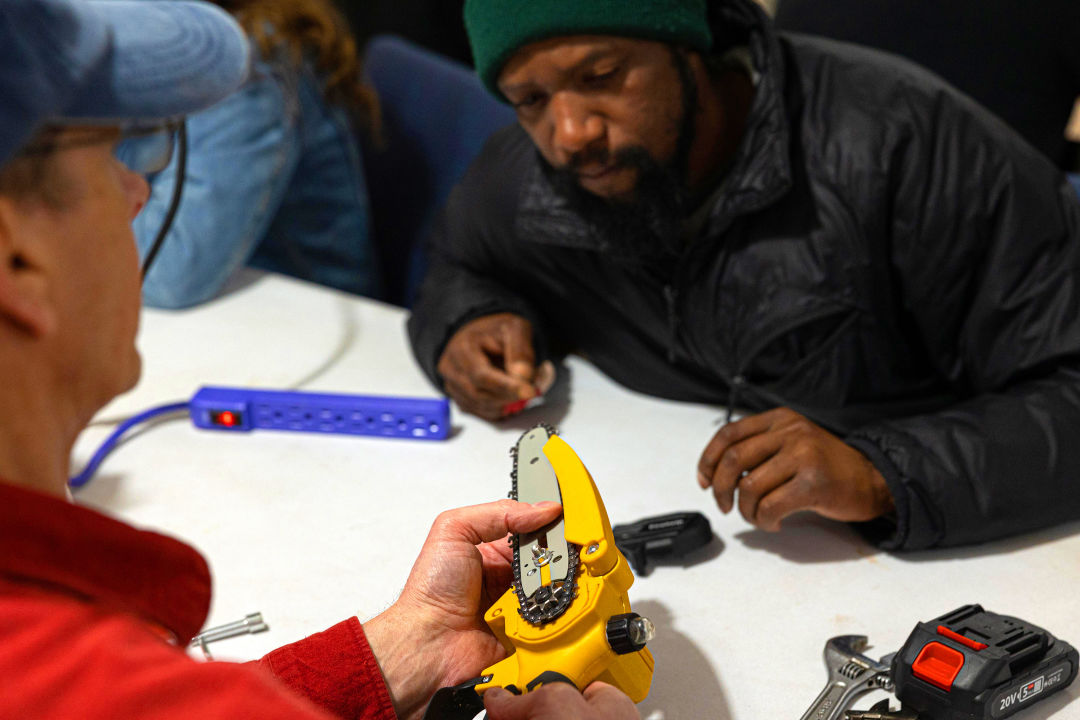
Image: Michael Novak
Most companies answered the new laws by making replacement parts extremely expensive, ostensibly voiding any consumer benefit. But having access to, say, Apple parts, has made it easier for Missona to show clients behind the curtain. Most consumers are skeptical of third-party parts (it’s easy to imagine a clunky whatsit from Radio Shack). In his opinion, however, many aftermarket screens, charging ports, and batteries are indistinguishable from the originals. Now he’s able to quote the price of labor, then illustrate the hundreds of dollars between part options—often the difference between replacing or repairing a device.
Throwaway living works only up to a certain price point. Still, ignoring the environmental devastation, fear of financial ruin is not the only reason to fix your stuff. Opposite throwaway living is so-called “repair culture,” an ideology questioning the entire status quo of disposability as opposed to cherry-picking thrifty exceptions. This can be as radical as refusing to buy anything at all or as casual as trying to repair your busted snowshoes instead of shelling out for new ones.
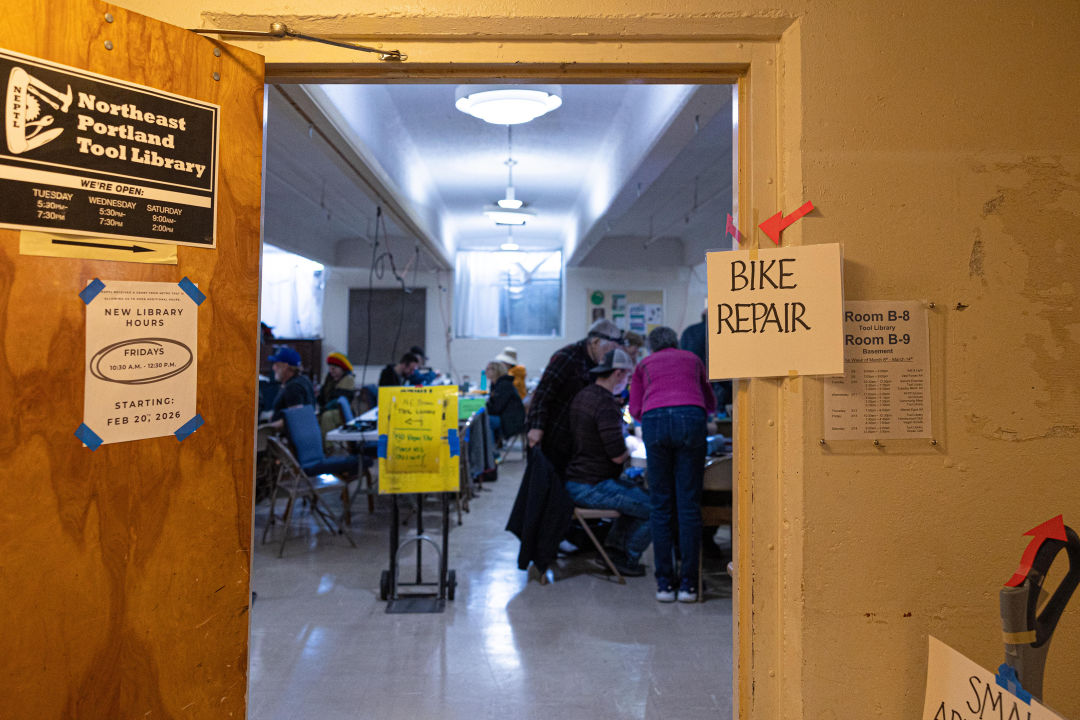
Image: Michael Novak
The nonprofit Repair PDX organizes events around a simple principle: “Volunteers fix people’s broken household stuff for free,” explains founder Lauren Gross. At monthly “repair cafés,” a cast of handy volunteers set up tables at Leaven Common House off of NE Killingsworth and fix strangers’ books, jewelry, and sewing machines. The cafés are generally organized into three repair categories: small appliances, clothes and textiles, and bikes. There’s also tool and knife sharpening. “And then whatever else volunteers want to offer,” Gross adds. In the past, that’s included the Japanese pottery repair craft kintsugi.
Some participants can’t afford to have their church dress mended elsewhere, or to replace the derailleur on the bike that gets them around town. Others bring in stand mixers, alarm clocks, lamps, and stuffed animals—because where the hell does one repair such things in 2026?
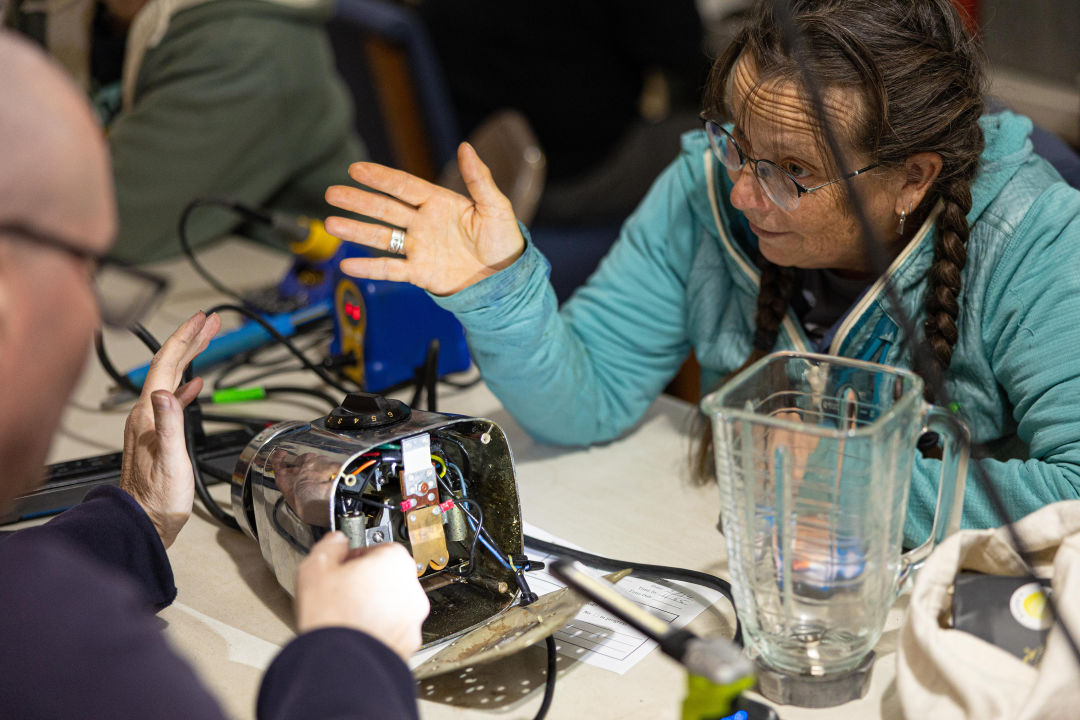
Image: Michael Novak
At the repair cafés, you chat with the stranger working on your stuff. Stories come out. “It was their great-grandfather’s cuckoo clock,” Gross says, “or their grandma’s KitchenAid that she used to make cookies.” You might make friends. You might grow interested and begin fixing things yourself. But more radical is simply observing firsthand exactly how most things can in fact be fixed.
Gross didn’t start Repair PDX because she was a hobby electrician or bike mechanic. “I can fix bike tires,” she says, “and I could fix my coffee grinder because I looked at a YouTube video.” She started it in 2013 after visiting a repair café in the Netherlands. She had an aversion to waste and a desire to bring people together, and she saw a chance to address one by doing the other. Her trade, she says, is people organizing, which could be understood as an approach to repairing the broken rhetoric of throwaway culture.


