Meet the Portlanders Who Can Fix Your Broken Stuff

Image: Michael Novak
While a YouTube instructional video or fix-it fair volunteer might take care of a repair, sometimes you need to seek out a professional. We checked in with a few Portlanders who help people hold on to things they love, whether it’s a family heirloom, a piece of camping gear, or a favorite pair of jeans.
Emi Joyce on practicing and teaching the Japanese method of repairing ceramics.
"Kintsugi is a little bit different from regular repair. Usually, you want to hide [repairs]. You want it to look new or original, seamless. But kintsugi highlights the repaired area with gold. [It] also represents lots of meanings. Its main meaning is the imperfection of our lives.
Kintsugi is a part of Japanese lacquerware craft. There’s a quick method using epoxy, but the slow and traditional method uses urushi lacquer, sap from a urushi tree. That can be the glue, filler, and the coating. While the last coating of lacquer is still wet—the lines are still wet—the gold powder is dusted to finish. With this slow and traditional method using only natural materials, repaired pieces will be food-safe.
Sometimes [the pieces people bring in] can be expensive, or a family heirloom. Sometimes it can just be a mug from a holiday. That’s probably not expensive, but it doesn’t matter. Say [the customer] went to a holiday with their favorite people or with family. That moment already has a story, so the value of the pieces doesn’t really matter to me. The story or memory matters. I usually don’t ask. People, when they want to tell me, they will tell me.
Some of my students, one of them had a heart surgery, or breast cancer surgery; some, mentally, have had problems before. When they start putting pieces together…they tell me, 'I was kind of healing myself by putting things together.' That’s really special. So it can be better than before. You can see the fractures or damages, emphasized with gold. You don’t need to hide. You can be confident,
yeah, with the fractures." —As told to Matthew Trueherz

Image: Michael Novak
Matt Merely is Portland’s handyman for outdoor gear repair.
If you drop off a jacket with a finicky zipper for repair at the Patagonia on W Burnside Street, it will likely wind up in Matt Menely’s basement. Same goes for Clackamas’s REI Re/Supply and Beaverton’s REI. Mountain Soles & Outdoor Threads, the current name of the company Menely took over in 1999, also takes mail-order fix-it jobs. With his two employees, he fixes and ships up to 300 orders per month.
Visiting in February felt like sneaking into his yard. “Knock loudly,” he’d emailed. In a workshop beneath his home in a Portland suburb, industrial sewing machines and a pegboard of colorful spools awaited items in the queue: a bike pannier with broken hardware, jeans needing a new button above the fly.
Menely began fixing outdoor gear in art school. Patching rubber climbing shoes with sculpting tools from class produced mixed results. Eventually, he shipped them to a certain hiking boot and climbing shoe repair operation with a punny name. After years as a customer, Menely met its founder, Bill McKinney, while working at the outdoor retailer Oregon Mountain Community; McKinney was running Mountain Soles out of the back of the shop at the time. When he mentioned selling the biz, Menely jumped. “I’ve always been kind of a hands-on, creative person,” Menely says. “Combining that with repair work, my interest in sustainability, and outdoor sports—it all seemed like a good fit.”
Menely steered the business toward rehabbing broken snowshoes and mending
fabric goods like well-loved puffy jackets, hiking packs, tents, and sleeping bags. The mood is casual, even playful in the workshop. Hammering, zipping, snipping, and sewing-machine buzz. But, asked about the “why” behind his handiwork, Menely turns reflective. To him, most things are worth saving—his version of “trying to be a good resident of the earth during my time here.” —Amelia Arvesen

Image: courtesy Sara Murphy
Sara White on books as living objects.
"I’m from Louisiana originally, [and] I went to college in New Orleans. The city shaped my ideals—in valuing history and wanting to learn cultural heritage. You’re surrounded by it all the time in New Orleans. Another big part of living there is being acutely aware of natural disasters. I lived there when [Hurricane] Katrina hit. Thankfully, I was able to evacuate and didn’t experience anything tragic. But it was a major event that shaped who I am, and there were hurricanes after that. The reality of losing something has played into how I treat books and paper materials…how easy it is to lose something and just how meaningful objects can be—books can be.
For me, the digital gets lost in the world of everything that is digital. It doesn’t hold my attention as strongly as if I’ve got the physical object in front of me, if I can hold it, if I can feel it. The life of a book is imbued [with the lives of its] owners and its readers. It’s a living object. I’ve repaired a lot of hardback books, repairing spines, sometimes repairing entire covers, sometimes resewing, and I sometimes make boxes. I definitely have a frugal mindset going in, and I don’t want to completely restore the book.
With conservation, I think more about honoring the integrity of the original object and making sure you can still see its history, but also making sure it won’t fall apart and disintegrate. So you’re using archival materials to make sure that doesn’t happen. I want to retain as much as possible, but I also hope that the work I put into it adds to its life." —As told to Gabriel Granillo
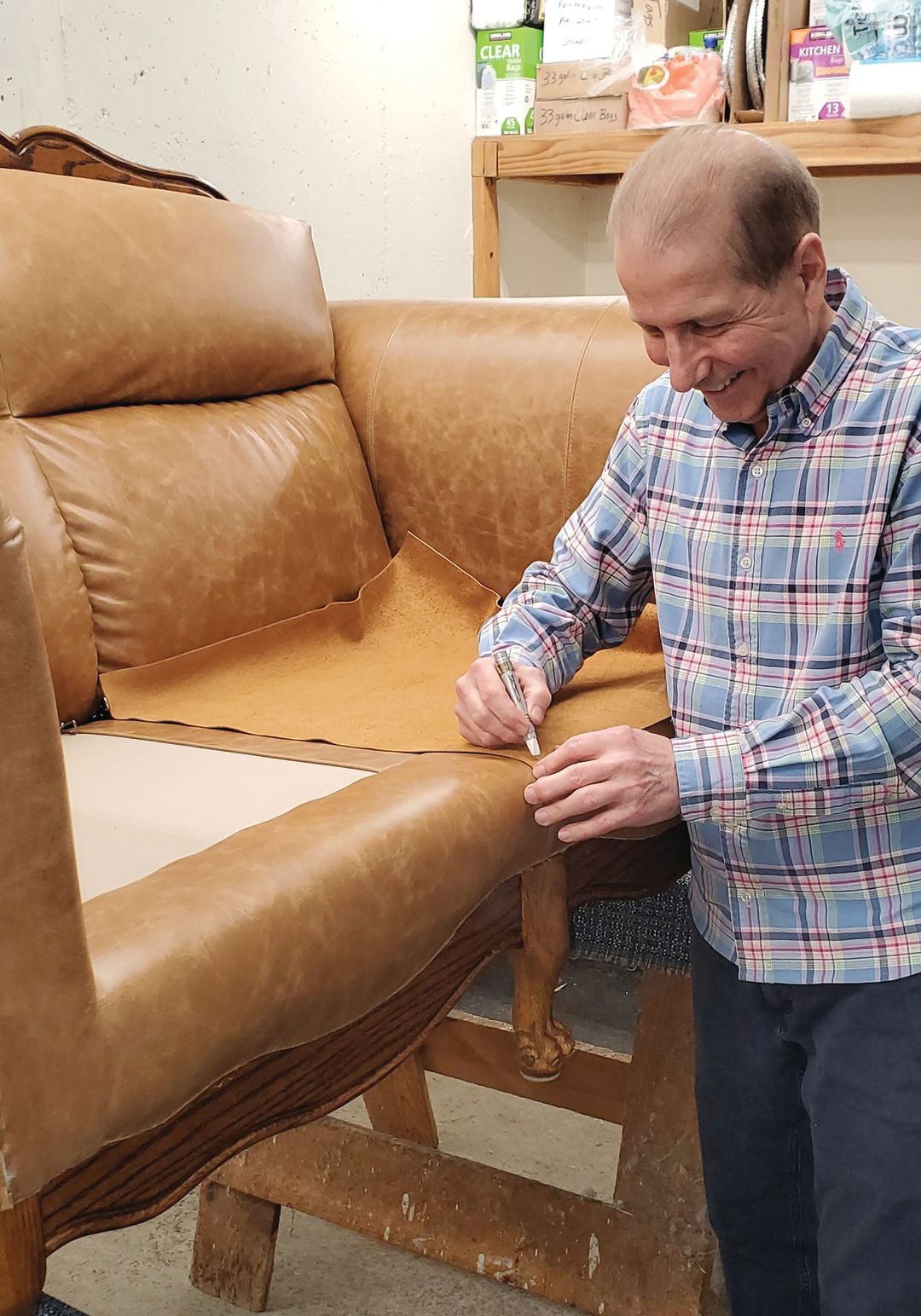
Image: Courtesy Kepler's Upholstery
Brian Ankele has a soft spot for family heirlooms.
The Kepler family’s upholstery roots run deep. The namesake shop started in Michigan in 1900, moved to Portland in the 1940s, and then to its current
Tigard address in 1965. Brian Ankele took over the family reupholstery and custom furniture shop in 1978. His great-grandfather, Charles Kepler, set up the business all those years ago. But of course, Charles’s dad had been in the upholstery business too.
Aside from the advent of staple guns and metal tack strips, and the move from horsehair and straw to synthetic fibers as the go-to cushion and pillow filling, Ankele says the trade hasn’t changed much in the business’s century and a quarter.
Ankele is game to reupholster most furniture, no matter how dilapidated. The frame under all that horsehair and straw is what’s important. If the bones check out, he says, you can “upcycle.” That means selecting a fabric from thousands of fabric samples to replace the leather on a Le Corbusier armchair or the tufted damask on a set of antique dining chairs. Upcycling can also mean switching
up the structure of a chair or sofa’s cushions to make it more comfortable.
Whatever the fix, Ankele says he’s in it for the look on customers’ faces when their beloved but slumped and lumpy chaise, sectional, or rocking chair returns plump and vibrant—an old friend in new duds. A recent customer brought in her late grandparents’ wing chair—the seat in which her grandmother sat, decades ago, when her grandfather proposed. She wanted it restored, the customer told Ankele, so the chair could fill her living room with romantic family lore. And the result? “She was thrilled!” —Alice Wolfe

Image: Courtesy Jason Leonard
Jason Leonard on the thrill of vintage poster restoration.
"There are two sides of the business. Any studio like mine has to have gallery clients. But then [there are] all the small-time clients. I get a lot of people that are like, 'This was in my dad’s attic for 30 years.' There’s a lot of sentimental family stuff. [Other] clients are collectors. They just love the chase of finding something old. The stuff I’m working on now is [for] this local guy—all he does is ’40s and ’50s movie posters. He’s constantly buying them at auctions.
Initially, what drew me to it was all the imagery. Coming from an illustration background, I really like that the bulk of it is done by artists—[it’s] not real photos.
I like the patina of something old. Some studios’ MO is to mask off the whole thing and just completely airbrush the border. You’re making it look completely brand-new and good, but to me it ends up looking fake. It’s a vintage poster, so it should look its age.
Most of the work is through the mail. It’s like Christmas Day. You’re opening the tube, and you’re like, 'What’s gonna be in here?' That’s what I really like, the variety. I’ll get things that are just a pile of pieces of paper. And it’s real brittle because it’s real acidic, and every time you touch it another piece falls off. A lot of it is like that—you can’t enjoy it at all unless you get it restored. We’re putting back these pieces of the puzzle so that you can finally enjoy it." —As told to Gabriel Granillo
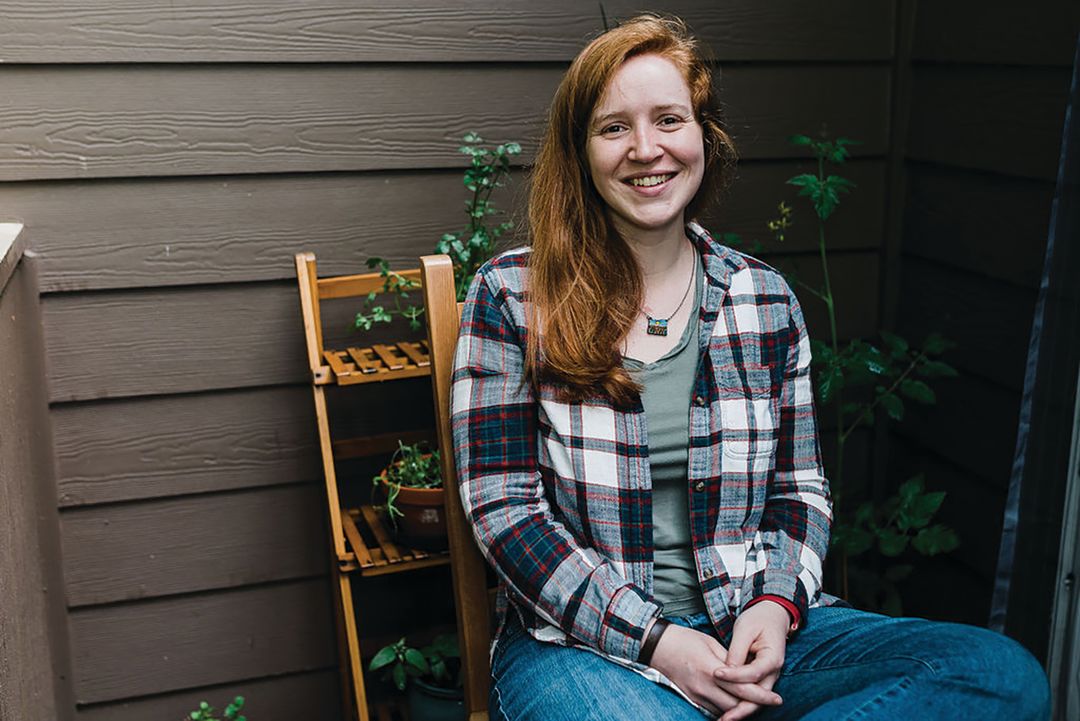
Image: Courtesy Ashley Russell
How Elise Webb started her one-woman knitwear repair business.
"I was working at For Yarn’s Sake in Beaverton during the pandemic. People with holes in their sweaters would come in and say, can anyone fix this? I went to my boss and was like, 'What are we supposed to do?' She was like, 'If you feel like you can do it, give it a try.' So I tried. It turned out I was pretty good at it. People started coming into the store more and more for me. My boss let me have a drop box for a while. A lot of clients tell me I’m a lot younger than they thought I’d be. I hyperspecialize in knitwear and am one of [the few] people in the US who do that professionally. Countless do it unprofessionally, like everyone’s grandma.
I started with raising goats in 4-H, so I started from the fiber. I learned to spin and felt before I learned to do anything with yarn. Years later I learned to knit from a book [and] YouTube. Now I’m writing a book and chapter one is 'Why Mend?' It comes down to three things. The first one is personality. That’s generally the visible mend or embroidering your clothes. Then there’s cost. A lot of times I fix $400 cashmere sweaters. You could replace it, but it wouldn’t be cheap. But the main things I fix are heirlooms. I get a lot of stuff that grandma made, or stuff the person made when they were younger that they want to keep around. It doesn’t matter how expensive it was or where it came from; if you care about it for any of those three reasons, it’s something you’re going to want to fix. What I tell people is, if you see yarn, send it my way. —As told to Amelia Arvesen

Image: Michael Novak
Julia Morgans resurrects midcentury denim repair.
The perfect pair of jeans molds itself to your body. “Denim is a very alive fabric. It changes over time,” says Julia Morgans of denim store Self Edge, which houses denim repair program 'Darn-It! “I can’t help but feel emotional about something that shows the history of the wearer.” With sentimental value comes the wearing, tearing, and fraying of daily use, which makes Morgans a kind of doctor of these second skins.
Clients bring Morgans their old Silver Tab Levis, high-end Japanese selvage denim, and well-worn designer jeans from Celine or Rick Owens. Others bring thrifted finds hoping she can resurrect them. She dutifully sews and darns, adopting traditional techniques developed to rehab hard-wearing work clothes first designed for gold rushers and cowboys. The results carry the handicraft of a 1950s repair shop, though instead of helping jeans survive a few more shifts in the mines, the methods are more often prized today for their ability to help a garment tell the story of its life.
Whether you bought or bled for your kneeholes, the shop uses only vintage machines to darn them, a more-or-less invisible reweaving technique. Hems are likewise adjusted with authentically chain-stitched seams to achieve the signature rope-texture cuff. This all requires specific and often rare hardware. Morgans’s favorite sewing machine is a Singer 47W70 from the mid-twentieth century so hardy that its first job was mending boat sails.
“When repairing your clothes was much more common,” Morgans says, “every department store would have a darning machine.” By repurposing these old techniques and machinery to suit modern interests, Self Edge proposes a bygone way of thinking about clothes as an alternative to the disposable culture of contemporary fast fashion. —Alice Wolfe
Editor's note: This story has been updated to reflect that Self Edge is a store that houses a denim repair shop.


