Conjuring Ghosts with Portland’s Japanese-Style Incense Maker

Image: Dina Avila
Clove and tree bark hit my nose as I enter Mia Reiko Braverman's home, which she shares with her husband, experimental musician Luke Wyland. Briefly, the incense transports me to a cup of very spicy tea, drunk on my friend Emi's couch in the early 2000s. I shake myself back to the present, take off my shoes, and step into Braverman's living room, which is filled with beautiful wooden objects: a rib-like chandelier, a wicker cabinet. A black bun sits atop her head like a little nest. She wears a flowing, sand-colored linen top and loose pants the deep brown of forest duff. Her glasses, hoop earrings, and the black pearls of her necklace are all very round, and I decide that she and her home are portals to a potent earthen realm.

Image: Dina Avila
I've come to watch Braverman make incense by hand. For several years, she's been making and selling incense sticks under the name Fumi. She's the only Japanese-style incense maker in Portland and one of few in the Pacific Northwest. Fumi sounds like the Spanish and Portuguese "to smoke," fumar, and even the English fume, cognates that remind me that mouths blow smoke with a "fooo." Fumi is also the nickname of Braverman's grandmother—a syllable shorter than her full name, Fumie—and of the shop Braverman opened in fall 2024 on North Mississippi Avenue, where she sells her incense and miscellaneous vintage clothes, oddities, and crafts, with much in the $5–20 range. Playful Japanese vintage glassware sits beside ceramic bells, tarahumara baskets made of pine needles, and her three incense varieties, offered in sleeves or in traditional Japanese kiribako incense boxes, made from quick-growing
paulownia wood.
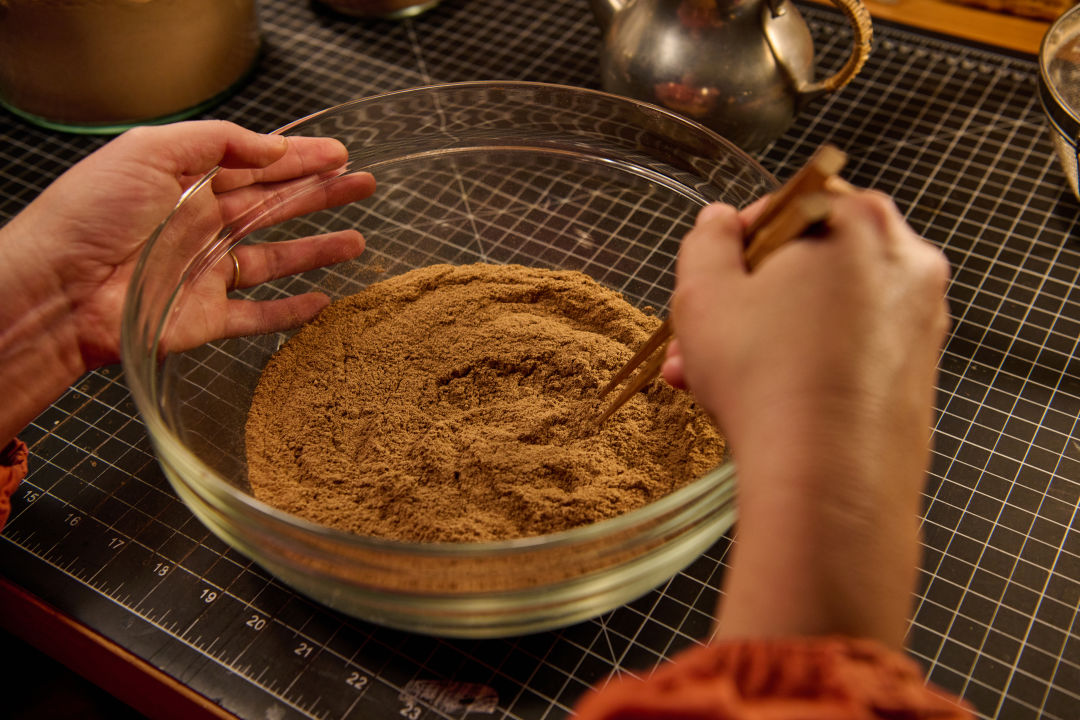
Image: Dina Avila
Among the fragrance arts, incense is distinct in its materiality. Unlike invisible perfume or vanishing candles, incense leaves behind its physical remains: a trail of ash and haze of smoke. "It's less white room, white gloves," Braverman says. Releasing incense's aroma requires a sacrifice of the materials that house it. Its residues can be messy, but the aroma, smoke, and ash offer proof of transformation. For Braverman, burning incense conjures beach bonfires in Hawaii as a teen, clove cigarettes at art school in San Francisco, and afternoons in her apartment in Kochi, Japan, where she lived from ages 25 to 30 and learned to burn incense while cleaning.
Braverman, who settled in Portland in 2014 and worked previously in nonprofits, began studying incense in 2020. She loved good smells and was interested in exploring her Japanese heritage, and she'd studied textiles and paper arts—practices that similarly complicate the line between art and craft. Incense sat at the center of her personal Venn diagram.

Image: Dina Avila
She spent 10 months during COVID helping Eriyo Watanabe, an incense instructor in Tokyo, improve her English translation of a self-published book on incense in exchange for incense-making lessons over Zoom. The depth of learning ahead made her giddy, but studying a tactile physical practice through the internet felt wrong. She didn't fully commit until Watanabe shipped her a box of ingredients, and for the first time she smelled real frankincense. "My gateway drug," she calls it.
Braverman and I have moved from her living room to her basement studio. She opens a jar and spills hard, crystalline, yellow-green globs about the size of raisins into my hand. I've only heard the word frankincense in the context of the three biblical magi bestowing gifts on the baby Jesus—gold, frankincense, and myrrh—but here it is against my skin, a resin scraped from a scraggly, dry tree on the Horn of Africa. The aroma is beautiful, citrusy, and clean. Next, she passes me a jar of powdered Hawaiian sandalwood from a family on the Big Island who bought a large swath of degraded forest and are rehabilitating native plants. "Anticolonial sandalwood," says Braverman. I recognize the aroma that greeted me when I arrived.

Image: Dina Avila
In addition to aromatics like frankincense and sandalwood, Japanese incense contains makko, a mild-smelling tree bark from East Asia that has adhesive qualities when wet. Resins can't hold a burn, so the quality and quantity of makko determine the sturdiness of the incense stick and the pace at which it smolders. Following her own handwritten recipe, Braverman begins scooping tan and brown powders from three jars into a glass bowl. "This is the part that looks like making taco seasoning," she jokes. We take a moment and send our minds to the home of each ingredient, imagining it in another form and giving thanks. The next steps—weighing, sifting, stirring, adding water, mixing, and kneading—remind me of baking and then ceramics and then baking again. One moment, the ball of wet incense looks like kinako-covered mochi, then porous clay, then graham cracker dough. As she kneads, she waits to feel the transformation she's learned to recognize.
Braverman designs each of her varieties to feature only two to three ingredients. Unlike the synthetic incense that crowds the market, incense made with natural materials dissipates more rapidly and doesn't "stain the room," she says. Much commercial incense comes on a thin bamboo stick, but Japanese incense doesn't and is typically extruded like spaghetti. A fabricator in Tokyo built her a custom incense extruder. Once she's shaped the dough into three small wheels, she slips one into a metal encasing and gets to work extruding seven soba noodles of incense at a time onto a cardboard sleeve.
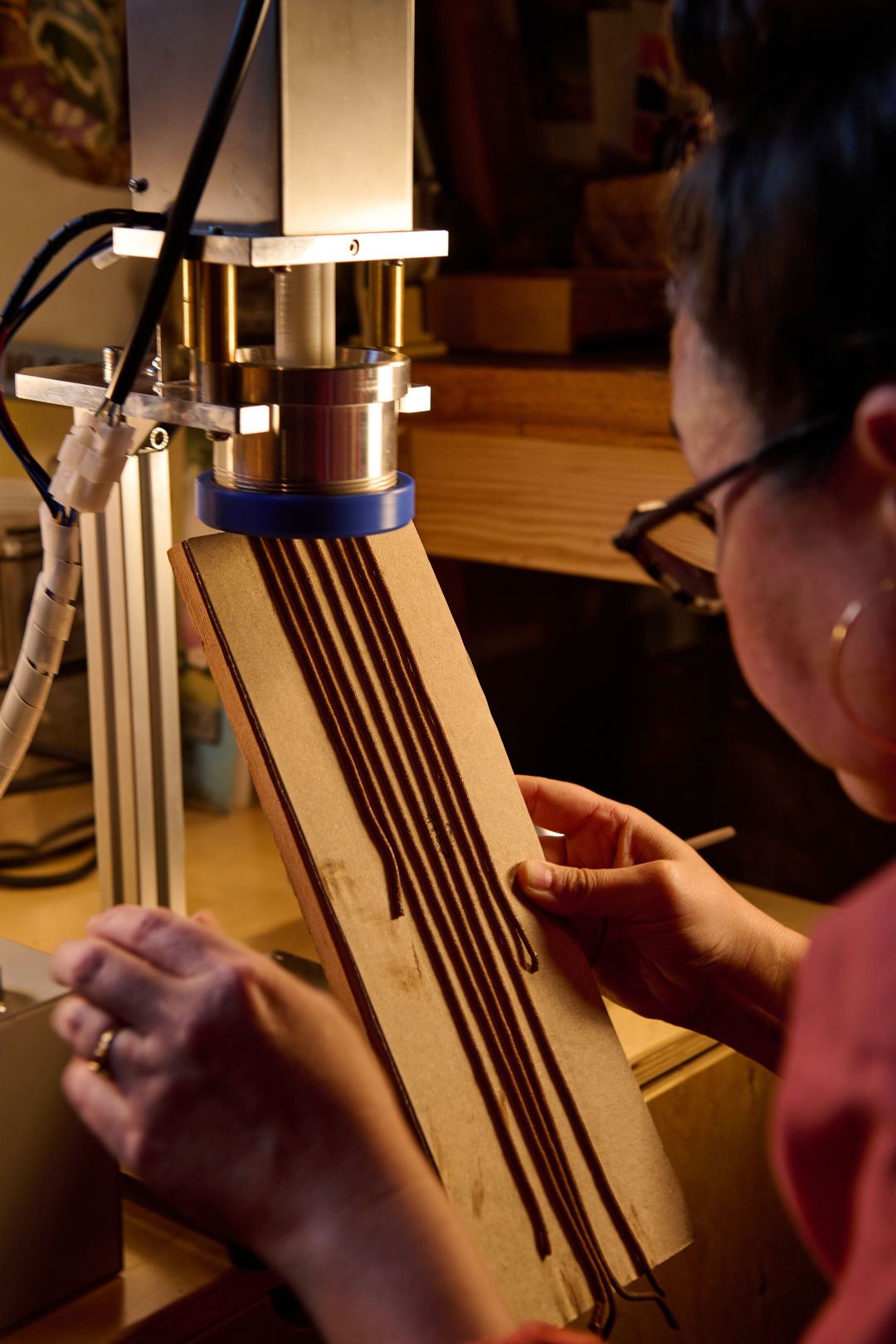
Image: Dina Avila
She works with speed and confidence, filling sleeve after sleeve. I leave after the wheels have become some 500 to 1,000 sticks. Braverman still has hours of work ahead, slowly brushing each stick onto a waffled paper where it'll dry. Each month, she makes as many as 1,200 sticks of each incense variety to sell at her shop. She also offers monthly classes, where students get an introduction to incense's immense history and culture and make their own cones to take home.
Incense came to Japan with Buddhism in the sixth century and remains integral to Buddhist temple ceremonies. It's also burned daily on the family altar, where the transformation from the concrete to the ephemeral simulates the voyage into the unknown. It's a spirit leaving the body and the lingering aroma of things past. Braverman's grandmother, Fumie, survived the firebombing in Tokyo during World War II by jumping into a water tank surrounded by flames. She lost her husband and newborn, but later in life remarried a man named, amazingly enough, Fumio. Fumie and Fumio ran a jewelry-glasses-watch store in a shopping arcade in Tachiaigawa, Tokyo, and lived above it. Braverman visited many times as a kid. It's where she learned she loved "peddling my wares."

Image: Dina Avila
One afternoon about a month after making incense with Braverman, I step off Mississippi through the glass door of Fumi and am once again transported by a beguiling aroma—this time the nose-perking clean of camphor. Braverman sits behind a tall wooden table, top knot again nest-like above her round glasses. Following her grandmother's example, she offers me tea. "I like things that slow you down," she says. Her store is even harder to pin down than her grandmother's was. She doesn't have glasses and watches, but aside from her own incense, the inventory follows only the rule that Braverman chose it. I thumb a rack of black-and-white illustrated cards drawn by Carola Penn, who used this storefront as an arts studio in the 1970s. Penn is a welcome ghost. As the rejuvenating camphor winds through me, I realize that Fumi is a conjuring: Braverman has built a business that compels her to burn incense and say her grandmother's name every day. Her practice of making incense feeds the same spirit. Crafts invite continuity between the past and present.


